
The Forgotten Toys (1995)
A festive tale about two lost toys searching for a new home.
 rating 8/10 User rating 29 votes 79%
 ❄ Christmas Connection
The Forgotten Toys is set entirely in the aftermath of Christmas Day, when new presents have arrived and older toys get thrown out. The premise only works because Christmas exists, and the story wrestles with what the holiday actually costs the things it discards. It aired for the first time on Boxing Day 1995, which was not an accident.
Our Review
On Boxing Day 1995, ITV broadcast a 25-minute animated special about two toys sitting in adjacent dustbins, wondering what they did wrong. It was not exactly a crowd-pleasing premise. It was also one of the best things British children's television produced that decade.
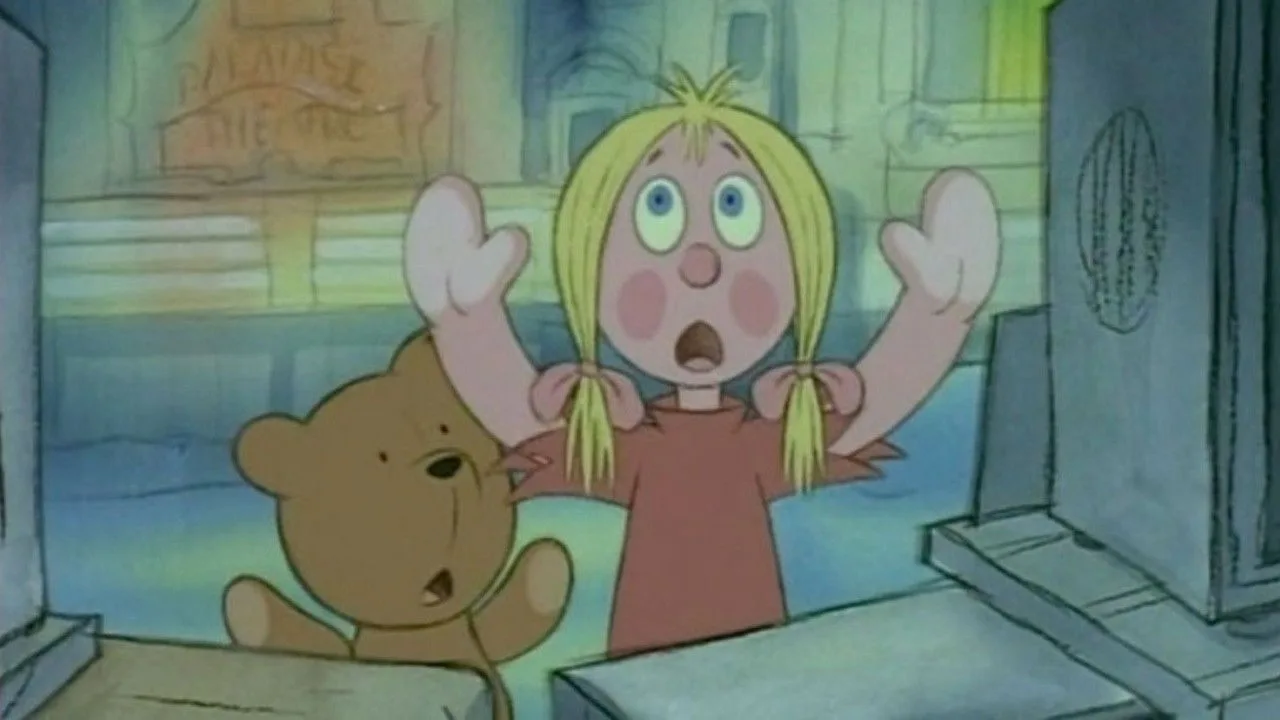
The Forgotten Toys begins where most Christmas stories end. The presents have been unwrapped, the excitement has passed, and somewhere in the rush of new toys and new gadgets, Teddy and Annie got left behind. Teddy is a battered, gruff bear with a Cockney attitude. Annie is a ragdoll with more dignity than any ragdoll has a right to have. Together they climb out of the rubbish and set off to find a child who will actually want them.
That's the whole plot. It's also enough.
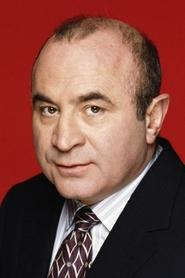
Bob Hoskins and Joanna Lumley as cartoon characters nobody deserved
The casting is so right it feels obvious in retrospect, but it wasn't. Bob Hoskins voices Teddy as a battered East End pragmatist who refuses to admit he's scared. Joanna Lumley gives Annie a kind of bruised elegance. They bicker, they rely on each other, and they avoid sentimentality even when the story is being sentimental around them.
Clement Freud voices Chauncey, a streetwise stray dog who shelters the pair in a hotel basement. Andrew Sachs appears as a chef and, later, a kind old man. The voice cast reads like a call sheet for a BBC prestige drama, not a children's Christmas special.
The chemistry works because Hoskins and Lumley play their characters as adults who happen to be toys, not toys performing for children. Teddy doesn't explain his feelings. Annie doesn't cry on cue. They just keep moving forward, which turns out to be more affecting than any amount of obvious emotion.
The animation, and why it holds up
Director Graham Ralph, working through Hibbert Ralph Entertainment and Collingwood O'Hare, used hand-drawn 2D animation with digital ink-and-paint. The character designs are deliberately soft, built around pastel tones and rounded shapes that emphasise how worn and gentle the toys are.
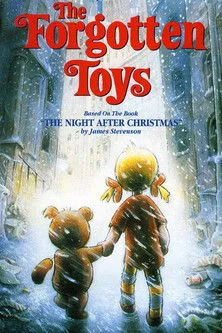
The special is based on James Stevenson's 1981 picture book The Night After Christmas, and the adaptation keeps the book's quiet sadness intact. Stevenson's original story has the same DNA as the Velveteen Rabbit: toys that have been loved enough to be real, but not loved enough to be kept.
What Ralph adds is London. The urban winter setting, all grey streets and leaky hotel basements, gives the special a texture you don't get in most Christmas animation. This is not a cosy fireside world. It's cold and a bit dangerous, which makes the eventual resolution feel earned rather than automatic.
What the Berlin Film Festival recognised
In 1996, the Kinderfilmfest at the Berlin International Film Festival awarded The Forgotten Toys the Crystal Bear for Best Short Film. The children's jury gave it to a Boxing Day ITV special over a field of international competition. It also received an Honorable Mention at the 1996 Chicago International Children's Film Festival.
These are not trivial awards. The Crystal Bear is judged by actual children, which makes it a harder audience to please than any adult critic. Getting it means the film worked on children without talking down to them, which is harder than it sounds.
ITV clearly agreed with the verdict. The special led to a full series, also called The Forgotten Toys, which ran from 1997 to 1999 across 26 episodes. Hoskins and Lumley returned for all of it.
The question the special refuses to answer
The film never tells you who threw Teddy and Annie away. It never explains whether it was a child who grew out of them, a parent clearing space, or just the indifferent logistics of Christmas morning. That deliberate vagueness is one of the smartest choices in the script.
It means children watching can project their own fear onto the story without the film confirming it. Adults watching can project something else entirely: the slow accumulation of things that get discarded without ceremony.
The final scene, in which the toys find a new home, is happy in the plainest possible sense. No music swells dramatically. Nobody makes a speech. A child picks them up. That's it. After 25 minutes of winter streets and cold basements, a child simply picking them up is enough to undo you.
Fun Facts
The special premiered on Boxing Day, 26 December 1995, on ITV's CITV block, a deliberate scheduling choice that placed the story exactly one day after Christmas, when the premise of discarded toys would feel most immediate to young viewers.
James Stevenson's source book, The Night After Christmas, was first published in 1981, fourteen years before the animated adaptation. The book was aimed at picture-book readers, but the animated version expanded the story considerably, adding Chauncey the dog and a full urban London setting.
Bob Hoskins gave Teddy a Cockney accent, which was his own natural speaking voice. He had made his name playing similar characters in live action, including Harold Shand in The Long Good Friday (1980) and George in Mona Lisa (1986), but this was one of his few voice-only roles.
Joanna Lumley voiced Annie for the original 1995 special, but for the US release the character was re-voiced by Shelley Thompson, while Clement Freud's Chauncey was replaced by Bob Sessions. The British cast was retained for all UK broadcasts and the subsequent series.
The Crystal Bear at the Berlin International Film Festival's Kinderfilmfest is judged entirely by a children's jury, typically aged 11 to 14. Winning it means the film was selected by the same audience it was made for, not by adult critics deciding what children should like.
The 1997-1999 series expanded the world of the special to 26 episodes across two seasons, moving the toys through various new adventures and settings while keeping Hoskins and Lumley as the lead voices throughout.
Andrew Sachs, who voiced both the chef and the kind old man who ultimately helps the toys, was best known in Britain as Manuel from Fawlty Towers (1975-1979). His daughter Kate Sachs also appeared in the voice cast.
Graham Ralph, who directed and co-wrote the special, ran Hibbert Ralph Entertainment, an animation company based in London. The production was made in partnership with Collingwood O'Hare Entertainment and broadcast through Meridian Broadcasting, the ITV franchise serving the south of England.
Cast