
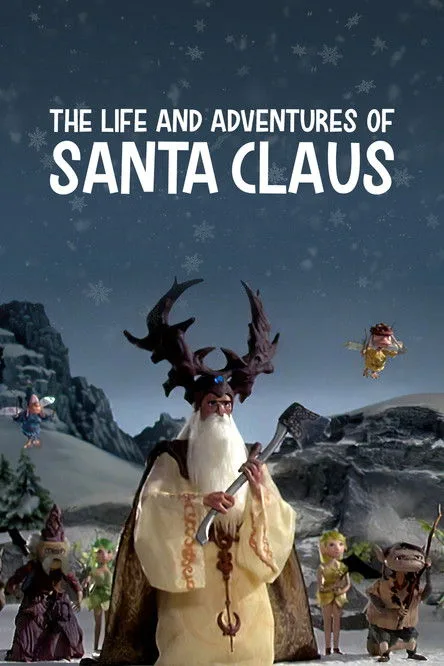
The Life and Adventures of Santa Claus (1985)
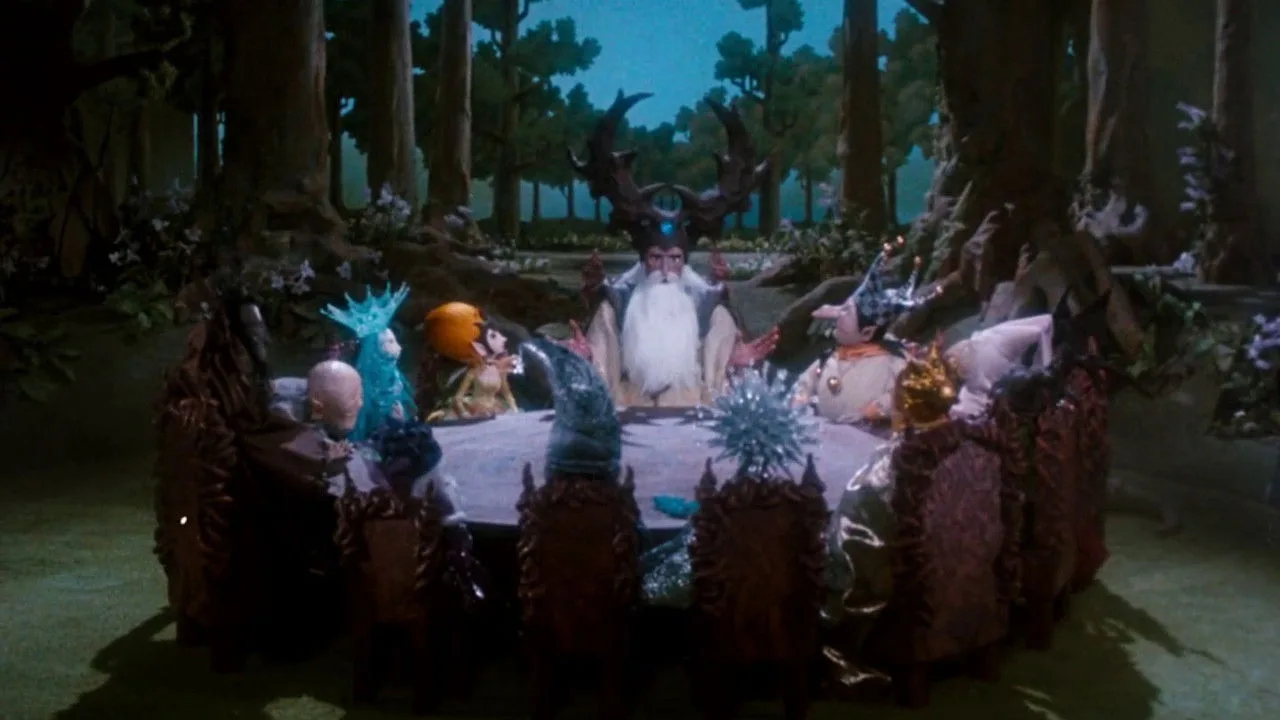
The Great Ak calls a council of the Immortals to ask that Santa Claus be given immortality. And to justify it, he tells the history of Santa Claus. The Ak found an abandoned baby and gave it to a lioness and a fairy to raise, who named him Claus. When Claus grew up, the Great Ak showed him the evil and hardship in the world and Claus decides to live there and relieve some of the suffering. He decides to make toys for orphans, but King Awgwa, the ruler of the valley where Claus lives doesn't want the children to be happy, and there is a great battle among Immortals.
 rating 8/10 User rating 22 votes 55%
 ❄ Christmas Connection
This special is literally the origin story of Santa Claus -- how he came to make toys, deliver them by sleigh, and earn immortality from the Great Ak and the Council of Immortals. Christmas itself exists in this story because of decisions Claus makes, making it arguably the most foundational Christmas special ever made. The entire mythology of the holiday is treated as biography here.
Where to Watch


Our Review
Most Christmas specials explain Santa Claus the way a press release explains a product launch. He exists, he's jolly, he gives gifts, here is a song. The 1985 Rankin/Bass special The Life and Adventures of Santa Claus takes a different approach: it treats Santa as a mythological figure on the order of Hercules, and spends 48 minutes presenting his biography with the seriousness that premise deserves. The result is one of the strangest, most ambitious Christmas specials ever produced.
The source material is not the usual Christmas IP. L. Frank Baum -- best known for The Wizard of Oz -- published The Life and Adventures of Santa Claus in 1902, four years before he wrote The Marvelous Land of Oz. It predates the version of Santa Claus that Coca-Cola advertising would later cement in the popular imagination. Baum's Santa is a mortal raised by immortal forest creatures, a man who chooses to spend his life making children less miserable, and who must eventually face death like any other human -- unless the immortals decide he's earned the right to live forever. Rankin/Bass adapted this almost faithfully. Almost.
What the Story Actually Is
The special opens at the Great Throne of the Immortals. The Great Ak, Master Woodsman of the World, is asking the Council of Immortals to grant the Mantle of Immortality to a mortal named Claus. The rest of the special is his argument: a life story told in flashback. A baby abandoned in the Forest of Burzee. A wood nymph named Necile who adopts him against the rules of her order. A lion named Shiegra who becomes his guardian. A human childhood spent among creatures who don't understand human suffering.
The Wicked Awgwas -- goblin-like beings who feed on misery -- are the antagonists, and they go to war with the immortals specifically because Claus's toy-giving is ruining their food supply. This is the detail that makes Baum's book genuinely interesting: evil in this story is not abstract. It has material interests. The Awgwas don't hate joy on principle; they need children to be unhappy to survive. Rankin/Bass keeps this, and it gives the special a logic that most holiday programming lacks entirely.
The war between immortals and Awgwas is depicted with surprising directness. Creatures are struck down. The Awgwas are defeated and destroyed, not just chased off. For a 1985 animated TV special aimed at children, this is not nothing.
The Animagic Technique and What It Looks Like Now
Rankin/Bass produced the special using Animagic, their brand name for stop-motion puppet animation developed with Japanese studio Mushi Production and, later, Rankin/Bass's Tokyo-based team. The same technique was used for Rudolph the Red-Nosed Reindeer (1964) and Santa Claus Is Comin' to Town (1970). By 1985 it was a deliberately nostalgic aesthetic choice, not a technical constraint.
The puppets here are more detailed than in the earlier specials. The Forest of Burzee has genuine visual texture. The immortal characters -- the Great Ak, the Fairy Queen Lurline, the various nymphs and ryls and knooks -- each have distinct designs that reflect their nature without becoming caricature. The Awgwas are appropriately grotesque. It's handsome work.
That said, the animation has the stilted quality inherent to the format. If you're coming from the fluid motion of modern CGI, this will register as either charming or distracting depending on your tolerance. The special makes no apologies for what it is.
The Voice Cast Does the Heavy Lifting
Alfred Drake voiced the Great Ak, and his performance is the backbone of the special. Drake was primarily a stage actor -- his 1948 Broadway run in Kiss Me, Kate is still discussed as one of the definitive musical theater performances of the postwar era. He brings genuine weight to Ak's narration and to the Council of Immortals scenes, which could easily have felt like a bureaucratic formality but instead feel like a genuine reckoning.
Earl Hammond voiced several characters, as was standard for Rankin/Bass productions that kept voice casts small. The approach occasionally makes itself felt when a second character sounds too much like the first, but Hammond manages distinct characterizations well enough that it rarely breaks the spell.
The score by Maury Laws and lyrics by Jules Bass include original songs written for the special. These are not the songs that will get stuck in your head for three weeks, but they serve the story rather than interrupting it, which is a higher bar than most Rankin/Bass songs clear.
Baum's Santa vs. the Santa We Know
The specific pleasures of this special come from watching Baum's mythology explain things the standard Santa legend leaves unexamined. Why does Santa give gifts specifically to children? Because Claus grew up outside human society and didn't understand why children suffered while adults seemed to accept it. His first toys were carved to comfort a specific child he encountered on his early travels through the human world. The gift-giving scaled up from there.
Why reindeer? The special has an answer: Claus can't travel fast enough on foot to deliver gifts in a single night, and the immortal Wil Knook grants him the ability to command reindeer to pull his sleigh. It's a practical solution to a logistics problem, not a magical gift from nowhere.
Why chimneys? Claus originally went through doors, but parents kept locking them because a strange man entering houses at night was reasonably alarming. A child suggested the chimney. Again: practical problem, specific solution, logical origin.
Baum wrote the book in 1902 specifically to give Santa Claus the kind of coherent mythology that figures like Thor or Hercules had. He succeeded, and Rankin/Bass preserved enough of that framework that the special works as genuine myth-making rather than sentimentality.
The Ending Is Genuinely Affecting
The special ends where it began: at the Great Throne. The Council of Immortals votes. Claus is granted the Mantle of Immortality. He will live as long as the world endures.
What makes this land is the setup. We've spent 48 minutes watching a mortal man grow old. The special doesn't skip over this. Claus ages visibly. His hair goes white not from magic but from time. He needs help he once didn't need. The question of whether he deserves immortality isn't rhetorical -- it's the organizing question of the entire special, and by the time the Council votes, you have an actual stake in the answer.
Rankin/Bass made dozens of holiday specials. Most of them are pleasant enough and forgotten by January. This one is different. It takes its mythology seriously, treats its source material with respect, and ends with the old man getting to keep living -- which is, after everything, what the story earns.
Fun Facts
L. Frank Baum published The Life and Adventures of Santa Claus in 1902, two years after The Wonderful Wizard of Oz (1900) but four years before The Marvelous Land of Oz. He considered the Santa book part of his broader fantasy world-building, and it shares the same mythological approach he used for Oz.
Alfred Drake, who voiced the Great Ak, was one of Broadway's most acclaimed leading men. His original 1948 performance as Fred Graham in Kiss Me, Kate ran for 1,077 performances and is widely considered the role that defined his career.
Rankin/Bass produced the Animagic puppet animation for this special in Japan, continuing a collaboration that dated back to their 1964 production of Rudolph the Red-Nosed Reindeer -- a working relationship spanning more than two decades.
The special aired on CBS on December 19, 1985. It was one of the final Animagic productions Rankin/Bass made before shifting their focus to other formats in the late 1980s.
Baum's original book invented several of the immortal beings -- the Ryls, Knooks, Fairies, and Nymphs of the Forest of Burzee -- as a complete cosmology separate from any existing mythology. He created the Awgwas specifically as a counterforce whose evil was economic rather than ideological.
The concept of Santa using a sled pulled by reindeer had been established since Clement Clarke Moore's 1823 poem "A Visit from St. Nicholas." Baum's innovation was to give the choice of reindeer a logical narrative cause inside his myth -- the grant of Wil Knook -- rather than treating it as a given.
Rankin/Bass adapted the story a second time in 2000 as a computer-animated feature film, also titled The Life and Adventures of Santa Claus, with Robby Benson voicing the adult Claus. The 1985 Animagic version remains the more discussed of the two adaptations.
Jules Bass, who co-directed the special with Arthur Rankin Jr., also wrote the lyrics for the original songs. Bass and Rankin had been producing holiday specials together since 1964, and by 1985 they had created more than a dozen television Christmas specials, making them the single most prolific producers of animated holiday programming in television history.
Cast