
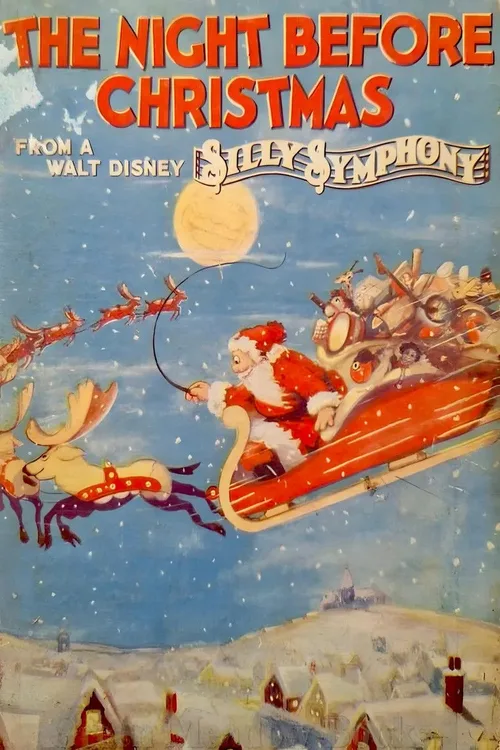
The Night Before Christmas (1933)
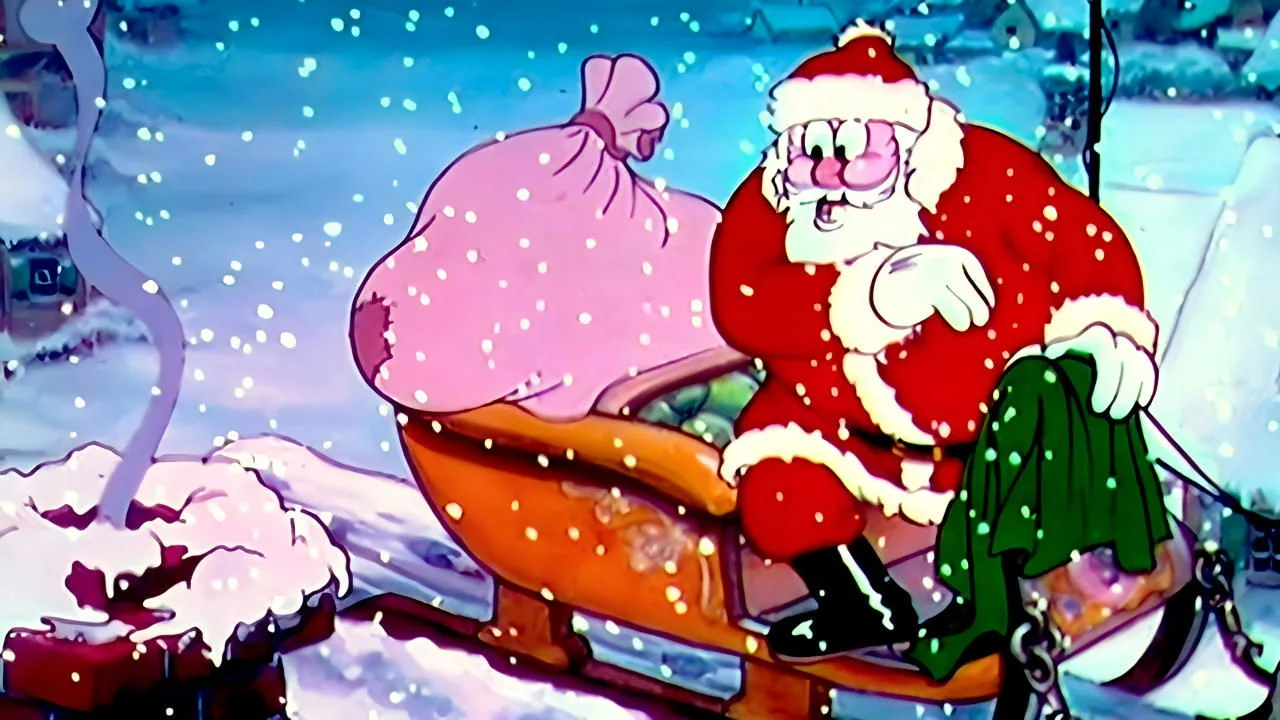
A narrator sings the opening stanzas of the classic poem while we see the house at rest. Santa lands on the roof, comes down the chimney, and opens his bag. The toys march out and decorate the tree, with the toy soldiers shooting balls from their cannon, a toy airplane stringing a garland like skywriting, and the toy firemen applying snow. A blimp delivers the star to the top. Meanwhile, Santa fills the stockings. His laughter awakens the children, who sneak out. The toys rush to their places, and Santa escapes up the chimney just in time.
 rating 8/10 User rating 56 votes 65%
 ❄ Christmas Connection
The Night Before Christmas is a direct adaptation of Clement Clarke Moore's 1823 poem of the same name, the single most influential piece of Christmas writing in the English-speaking world. Santa Claus, the sleigh, eight reindeer, the chimney entrance, the stocking delivery: this poem invented the modern Christmas night. Disney's 1933 short puts the whole thing on screen, from Christmas Eve anticipation to Santa's departure before dawn.
Our Review
Eight minutes. That is all it takes for Disney's 1933 short The Night Before Christmas to deliver a complete, polished, genuinely moving version of the poem that gave Western culture its Santa Claus. Not a loose adaptation. Not a reimagining with added characters and a third-act conflict. A faithful, illustrated reading of Clement Clarke Moore's 1823 text, set to music and brought to life by animators who were, at that particular moment in history, the best in the world at what they did.
The film belongs to the Silly Symphonies series, Walt Disney's experimental shorts run from 1929 to 1939 that served as the studio's testing ground for color, music synchronization, and character animation. By 1933, the series had already won two Academy Awards and was operating at a level of craft the rest of the animation industry was still trying to understand. This short was directed by Wilfred Jackson, one of the studio's most reliable directors of the period, and it shows in every sequence.
What the 1933 Short Gets Right About the Poem
Moore's poem has been adapted so many times and absorbed so completely into Christmas culture that it can be hard to read it fresh. Disney's version strips away the accumulated noise. The film opens on a snow-covered house at night, children asleep, stockings hung, and the voiceover reading the poem's lines directly while the images illustrate them without editorializing.
The animators resist the temptation to invent. When the poem says "the moon on the breast of the new-fallen snow / gave the lustre of mid-day to objects below," the film gives you moonlit snow and nothing else. When Santa laughs and shakes "like a bowlful of jelly," the animators give you that laugh in full, unfiltered physical comedy. They trust the source material, which is the correct instinct.
The color work deserves particular attention. The film was made in Technicolor, using the three-strip process that Disney had pushed to be one of the first animation studios to adopt. The palette is a controlled study in Christmas reds, cool blues, and warm interior golds. The transition from the cold moonlit exterior to the firelit living room interior, as Santa descends the chimney, is a small technical achievement that lands emotionally every time.
The Wilfred Jackson Approach
Jackson was not the flashiest director in the Disney stable. He did not invent the bold stylistic experiments that Ub Iwerks or later Ward Kimball pursued. What he did consistently was find the emotional center of a scene and make sure the music and animation served it without distraction.
In this short, that means the pacing is slow by modern standards. The film breathes. Children's faces are held on screen long enough for you to register their expressions. Santa's sleigh, rising into the moonlit sky at the film's end, is given a full, unhurried arc across the frame. A modern production would cut away sooner. Jackson lets it hang there until the image completes itself.
The music, arranged to synchronize with the animation in the Silly Symphonies style, draws on traditional carols without being slavish about it. The score underlines the poem's rhythm rather than competing with it.
Where It Stands in the Disney Canon
The Silly Symphonies are underappreciated as a body of work. They sit in the awkward middle ground between early Mickey Mouse shorts and the feature films that followed Snow White in 1937, and they tend to get skipped over in the standard Disney history. That is a mistake.
This particular short is not the most technically daring in the series. "Three Little Pigs" (1933) has more cultural footprint. "The Old Mill" (1937) is more visually ambitious. But The Night Before Christmas is the series at its most complete: technically accomplished, emotionally coherent, and in direct service of material that genuinely merits the treatment.
The film also represents a specific historical moment. By 1933, the visual language of Santa Claus was not yet fully standardized in popular culture. Coca-Cola's advertising campaigns featuring Haddon Sundblom's definitive red-suited Santa had begun in 1931 but had not yet saturated the cultural landscape. Disney's version of Santa here, round and red-suited and white-bearded, arriving by sleigh and departing up the chimney, was itself contributing to the consolidation of that image. The film was part of the process by which Moore's poem became a visual template, not just a written one.
The final image stays with you: the sleigh crossing the full moon, Santa calling back to his reindeer by name, the voice fading as the poem ends its last stanza. It earns its sentiment because it hasn't cheated to get there.
Fun Facts
The Night Before Christmas (1933) was part of Disney's Silly Symphonies series, which ran from 1929 to 1939 and produced 75 shorts total. The series won the Academy Award for Best Animated Short Film seven consecutive times from 1932 to 1939.
Director Wilfred Jackson joined Disney in 1928 and went on to co-direct major features including Fantasia (1940), Cinderella (1950), and Alice in Wonderland (1951). He retired from Disney in 1961 after more than three decades with the studio.
Clement Clarke Moore's poem, first published anonymously in 1823 in the Troy Sentinel newspaper, is the source of the names of all eight original reindeer: Dasher, Dancer, Prancer, Vixen, Comet, Cupid, Donner, and Blitzen. Rudolph was not added until a 1939 Montgomery Ward promotional booklet written by Robert L. May.
The three-strip Technicolor process used in this film required cameras that were large, expensive, and available only through exclusive licensing from Technicolor. Disney was one of the first animation studios to sign an exclusive agreement with Technicolor, giving the studio a competitive advantage in color production from 1932 to 1935.
The 1933 short is one of at least three separate animated films with the title "The Night Before Christmas" Disney produced over the decades. The studio returned to Moore's poem repeatedly, reflecting both its public domain status and its near-universal name recognition.
Clement Clarke Moore's authorship of the poem was disputed for much of the 20th century. Some scholars have argued the real author was Henry Livingston Jr., a New York poet who died in 1828. Moore did not publicly claim authorship until 1837, fourteen years after the poem's first publication.
The Silly Symphonies shorts were specifically designed to experiment with music-driven animation, an approach Walt Disney developed after the success of Steamboat Willie (1928), which synchronized character movement to a musical score. By 1933, the studio's synchronization techniques had become sophisticated enough to match lip movements, limb gestures, and physical comedy beats to individual musical phrases.
Cast