

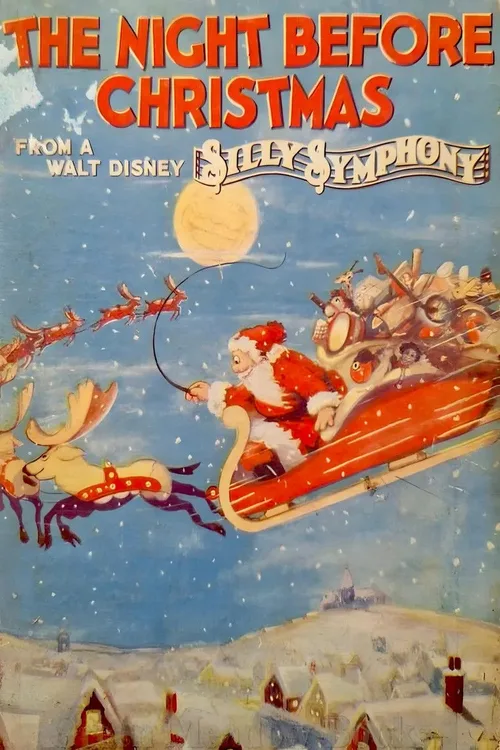
The Night Before Christmas (1946)
A live-action visualization of the poem, blended with animation.
 rating 6/10 User rating 5 votes 32%
 ❄ Christmas Connection
This short is a direct animated adaptation of Clement Clarke Moore's 1823 poem "A Visit from St. Nicholas," which is the poem that codified the modern image of Santa Claus, his eight reindeer, and the Christmas Eve delivery of gifts. The film is set entirely on Christmas Eve and follows the poem's narrative beat for beat. There is no more Christmassy source material in the English-speaking world.
Our Review
Clement Clarke Moore wrote "A Visit from St. Nicholas" in 1823, and for over a century afterward, every studio with an animation department eventually felt compelled to adapt it. The Night Before Christmas from 1946 is one such effort, produced in the immediate aftermath of World War II, when American popular culture was busy reassembling itself and Christmas animation was still a patchwork of competing styles and ambitions. This particular version is a modest, sincere piece of work that treats its source material with respect and little else.
What the Film Is and Where It Came From
The 1946 short follows Moore's poem closely, which is both its strength and its limitation. The narrative is the poem: a child wakes on Christmas Eve, hears a clatter, watches Santa arrive via rooftop, descend the chimney, fill the stockings, and depart with a wink and a finger laid aside his nose. There is no subplot. No comedy sidekick. No villain attempting to steal Christmas. The film trusts the poem to carry the runtime, which at roughly eight minutes, it can.
The animation style reflects the era's constraints. Studios in 1946 were working through postwar economic realities. Wartime had redirected creative talent and budgets, and the American animation industry was still reconsolidating. The result is artwork that sits between the lush prewar Disney aesthetic and the cheaper, flatter styles that would define television animation in the following decade. Backgrounds are painted with care. Character movement is functional rather than fluid. Santa himself is rendered in the round, red-suited, white-bearded form that had become standard by the 1940s, largely because of Moore's poem and Haddon Sundblom's Coca-Cola paintings from the 1930s.
What the 1946 Version Adds
Adapting a poem that contains almost no action requires animation studios to make choices. The 1946 film chooses atmosphere over invention. There are sustained shots of the snow-covered roof, of the chimney's interior, of the firelit living room waiting in silence. The pacing is slow by modern standards, which suits the material. Moore's poem is not a thriller.
The voice narration follows the poem's text closely, and the musical accompaniment is what you'd expect from a studio Christmas short of the period: orchestral, warm, leaning on sleigh bells. Nothing in the score is remarkable, but nothing is wrong either. The film knows its job is to serve the poem, not to compete with it.
What the 1946 version does not add is any revisionism. Santa is jolly. The children are asleep. The house is middle-class American. The film is not trying to deconstruct anything or update the poem for postwar anxieties. Given that American families in 1946 had just spent years in genuine deprivation and fear, a straight, comforting Christmas story was probably the correct editorial decision.
The Poem's Own History Is the Interesting Part
Moore's poem did more to shape the visual image of Santa Claus than any other single document. Before "A Visit from St. Nicholas," Saint Nicholas was depicted in a dozen different ways across European cultures, ranging from thin and bishop-like to threatening and punitive. Moore's Santa was fat, jolly, magical, and specifically benevolent. He came at night, entered through chimneys, used a sleigh pulled by eight named reindeer, and left gifts without expecting anything in return except good behavior that had already occurred. This version of Santa won.
By 1946, that image had been reinforced by decades of illustrations, department store Santas, Sundblom's Coca-Cola campaigns, and radio broadcasts. The animated short had nothing new to add to the mythology. It was, in that sense, a celebration of something already settled rather than a contribution to it.
This distinction matters when you're deciding how to watch the film. Approach it as a primary document, a record of how American studios in 1946 understood and visualized Christmas Eve, and it has genuine value. Approach it expecting the invention of a Fleischer brothers cartoon or the technical achievement of Disney's wartime features, and you'll be disappointed.
Is This Christmas Enough?
The Christmas Vibes question answers itself here. This is a film about nothing except Christmas Eve, Santa Claus, reindeer, stockings, and snow. There is no setting other than a house on December 24th. There is no character whose motivation is not Christmas-related. The source poem is the single most influential document in the history of how the English-speaking world visualizes Christmas.
Five out of five. Obvious.
The film's actual score of 6 out of 10 reflects its technical modesty and the reality that, as an adaptation, it adds little to what Moore wrote in 1823. If you're introducing a young child to the poem, this short works. If you're looking for the best Christmas animation of the 1940s, the Fleischer brothers' work from earlier in the decade has more personality. The 1946 version is honest about what it is: a faithful, unflashy rendering of a poem that needed no improvements and received none.
The eight reindeer named in the poem, Dasher, Dancer, Prancer, Vixen, Comet, Cupid, Donner, and Blitzen, all appear in their expected form. Rudolf, invented by Robert L. May in 1939 and popularized by Gene Autry's song in 1949, does not appear. That absence is, in its own way, a historically accurate touch.
Fun Facts
Clement Clarke Moore's poem "A Visit from St. Nicholas" was first published anonymously in the Troy Sentinel newspaper on December 23, 1823. Moore did not publicly claim authorship until 1844, and there remains a minority scholarly argument that the actual author was Henry Livingston Jr.
The eight reindeer named in Moore's poem were given their names from Dutch and Norse roots: Donner means "thunder" in Dutch, and Blitzen means "lightning" in German, giving Santa's team a storm-related pair at the back of the herd.
Rudolf the Red-Nosed Reindeer was not part of Moore's original poem. Robert L. May created Rudolf in 1939 as a promotional booklet for Montgomery Ward department stores. By 1946, when this film was made, Rudolf existed but had not yet become the dominant ninth reindeer of popular culture.
By 1946, Haddon Sundblom had been painting Santa Claus for Coca-Cola for over a decade, having started in 1931. These paintings, which appeared in national magazines every Christmas season, did more than any other single source to standardize the red-suited, rosy-cheeked, round Santa that appears in the 1946 film.
The phrase "Happy Christmas to all, and to all a good-night," which ends Moore's poem and provides the concluding line for most animated adaptations including this one, was one of the first widely reprinted pieces of holiday text in American newspaper history.
American animation studios produced a significant number of Christmas shorts in the years immediately following World War II as the industry shifted back from wartime training and propaganda films to commercial entertainment. The 1946 Christmas season was the first postwar Christmas with most servicemen home, making sentimental holiday content commercially valuable.
Moore's poem established that Santa enters homes via the chimney, a detail that had no strong precedent in earlier Saint Nicholas folklore and which cartoonists have been faithfully illustrating ever since. The 1946 film includes this scene, as virtually every adaptation of the poem does.