
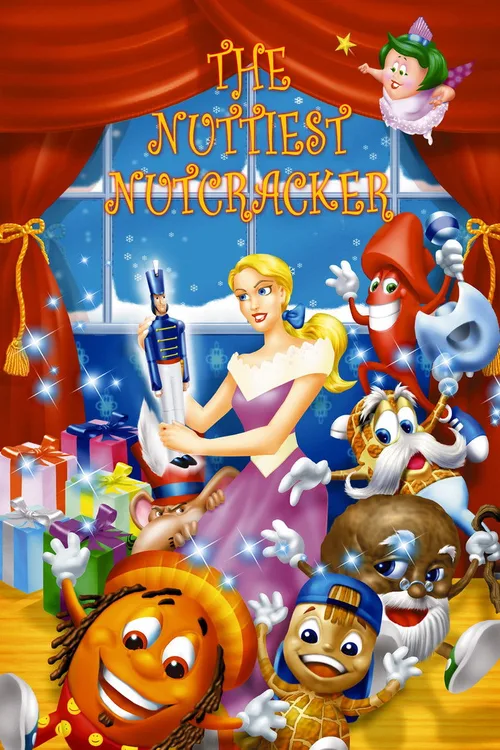
The Nuttiest Nutcracker (1999)
A group of fruit and vegetables try to help the Nutcracker's army get a star up on a Christmas tree before midnight, and stop a rodent army from destroying Christmas.
 rating 4/10 User rating 15 votes 44%
 ❄ Christmas Connection
The Nuttiest Nutcracker is a direct retelling of Tchaikovsky's The Nutcracker ballet, one of the most recognizable Christmas traditions in the Western world. The story is set at Christmas and follows the classic Nutcracker narrative arc: a girl, a toy soldier, a Sugar Plum Fairy, and a villainous Mouse King. It has about as strong a claim to Christmas as any adaptation of the source material.
Where to Watch


Our Review
There is a specific category of late-1990s direct-to-video animation that exists somewhere between ambition and complete chaos. The Nuttiest Nutcracker (1999) plants its flag firmly in that territory. It takes Tchaikovsky's beloved Christmas ballet, replaces the human cast with sentient fruit and vegetables, hands the lead role to Jim Belushi, and dares you to look away.
Produced by Kaboom Entertainment, this 45-minute oddity arrived in 1999 on VHS, aimed squarely at parents who needed to occupy children during the holiday season and weren't too fussy about what exactly was doing the occupying. It has the look of early CGI that was already being outpaced by Pixar, and the comedic sensibility of a Saturday morning cartoon that wasn't quite sure who its audience was.
The Plot, Such As It Is
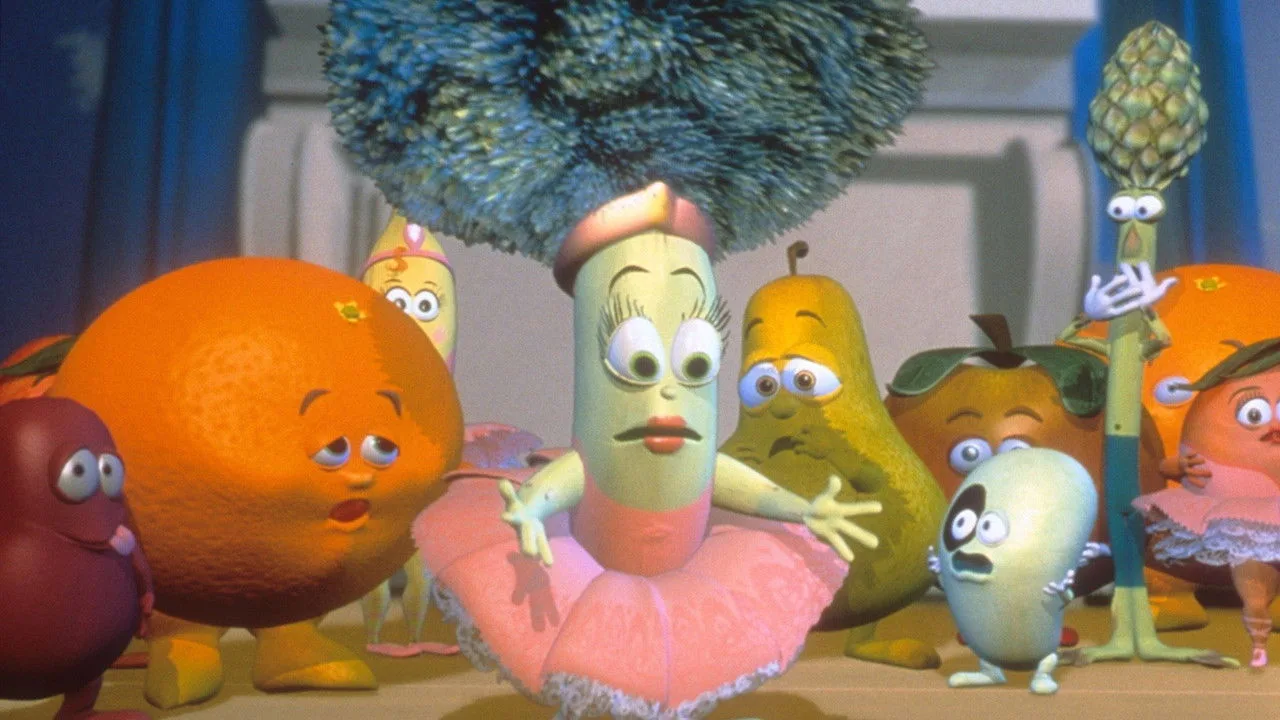
The story follows the familiar Nutcracker structure. A young girl named Marie receives a nutcracker as a Christmas gift. The nutcracker comes to life, battles the Mouse King, and takes Marie to a magical kingdom. The major deviation: all of the characters are anthropomorphic produce. The Nutcracker is a fruit soldier. The Sugar Plum Fairy is a plum. The villain is a rodent with designs on eating everyone.
It's a premise that could work with the right execution. A comedic animated Nutcracker with a cast of talking food isn't inherently a bad idea. The problem is that The Nuttiest Nutcracker never quite decides what it wants to be. It runs the classic story mostly straight while inserting slapstick gags and one-liners that don't always land. The comedy feels like it was added in post-production to a script that started more earnest.
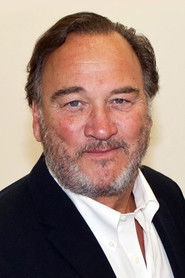
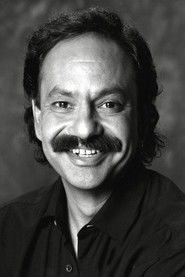
Cheech Marin as the Mouse King is genuinely funny in places. Marin understands how to voice a cartoon villain without completely collapsing into self-parody, and he gets a few decent lines. Jim Belushi's fruit soldier is more variable. Belushi has real comedic instincts, but the material doesn't always give him much to work with beyond reaction takes.
The Voice Cast Deserves Better Material
The cast assembled for this production is, on paper, legitimately interesting. Jim Belushi, Cheech Marin, Phyllis Diller, and Ben Stein in the same animated Christmas special sounds like the setup for something far weirder and more memorable than what actually arrived.
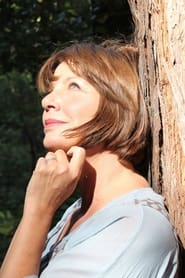
Phyllis Diller shows up as the Fairy Godmother, and she's the best thing in the film. Diller was in her early eighties at this point and had been doing voice work with her distinctive cackle for decades. She doesn't need much screen time to register. Ben Stein, deployed in his trademark deadpan, gets exactly the kind of role you'd expect: a character whose whole joke is that he sounds utterly bored by everything happening around him. It works about half the time.
The irony of The Nuttiest Nutcracker is that it had enough star power to be something people actually remember. Instead it functions as a footnote, the kind of movie that surfaces in "weird Christmas movies" lists written by adults who vaguely recall seeing it at age six.
The Animation and Tchaikovsky's Music
The CGI animation has not aged well, though in fairness it wasn't particularly state-of-the-art when it was new. Characters have a rubbery, unfinished quality. Textures look like they were rendered on a deadline. The fruit and vegetable designs are at least visually distinct, which helps during scenes with multiple characters on screen.
The film uses arrangements of Tchaikovsky's original score, which is a genuine asset. The Nutcracker Suite is one of the most immediately recognizable pieces of classical music in the Christmas repertoire, and hearing the Dance of the Sugar Plum Fairy under a scene involving animated plums has a genuinely surreal quality that the rest of the film struggles to match. The score carries sequences that the animation and dialogue can't.
Tchaikovsky wrote the original Nutcracker ballet score in 1891 and 1892, and it premiered in St. Petersburg in December 1892. The piece became a staple of American Christmas culture largely through the San Francisco Ballet, which staged the first complete American production in 1944. By 1999, the music was so embedded in Christmas consciousness that even a low-budget direct-to-video animated film could rely on audiences recognizing it instantly. The Nuttiest Nutcracker gets something for free that it didn't earn.
Is This Worth Watching?
For adults watching alone, no. For children who haven't seen it, possibly, if expectations are managed. For people hunting through the strangest corners of Christmas animation history, absolutely yes.
What The Nuttiest Nutcracker represents is a specific moment in holiday direct-to-video production when studios believed that recognizable IP, a celebrity voice cast, and passable CGI were sufficient ingredients for a successful Christmas special. Sometimes that formula worked. More often, it produced films that exist in a strange liminal space: not bad enough to be camp classics, not good enough to be perennial favorites.
The movie ends with Tchaikovsky's Waltz of the Snowflakes playing over a scene of fruit characters dancing in a sugary kingdom. It's more affecting than it has any right to be. Credit the composer, not the production.
Fun Facts
Tchaikovsky's Nutcracker ballet, which this film adapts, premiered at the Imperial Mariinsky Theatre in St. Petersburg on December 18, 1892, and received only a lukewarm reception from critics. It took decades before it became the Christmas institution it is today.
The San Francisco Ballet performed the first complete American production of The Nutcracker in 1944, staged by William Christensen. This production is widely credited with turning the ballet into a holiday tradition in the United States.
Phyllis Diller, who voices the Fairy Godmother in this film, had one of the longest careers in American comedy, performing stand-up from 1955 until she was in her nineties. She was 81 when this film was released.
Cheech Marin, who voices the Mouse King, had a notable run of animated voice work in the late 1990s, including the hyenas in Disney's The Lion King (1994) and appearances in several other animated features during this period.
Ben Stein's deadpan delivery in animated roles mirrors his most famous screen appearance: the monotone economics teacher in Ferris Bueller's Day Off (1986), a role John Hughes originally wrote as a much smaller part that Stein expanded through improvisation.
The Kaboom Entertainment label that produced this film was active in the late 1990s releasing budget animated titles aimed at the holiday direct-to-video market, a category that expanded sharply after the success of Disney's direct-to-video sequels in the mid-1990s.
The tradition of staging The Nutcracker as a fundraiser for ballet companies became so commercially important that by the 1990s it was estimated to account for roughly 40 percent of many American ballet companies' annual revenue, making the source material this film parodies effectively a financial pillar of the classical dance world.
Cast