
They needed help. What they got was a miracle.
The Preacher's Wife (1996)
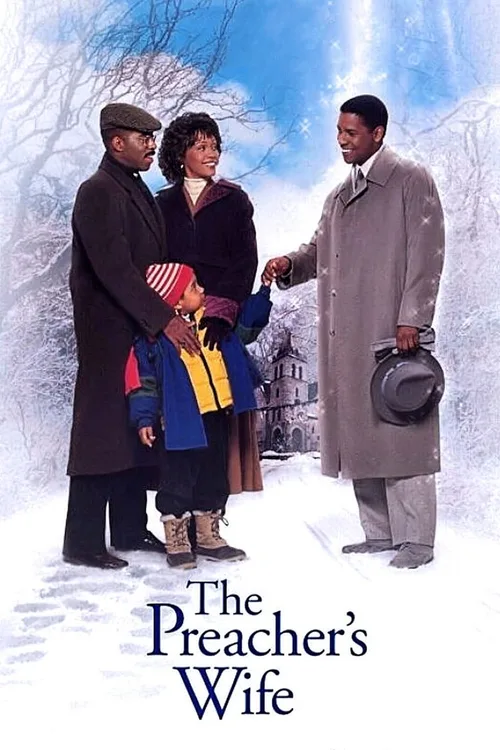
Good-natured Reverend Henry Biggs finds that his marriage to choir mistress Julia is flagging, due to his constant absence caring for the deprived neighborhood they live in. On top of all this, his church is coming under threat from property developer Joe Hamilton. In desperation, Biggs prays to God for help – which arrives in the form of an angel named Dudley.
 rating 7/10 User rating 247 votes 58%
 ❄ Christmas Connection
Set during the Christmas season in a Black Baptist church community, the film's entire plot revolves around an angel arriving during the holidays to restore a preacher's faith and marriage. The Christmas concert finale, featuring Whitney Houston's full gospel performance, is one of the most emotionally charged holiday musical sequences in 1990s cinema.
Where to Watch


Our Review
Penny Marshall's 1996 film The Preacher's Wife has a problem that most Christmas movies would kill for: Whitney Houston is so good in it that she threatens to make everything else on screen irrelevant. Based on the 1947 classic The Bishop's Wife (starring Cary Grant and Loretta Young), this remake transplants the story from a stuffy Episcopalian parish to a lively Black Baptist church in New York City. The upgrade works. The original is a fine film. This one has a pulse.
Denzel Washington as the Smoothest Angel in Cinema
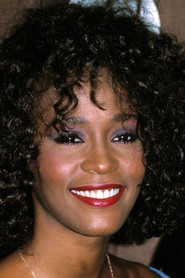
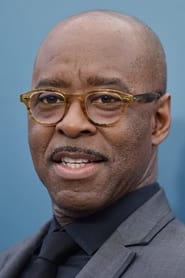
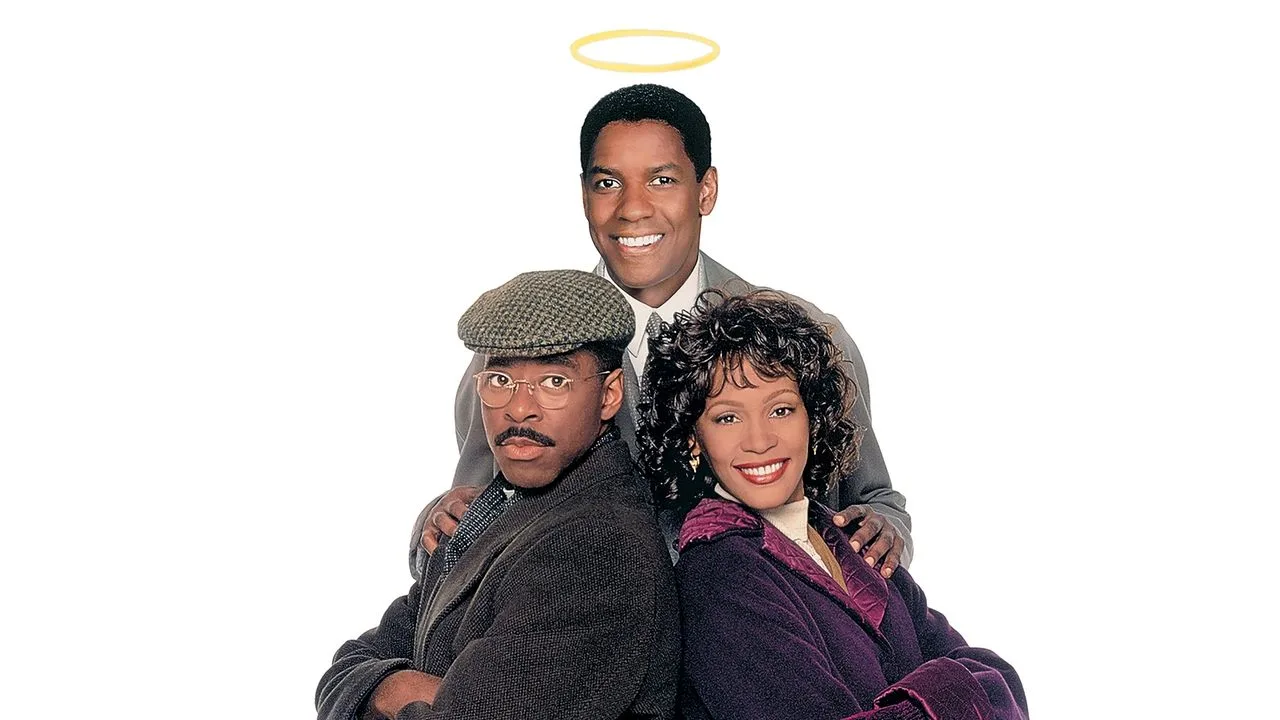
Denzel Washington plays Dudley, an angel sent from heaven to help Reverend Henry Biggs (Courtney B. Vance) save his struggling church and crumbling marriage. Dudley arrives in a perfectly tailored coat, performs small miracles with a wink, and immediately starts charming everyone in the neighborhood, including Julia Biggs (Houston), the preacher's wife.
Washington is doing something interesting here. He plays Dudley not as an otherworldly being but as the most charismatic man at any party. He ice-skates with impossible grace. He wins over children instantly. He makes a pizza appear out of thin air. The performance walks a razor-thin line between divine messenger and romantic rival, and Washington never tips too far in either direction.
The real tension isn't whether Dudley will steal Julia away. It's whether Henry will notice what he's losing before it's too late. Courtney B. Vance plays the preacher's frustration and self-doubt with a restraint that grounds the whole film. His Henry is a good man stretched thin, not a villain, and that makes the domestic drama far more compelling than a simple love triangle.
Whitney Houston and the Soundtrack That Became a Classic
Houston doesn't just act in this film. She sings. And when Whitney Houston sings gospel in a church setting, the movie stops being a movie and becomes something closer to a religious experience.
The accompanying soundtrack album went on to sell six million copies worldwide, making it one of the best-selling gospel albums of all time. "I Believe in You and Me," originally a 1982 track by The Four Tops, became a massive hit in Houston's hands. Her version turns a solid R&B ballad into something genuinely transcendent.
But the real showstopper is the Christmas concert sequence near the film's climax. Houston performs "Joy to the World" with the Georgia Mass Choir backing her, and the scene carries an emotional weight that the plot alone couldn't generate. Marshall, a director who understood musical performance better than most (she directed the Laverne & Shirley pilot and knew timing), lets the camera hold on Houston and doesn't cut away. Smart choice.
A Remake That Found Its Own Identity
Remaking The Bishop's Wife was a gamble. The 1947 original is a well-regarded film with a Best Picture nomination and a David Niven performance that still holds up. But Marshall and screenwriters Nat Mauldin and Allan Scott made the crucial decision to move the setting into a Black church community, and everything followed from there.
The 1947 version is about genteel doubt. The 1996 version is about a community under economic pressure. Henry's church needs money. A real estate developer (played with oily charm by Gregory Hines) wants to tear it down and build condos. The congregation is aging. These aren't abstract theological problems. They're the kind of pressures that actually break up marriages and close churches.
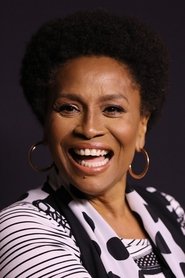
Jenifer Lewis, as Henry's mother-in-law Margueritte, steals every scene she's in. She delivers her lines with the timing of a veteran stand-up comic, and her immediate suspicion of Dudley provides the film's best laughs. When she mutters about the too-perfect stranger hanging around her daughter, you believe every word.
Where It Falls Short
The film isn't perfect. At 124 minutes, it sags in the middle. Some of the miracle sequences feel like padding, particularly a scene involving a Boys' Club basketball game that goes on longer than it needs to. The special effects, even by 1996 standards, look cheap. Dudley's ice-skating miracle on a frozen pond plays more like a screensaver than divine intervention.
Marshall also struggles with tone in places. The film wants to be a romantic comedy, a family drama, a musical, and a spiritual parable all at once. It mostly pulls this off, but there are moments where the gears grind as it shifts between registers.
Still, the core performances carry it through every rough patch. Washington, Houston, and Vance form a triangle where you genuinely care about all three characters, and that's harder to pull off than any special effect.
The Christmas Factor
This is a Christmas movie through and through. The entire story takes place during the holiday season, the church is preparing for its annual Christmas concert, and the film's emotional resolution happens on Christmas Eve. Snow falls on cue. Carols fill the soundtrack. An angel walks among ordinary people.
What separates it from generic holiday fare is the specificity of its setting. This isn't a vague, Hallmark-style Christmas. It's Christmas in a particular community, with particular music, particular food, and particular traditions. The gospel choir isn't decoration. It's the beating heart of the film.
Penny Marshall passed away in 2018, and The Preacher's Wife remains one of her most underappreciated films. It earned $48 million at the box office against a $40 million budget, making it a modest commercial disappointment. But the soundtrack outsold and outlasted the film itself, and every December, a new generation discovers that Denzel Washington once played an angel who could ice-skate backwards.
Fun Facts
The film is a remake of The Bishop's Wife (1947), which starred Cary Grant as the angel, David Niven as the bishop, and Loretta Young as the wife. The original was nominated for five Academy Awards, winning one for Best Sound.
Whitney Houston's soundtrack album for the film has sold over six million copies worldwide, making it one of the best-selling gospel albums in history.
"I Believe in You and Me" was originally recorded by The Four Tops in 1982. Houston's cover reached number four on the Billboard Hot 100 and became one of her signature songs.
Director Penny Marshall had Denzel Washington take ice-skating lessons for weeks before filming the pond scene. Washington, who had no prior skating experience, reportedly found the training more physically demanding than any action film he'd done.
Gregory Hines, who plays the developer Joe Hamilton, was one of the greatest tap dancers in American history. Marshall originally wanted a bigger dance sequence for him but cut it for time.
The Georgia Mass Choir, who appear in the film's climactic concert scene, recorded their parts live on set rather than lip-syncing to a studio track.
Courtney B. Vance and Angela Bassett, who were dating during production, married in 1997. The couple has been together ever since.
Cast