
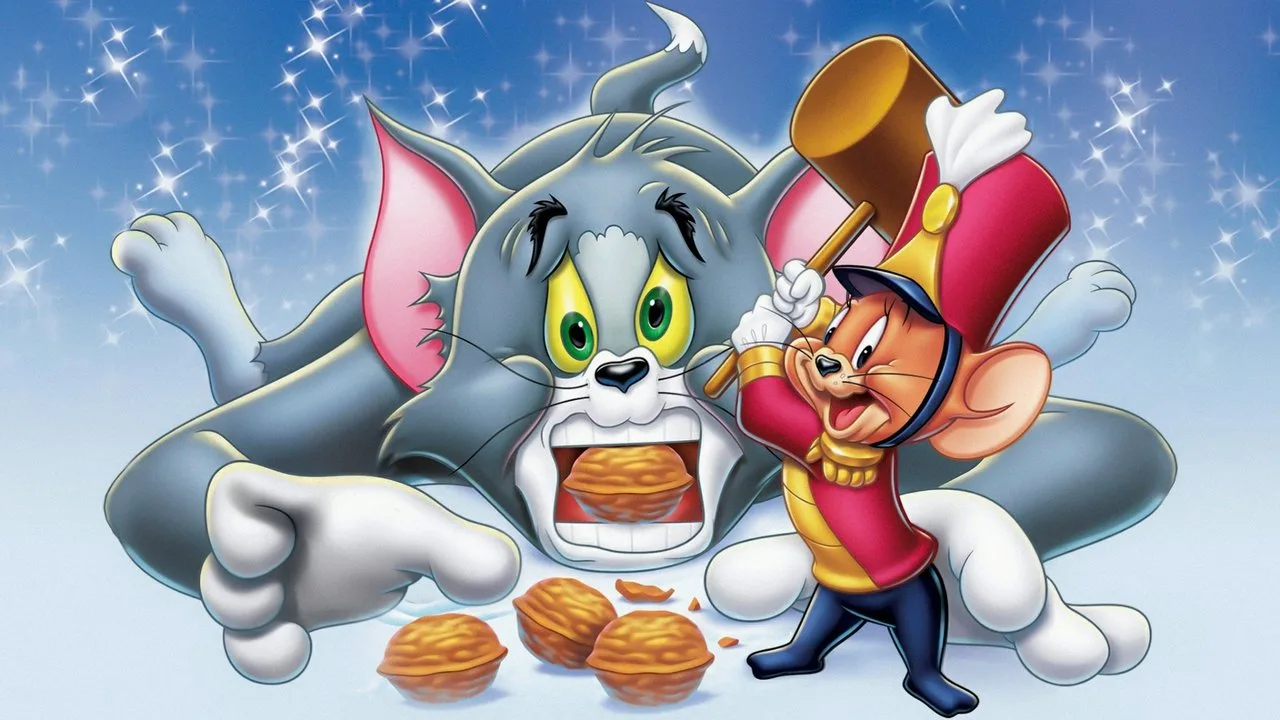
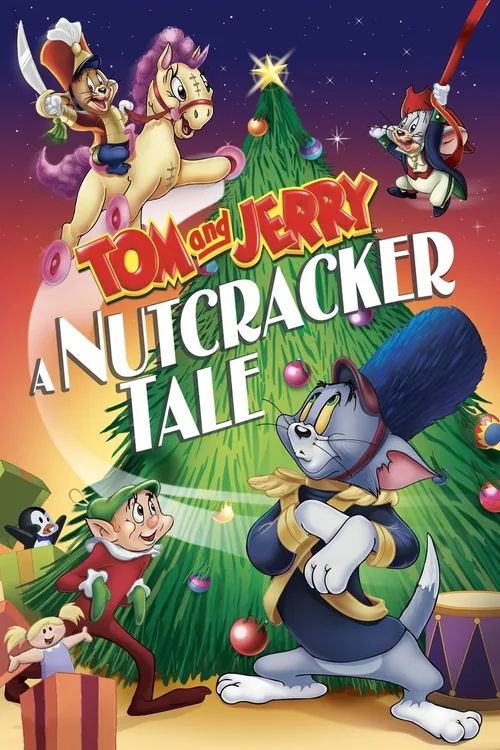
Ballet meets mayhem in the ultimate nutcracker battle!
Tom and Jerry: A Nutcracker Tale (2007)
Christmas is never so spirited as when Tom and Jerry lock horns for the holidays in their new original movie--Tom & Jerry: A Nutcracker Tale In an empty opera house, Jerry wishes for a chance to perform -- and magically his dream comes true. The little mouse is whisked away to an enchanted kingdom where anything is possible: candy forests, singing snowflakes, even the toys spring to life! Jerry has a great time with his new friends, and when Jerry dances with the music box ballerina, he is as happy as happy can be. Unfortunately, alley cats led by Tom crash Jerry's party, kidnap the music box ballerina and wreak havoc in the holiday kingdom. It's up to Jerry to set things right -- and with help from a fellow mouse named Tuffy and more newfound friends, Jerry just may win the day!
 rating 7/10 User rating 164 votes 68%
 ❄ Christmas Connection
The film is set on Christmas Eve and Christmas Morning, with the entire plot hinging on magic that expires at sunrise on Christmas Day. Santa Claus appears as the Toymaker who created Jerry's kingdom of living toys. Tchaikovsky's Nutcracker score plays throughout, making it as seasonally saturated as holiday specials get.
Where to Watch


Our Review
There is a version of Tom and Jerry: A Nutcracker Tale that could have been lazy holiday filler. Warner Bros. had the property, had a ballet score in the public domain, and had a direct-to-video slot to fill. The cynical move would have been to slap some snowflakes on a chase sequence and call it Christmas. Instead, the 2007 film does something more interesting: it commits fully to the operatic logic of Tchaikovsky's original ballet and trusts that children can follow a story with actual stakes.
The Setup That Actually Works
Jerry and his ward Tuffy fall into the world of a Nutcracker performance, landing in a wintry kingdom where toys and decorations are alive. Tom arrives with an army of stray cats led by the King of Cats, raids the feast, and takes over the kingdom. Jerry's only hope is to reach the Toymaker, who turns out to be Santa Claus, before sunrise on Christmas Morning. When the sun rises fully, the magic that created the kingdom fades permanently.
That ticking-clock structure is borrowed directly from E. T. A. Hoffmann's 1816 story "The Nutcracker and the Mouse King," and it gives the film real tension. The cats aren't just chasing Jerry for laughs. They're holding a kingdom hostage. The stakes are higher than the usual living-room destruction derby, and the film earns it.
The role reversals are smart. Jerry plays the heroic Nutcracker. Tom is recast as a henchman to the Cat King rather than the Mouse King of the original ballet. Tuffy, the little grey mouse who usually plays sidekick in the short films, gets a genuine arc. None of this requires a rewrite of who these characters are. Tom is still physically dangerous and comedically overconfident. Jerry is still fast, clever, and outgunned. The ballet's structure just happens to suit them well.
Tchaikovsky Played Straight
The score is the film's biggest gamble and its best asset. The music was performed by the Chamber Orchestra of Philadelphia and conducted by Dirk Brosse. This is not a synthesizer approximation or a pop cover version. The "Dance of the Sugar Plum Fairy," the "Waltz of the Snowflakes," the march sequences, all of it is played live and properly.
Directors Spike Brandt and Tony Cervone built the animation around the music rather than editing the music to fit existing gags. The result is sequences that feel choreographed rather than assembled. A chase through the toymaker's workshop tracks closely to the rhythmic pulse of the march. A quieter moment with the ballerina character uses the adagio without rushing it. For a 47-minute direct-to-video release, the musical discipline is serious.
The animation style comes from the second season of the Tom and Jerry Tales television series, which means it's cleaner and more modern than the original Hanna-Barbera theatrical shorts. The widescreen high-definition presentation helps. The toy kingdom, with its candy-stripe architecture and snow-dusted rooftops, looks genuinely good on a television screen in ways that not all Warner direct-to-video productions from this era managed.
Joseph Barbera's Final Credit
Tom and Jerry co-creator Joseph Barbera died on December 18, 2006, while the film was still in production. He was 95. A Nutcracker Tale became his last animated production credit, and the film carries a dedication to his memory.
The connection runs deeper than a closing title card. It was Barbera himself who pushed for the Nutcracker concept. According to director Spike Brandt, Barbera believed Tchaikovsky's music fit Tom and Jerry specifically, not as a generic holiday backdrop but as a score that matched the cartoon's physical comedy and timing. He was right. The slapstick chases sync to the Tchaikovsky rhythms with enough precision that you wonder why no one tried this pairing in the original theatrical shorts.
Barbera spent decades watching the character he created get adapted, updated, rebooted, and occasionally misunderstood. That his last project was also one of the more thoughtful Tom and Jerry productions since the theatrical era is a good ending to a very long career.
Where It Falls Short
The voice performances are functional but thin. Tom and Jerry themselves don't speak, as is traditional, but the supporting cast includes characters who exist mainly to explain what's happening. Paulie the pixie narrates plot points that the animation has already shown. Tuffy gets one emotional beat that the film doesn't quite earn in the time available.
At 47 minutes, the film is the shortest Tom and Jerry direct-to-video release. That brevity mostly works in its favor. There's no padding. But a few character moments that could have landed harder get trimmed to keep the pace. The ballerina character, voiced by Tara Strong, appears as a catalyst and then disappears from the story before she's done anything particularly memorable.
These are mild complaints for a film aimed at children who are already watching a Christmas movie at home. The target audience gets exactly what was promised: Tom chasing Jerry through a magical winter kingdom set to music they may not know yet but will probably recognize forever after.
Fun Facts
Tom and Jerry: A Nutcracker Tale was the last animated production that Joseph Barbera worked on before his death on December 18, 2006, at age 95. The film was dedicated to his memory and is the direct result of his decision to pursue a Nutcracker concept.
The film's score was performed by the Chamber Orchestra of Philadelphia and conducted by Dirk Brosse, making it one of the few direct-to-video animated productions of its era to use a live orchestra recording rather than a synthesized or licensed track.
At a runtime of approximately 47 minutes, A Nutcracker Tale holds the record as the shortest Tom and Jerry direct-to-video film ever produced.
The story is a loose adaptation of E. T. A. Hoffmann's 1816 novella "The Nutcracker and the Mouse King," but the Mouse King is reimagined as a Cat King, which conveniently places Tom on the villain's side without changing his character.
The film was shot in high-definition widescreen, the fourth Tom and Jerry production to use that format, and uses the character design style established in the second season of the Tom and Jerry Tales TV series.
Voice actress Tara Strong, who plays the ballerina character La Petite Ballerina, has also voiced characters in the Powerpuff Girls, Fairly OddParents, and Teen Titans, among dozens of other animated series.
Joseph Barbera originally conceived the Tom and Jerry characters with William Hanna in 1940 at MGM. The pair won seven Academy Awards for the original theatrical shorts between 1943 and 1952, making the property one of the most decorated in animation history.
The Wilhelm Scream, the famous stock sound effect used in hundreds of films since the 1950s, appears in the film during a sequence where cats fall off a cliff.
Cast