

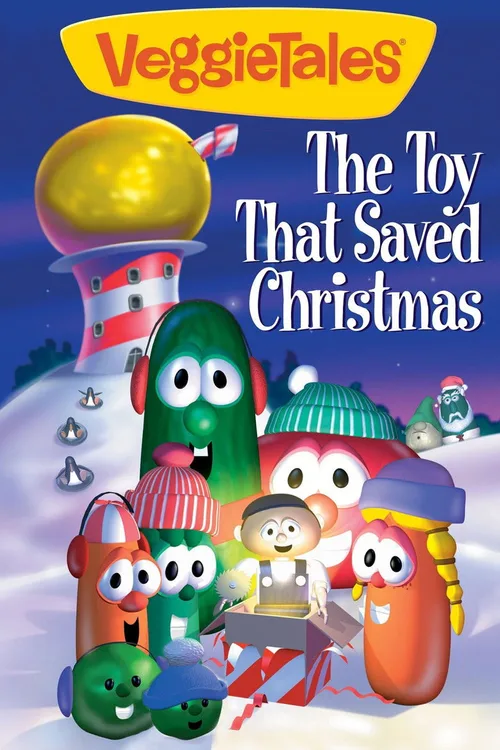
can a brave little toy find the true meaning of Christmas before it's too late?
VeggieTales: The Toy That Saved Christmas (1996)
Appearing in his own TV commercials, unscrupulous toy maker, Wally P. Nezzer has convinced all of Dinkletown that "Christmas is when you get stuff!" With the town's children begging for more toys, it's sure to be the worst Christmas ever -- until one brave little Buzz-Saw Louie doll decides to take matters into his own hands! The Toy That Saved Christmas reminds children of all ages that "Christmas isn't about getting; it's about giving.
 rating 7/10 User rating 14 votes 59%
 ❄ Christmas Connection
VeggieTales: The Toy That Saved Christmas is set entirely during the Christmas season, centered on toy manufacturing, gift-giving, and a retelling of the nativity story. The special directly engages with the question of what Christmas is actually for, contrasting consumerism against the birth of Jesus. It's about as Christmas-focused as a children's video can get.
Where to Watch


Our Review
In 1996, Big Idea Productions released VeggieTales: The Toy That Saved Christmas, a direct-to-video animated special built around a deceptively simple premise: what if the toy every kid wants for Christmas started asking uncomfortable questions about why Christmas exists at all? The result is one of the better pieces of Christian children's media produced in the 1990s, and it sold enough copies to cement VeggieTales as a genuine cultural force, not just a church-basement curiosity.
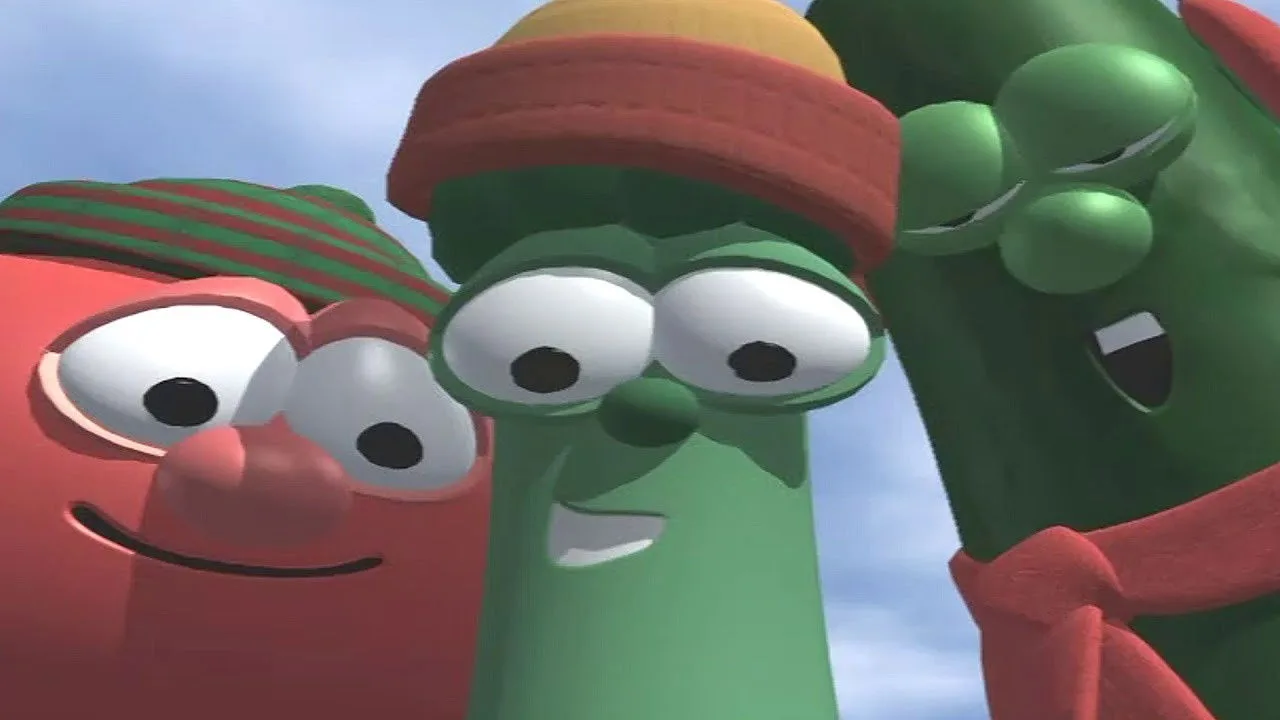
The premise works because it inverts the usual setup. Buzz-Saw Louie is the hottest toy of the season, manufactured by the cynical Mr. Nezzer (a recurring VeggieTales antagonist with a talent for missing the point). When Louie overhears that Christmas is really about giving rather than getting, he escapes the factory to find out whether anyone actually knows the true story. Bob the Tomato, Larry the Cucumber, and Junior Asparagus spend most of the special trying to catch up with him.
What VeggieTales Got Right About Talking to Kids
Phil Vischer and Mike Nawrocki, who co-created VeggieTales in 1993, had a specific theory about children's programming: kids can handle substance if you respect their intelligence. The Toy That Saved Christmas puts a fairly complete version of the nativity story on screen, including the shepherds, the magi, and Bethlehem, without dumbing it down into abstraction. The biblical material is presented as the actual answer to Louie's question, not as decoration around a more palatable secular message.
That directness was the whole VeggieTales brand identity. Bob and Larry didn't hedge. This worked commercially because the audience for explicitly Christian children's content in the mid-1990s was large and underserved. Christian bookstores moved enormous quantities of VeggieTales tapes. The franchise reportedly sold tens of millions of units by the end of the decade.
The humor is genuinely funny in places, which is what separates the better VeggieTales entries from the preachy ones. Larry's running gags and the mock-seriousness with which the vegetables treat their various predicaments give adults something to enjoy while the message lands for younger viewers. The jokes don't pause for the lesson; the lesson arrives inside the jokes.
Buzz-Saw Louie as a Character Who Actually Works
The special's smartest creative choice is making Louie a toy who wants to understand his own cultural context. He's not confused about whether he should be given as a gift. He's confused about what the gift is supposed to mean. That's a more sophisticated question than most children's holiday programming bothers to ask, and it gives the special a logical spine that holds the vignettes together.
Louie also has a wry delivery that keeps him from becoming saccharine. He's curious rather than preachy, which means the special can let the story of Christmas speak for itself instead of having a character explain how important it is every two minutes.
The Limitations Are Real
The animation was produced on very limited budgets using early CGI, and it shows. The character models are simple and the environments are sparse. This was the reality of Big Idea's operation in Lombard, Illinois in the mid-1990s. Vischer and his team were doing work that required significant computing power on hardware they could barely afford. The visual roughness doesn't kill the special, but it does date it clearly to its era.
The runtime is also short, around 30 minutes, which means some plot elements get resolved faster than they're set up. Mr. Nezzer's arc is compressed to the point where his change of heart reads more as plot requirement than character development. For adults watching alongside their children, that's noticeable.
The music is functional rather than memorable. The VeggieTales Silly Songs format that became a franchise trademark is present here but doesn't produce anything that sticks the way "I Love My Lips" or "The Pirates Who Don't Do Anything" would later. Larry's Silly Song in this entry is charming but skippable.
Why It Still Gets Watched
The special holds up because the core argument it makes is clear and it commits to it. VeggieTales didn't make The Toy That Saved Christmas to soften a Christian message for broader audiences. It made it for families who specifically wanted to watch something that treated the nativity as the literal point of December 25. That clarity of purpose gives it a coherence that a lot of holiday specials lack because they're trying to be everything to everyone.
It's also a genuine artifact of a specific moment in American Christian popular culture, when evangelical families were building parallel entertainment ecosystems and VeggieTales was the flagship product. The franchise reached 50 million videos sold by 2003. This special, along with A Very Veggie Christmas, was central to that growth. Any honest account of 1990s Christian children's media has to reckon with Bob the Tomato and Larry the Cucumber.
Junior Asparagus asking his grandfather to tell him the Christmas story, and the grandfather's telling it simply and without embellishment, remains the most effective sequence in the special. It doesn't try to be emotional. It just tells the story.
Fun Facts
VeggieTales was created in 1993 by Phil Vischer and Mike Nawrocki in Lombard, Illinois, using early CGI software at a time when Pixar was still years away from releasing its first feature film. The entire operation ran on consumer-grade hardware.
The VeggieTales franchise sold over 50 million videos by 2003, making it one of the best-selling direct-to-video children's series in American history. The bulk of that sales volume moved through Christian bookstores rather than mainstream retail chains.
Mr. Nezzer, the factory-owner villain of The Toy That Saved Christmas, was voiced by Phil Vischer himself, who also voiced Bob the Tomato. Vischer performed multiple characters across the VeggieTales catalog simultaneously.
Big Idea Productions, the company behind VeggieTales, filed for bankruptcy in 2003 after losing a lawsuit brought by its own marketing company. The intellectual property was purchased by Classic Media and later by DreamWorks Animation.
The special was released on VHS in 1996 as part of the sixth entry in the VeggieTales series, following a run of non-holiday episodes that had already built a substantial base of loyal buyers in the Christian retail market.
Mike Nawrocki, who co-created VeggieTales and voiced Larry the Cucumber, wrote and performed the Silly Song segments throughout the franchise, including the one featured in this special. Nawrocki continued voicing Larry through all subsequent VeggieTales productions.
The animation in early VeggieTales episodes was deliberately designed without arms or hands on the vegetable characters, partly for stylistic reasons and partly because animating limbs would have significantly increased the production cost and rendering time on the limited hardware Big Idea had available.
Cast