

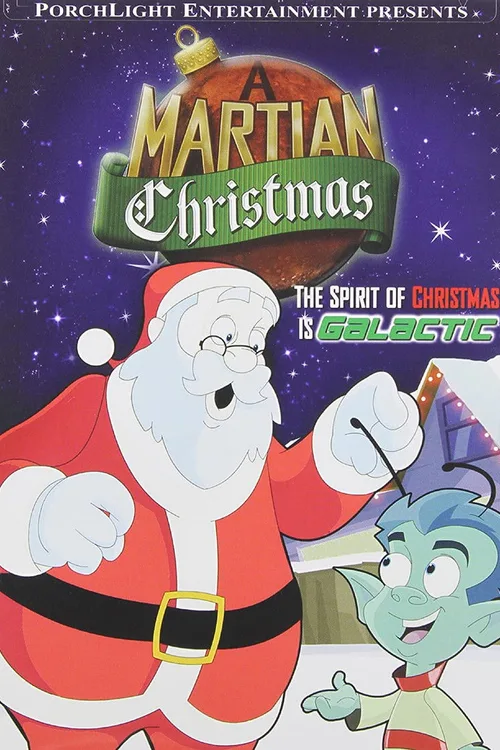
The Spirit of Christmas is galactic.
A Martian Christmas (2009)
A Martian kid and his father must prevent an impending Martian attack on Earth during the Christmas season.
 rating 4/10 0
 ❄ Christmas Connection
A Martian invasion fleet arrives on Earth during Christmas, forcing a Martian father and son to discover the holiday spirit and stop the attack with help from Santa Claus himself.
Our Review
When Mars Comes to Christmas
There is something oddly charming about a film that almost nobody has seen. A Martian Christmas, released direct-to-video in November 2009, is exactly that kind of movie -- a brisk, earnest 48-minute animated special that slipped through every crack in the entertainment industry and ended up as one of the rarest Christmas titles in circulation. It is not a masterpiece. It is not even particularly polished. But it has a heart that keeps beating through every awkward scene transition and recycled background plate.
The setup is as old as science fiction itself: Martians intercept an Earth probe and misread it as the opening move of an invasion. Commander Zork orders a preemptive strike fleet to destroy Earth -- only for the mission to land squarely in the middle of the Christmas season. His young son Kip stows away to spend time with his workaholic father, accidentally ejects himself to Earth's surface in a space pod, and suddenly the whole war is on hold while dad goes looking for his kid in a shopping mall. Christmas movies have been built on flimsier premises.
Outsiders Looking In
The film's best idea is also its simplest: let Christmas be discovered through alien eyes. When Kip wanders into a decorated town square for the first time, the familiar sight of colored lights and wrapped gifts becomes genuinely strange again. The script does not linger on this as long as it should, but the moments it does commit to land with unexpected warmth. There is a sequence where Kip tries to understand why humans give each other boxes wrapped in paper, and the explanation he receives -- that the point is not the box but the thought behind it -- is more direct and honest than most holiday specials manage in twice the runtime.
Zork's arc follows a well-worn path from distant parent to present father, but voice actor Dino Andrade grounds the character just enough to make the resolution feel earned rather than mechanical. The father-son dynamic is the film's actual spine, and it holds up better than the invasion plot surrounding it.
The Production Behind the Curtain
Understanding where this film came from explains a lot about its texture. A Martian Christmas is a co-production between Mexico's Anima Estudios, American distributor PorchLight Entertainment, and Irish post-production house Telegael -- an unusual triangle of creative geography for a Christmas special aimed at the English-speaking market. Anima Estudios, founded in 2002 in Mexico City, has since become Latin America's largest animation studio, with Netflix originals and a Batman co-production with Warner Bros. on its resume. In 2009, it was still building its international profile.
The animation shows the seams of its budget. Most of the film uses traditional 2D animation, but a handful of scenes were produced using Flash, and the difference in fluidity is noticeable when you know to look. Character designs are functional rather than distinctive, and backgrounds are reused more than they should be. Director Jose Alejandro Garcia Munoz keeps the pacing tight enough that these limitations rarely become distracting.
Voice Work and Music
The English-language voice cast is made up of seasoned animation professionals who do solid work with limited material. Cindy Robinson voices the young Martian Kip with genuine energy, and David Lodge handles the triple duty of Gleeb, the Martian Leader, and Santa Claus without any of the three feeling phoned in. Katie Leigh, a veteran of countless animated series since the 1980s, brings warmth to Roxy, one of the Earth children who helps Kip find his footing. The casting choices suggest that PorchLight understood the assignment even when the script did not fully deliver on it.
The music follows the template of holiday specials produced at this budget level -- original songs that aim for memorability and land somewhere in the vicinity of pleasant. None of it will follow you out of the room, but none of it actively works against the film either.
Should You Watch It?
The honest answer is: it depends on what you are looking for. A Martian Christmas is not a film that rewards close critical attention. Its story structure is lumpy, its first act buries the interesting material under too much backstory, and it never fully commits to any of its better ideas. Common Sense Media's reviewer noted that once the Martians actually reach Earth, the film picks up considerably -- which is accurate, and also a problem, since Earth does not appear until the halfway mark.
But for families with young children who have exhausted the major Christmas movie rotations, it offers something genuinely different: a holiday story told from the outside looking in, made by people who clearly believed in the project even if the market never quite found them. The message -- that Christmas kindness is legible even to someone who has never encountered it before -- is handled without irony or condescension. That is rarer than it sounds.
Rate it a curiosity rather than a classic. Watch it once, during the week before Christmas, with kids old enough to follow a plot but young enough to forgive its rough edges. It will not become anyone's annual tradition, but it earns a quiet spot in the catalog of holiday specials that tried.
The DVD release date of November 10, 2009 means A Martian Christmas arrived in stores exactly two weeks before Thanksgiving -- a window that may have contributed to its commercial obscurity, landing it between Halloween clearance and the peak holiday rush.
Fun Facts
The film is listed on the Lost Media Archive as "partially found" -- despite having received an official DVD release, a complete high-quality version has proven extremely difficult to locate, making it one of the rarest Christmas animations from the 2000s.
Production spanned three countries: the animation was handled primarily by Anima Estudios in Mexico City, distribution was managed by PorchLight Entertainment in the United States, and post-production facilities were provided by Telegael in Ireland.
Anima Estudios, the primary animation studio on the project, is now recognized as Latin America's largest animation studio -- but in 2009 it was still relatively early in building its international co-production track record.
A small number of scenes in the film were animated using Adobe Flash rather than traditional 2D methods, creating subtle but visible differences in character movement within the same runtime.
Despite being labeled a "TV Movie" in most databases, no confirmed television broadcast of the film has ever been documented, and its actual air date and network remain unknown as of 2026.
Voice actor David Lodge voiced three separate characters in the film -- Gleeb, the Martian Leader, and Santa Claus -- making him responsible for both the primary comic sidekick and the film's most iconic human figure.
The film was announced in The Hollywood Reporter on October 6, 2008, more than a year before its November 2009 DVD release, suggesting a longer production pipeline than its modest final runtime might imply.
Cindy Robinson, who voiced the young Martian protagonist Kip, is also known for her extensive work in video game voice acting, including the English voice of Amy Rose in the Sonic the Hedgehog franchise since 2010.
Cast