

Ever wonder how 2 Billion presents get delivered all in 1 night?
Arthur Christmas (2011)
For hundreds of years, the Claus family has delegated the title "Santa" to a chosen few of its members, which can be passed down upon retirement. Each Christmas, Santa and his vast army of highly trained elves produce gifts and distribute them around the world in a one-night high-tech operation. However, when one of 600 million children to receive a gift from Santa on Christmas Eve is missed, it is deemed ‘acceptable’ to all but one—Arthur Claus, the current Santa’s misfit son deemed ineligible for the title, who executes an unauthorised rookie mission to get the last present halfway around the globe before dawn on Christmas morning.
 rating 8/10 User rating 1,605 votes 68%
 ❄ Christmas Connection
Arthur Christmas is Christmas to its core. The entire plot revolves around the Claus family's global gift-delivery operation on Christmas Eve, and the film's central question is whether every single child matters enough to receive their present on time.
Where to Watch


Our Review
Arthur Christmas opens with a question that sounds like a logistics exam: how do you deliver two billion presents in one night? Most Christmas films treat that as a throwaway miracle. Director Sarah Smith and co-writer Peter Baynham built an entire 2011 animated film around taking it seriously, and the result is one of the sharpest, funniest Christmas movies of the last two decades.
Santa's Operation as Military Machine
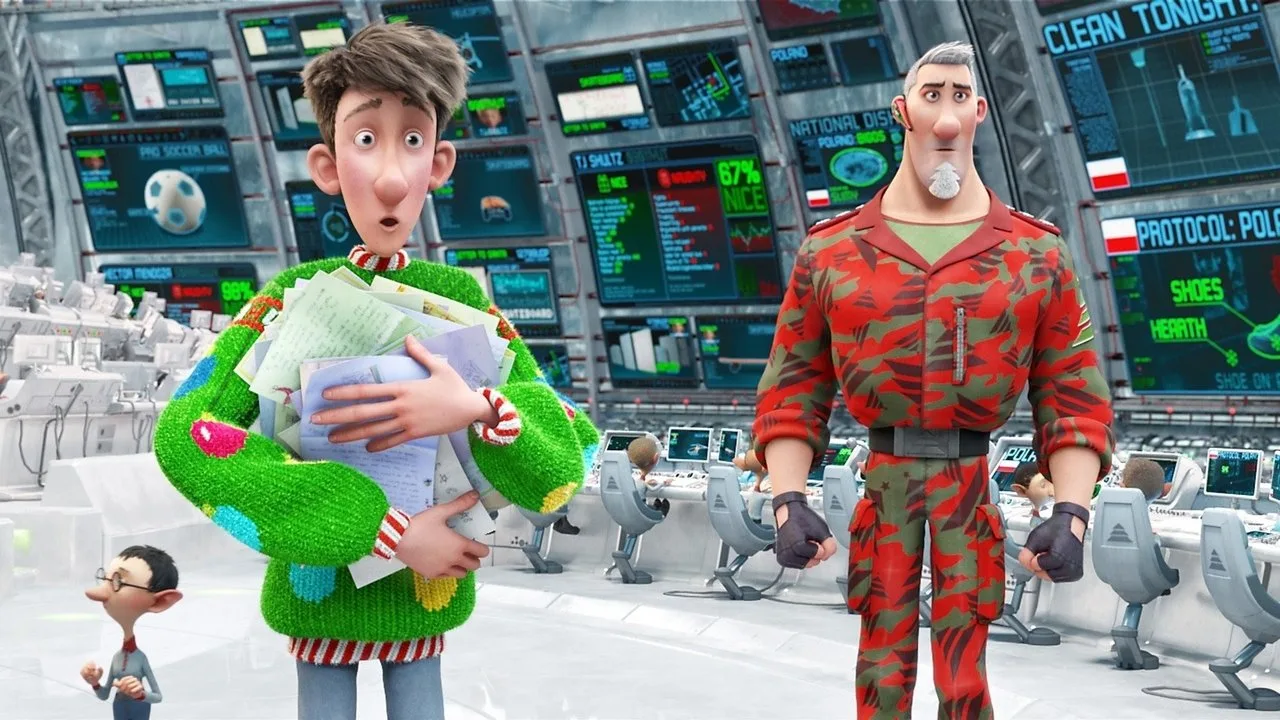
The North Pole in Arthur Christmas is not a cozy workshop. It is a subterranean command center staffed by thousands of elves who operate with the discipline of a special forces unit. Presents are delivered from the S-1, a mile-wide stealth spacecraft that hovers silently over cities while elf teams rappel down on wires, slip through windows, and place gifts with surgical precision. Each elf carries a HOHO 3000 tablet. Each mission is GPS-tracked. The entire operation runs on protocol, hierarchy, and ruthless efficiency.
This is the film's masterstroke. By treating Santa's job as an actual logistical problem, Smith and Baynham create a world that feels internally consistent and absurdly funny at the same time. The opening delivery sequence in a quiet English town plays like a heist movie, and it's genuinely thrilling.
The Arthur Christmas Cast and the Claus Family Dysfunction
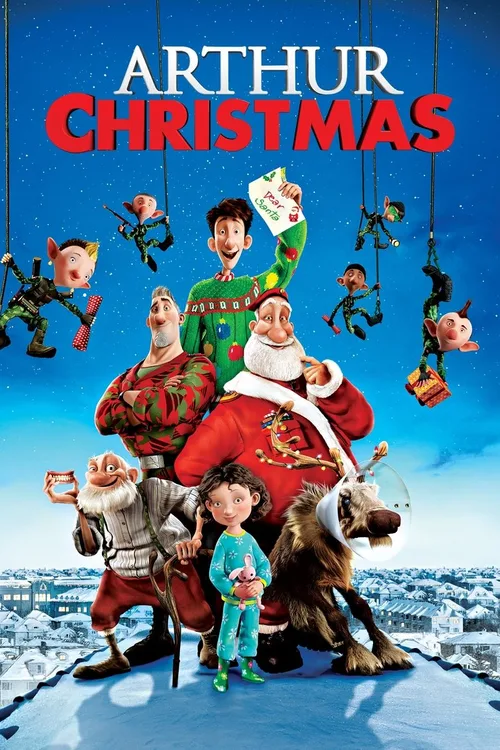
The Claus family functions like a corporation with a succession crisis. Malcolm (Jim Broadbent), the current Santa, is a genial figurehead who barely understands the technology keeping his legacy alive. Steve (Hugh Laurie), the eldest son, runs the entire operation from mission control and has been waiting years for his father to retire. Arthur (James McAvoy), the younger son, works in the mailroom answering children's letters by hand, a job nobody else considers important.
Then there is Grandsanta (Bill Nighy), a 136-year-old retired Santa who keeps his old wooden sleigh and eight reindeer hidden in a barn. He thinks the S-1 is an abomination. He misses the days when delivering presents meant getting shot at over the trenches.
The family dynamic is where the film quietly becomes something more than a holiday comedy. Steve is competent but treats children as data points. Malcolm has the title but not the talent. Arthur has the heart but not the confidence. Grandsanta has the stubbornness but not the relevance. Every member of this family represents a different answer to the question of what Santa Claus should actually be.
One Missed Present and Why It Matters
The plot kicks in when the S-1's flawless system misses one child: Gwen Hines, a girl in Trelew, England, whose wrapped bicycle sits unclaimed in the hold. Steve's position is coldly rational. One child out of two billion is a 0.0000000005% error rate. Statistically, the mission was perfect.
Arthur's position is simpler. Gwen wrote a letter. She believes in Santa. She deserves her present.
So Arthur, Grandsanta, a wrapping-obsessed elf named Bryony (Ashley Jensen), and eight elderly reindeer set off in a rickety wooden sleigh to cross the globe before sunrise. The journey is predictably chaotic, bouncing from the Serengeti to Mexico to Cuba, and the comedy mines each stop for all it's worth. But the film never loses sight of its argument: that the whole point of Christmas is caring about individuals, not managing populations.
What Aardman Brought to a Sony Production
Arthur Christmas was Aardman Animations' second CGI feature after Flushed Away, and the collaboration with Sony Pictures Animation shows in every frame. The character designs are distinctly Aardman. Arthur is gangly and awkward, with the slightly lopsided look of someone who was assembled rather than designed. The elves are uniformly tiny and enthusiastic. Grandsanta looks like a walnut with opinions.
Aardman spent 18 months on pre-production in Bristol before the team relocated to Sony's Culver City studio for another 18 months of production. The result is a film that moves with the speed and polish of a big-budget American animated feature but feels unmistakably British in its humor. The jokes are dry, the family arguments are passive-aggressive, and everyone keeps offering cups of tea during a global crisis.
Why Arthur Christmas Deserves to Be a Seasonal Standard
The film earned $147 million worldwide against a $100 million budget, which was enough to keep Sony happy but not enough to launch a franchise. No sequel materialized, despite director Smith expressing interest in a Grandsanta prequel. It holds a 92% score on Rotten Tomatoes, where it won the Golden Tomato for best-reviewed animated film of 2011.
Despite all that, Arthur Christmas still gets treated as a second-tier Christmas film, overshadowed by the Rankin/Bass classics and the Pixar-era heavyweights. That's a shame. The film does something genuinely rare: it builds a fully realized world around the Santa mythology, fills it with complicated characters, and then asks a moral question worth asking. The answer Arthur gives, that every single child matters, is exactly the right amount of sentimental for a Christmas movie. He believes it without being naive about it.
The last image that sticks is Arthur's reindeer slippers. They have googly eyes that wobble when he walks. He wears them throughout the most stressful night of his life. That's the kind of detail that separates a good animated film from a great one.
Fun Facts
The S-1 spacecraft in the film is described as being one mile wide, making it one of the largest fictional vehicles ever depicted in an animated film.
Director Sarah Smith spent three years developing the story with co-writer Peter Baynham before production even began at Sony's Culver City studio.
Composer Harry Gregson-Williams replaced Michael Giacchino at the last minute and scored the entire film on a compressed timeline, using an 80-piece orchestra.
The opening elf delivery sequence contains a deliberate homage to Aardman's own Wallace and Gromit: an elf lays model train tracks while riding the train, mirroring a famous scene from The Wrong Trousers.
Arthur Christmas was Aardman Animations' second computer-animated feature film, following Flushed Away in 2006. The studio is best known for stop-motion clay animation.
The film's animators gave Arthur's reindeer slippers their own subtle animations throughout the movie, with the googly eyes reacting independently to the action around them.
In the opening sequence, the classic 1982 animated short The Snowman can be spotted playing on a television as the elves work.
Cast