
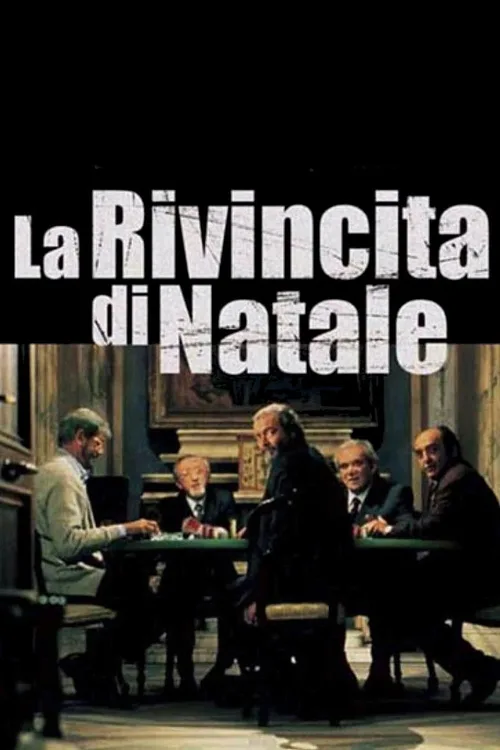
Christmas Rematch (2004)
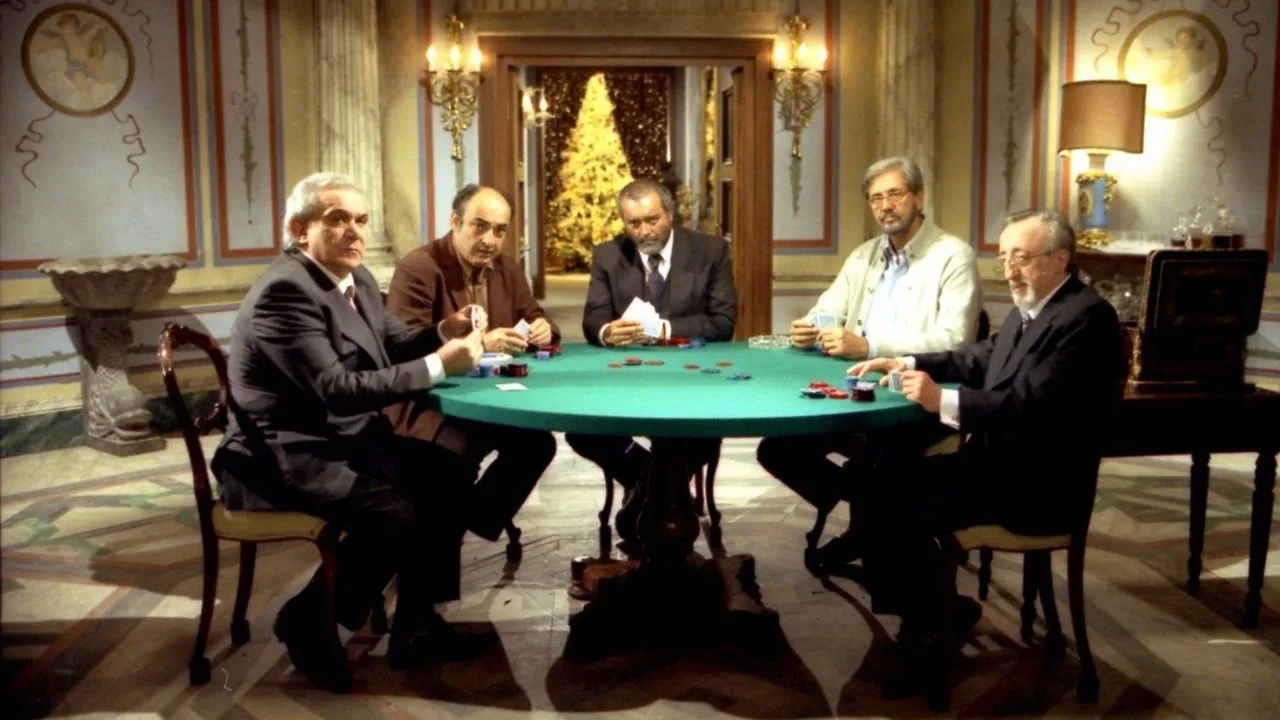
15 years after that fateful card game on Christmas Eve, Franco gets his onetime friends back at the poker table for the rematch and a long-awaited payback.
 rating 7/10 User rating 112 votes 68%
 ❄ Christmas Connection
The film is set during the Christmas season and uses the holiday as a structural anchor, pulling five old acquaintances back together for a Christmas Eve poker rematch after 17 years. Christmas here is not about decorations or sentiment -- it's the one time of year these men will actually show up, which makes the season feel almost menacing. The title itself frames Christmas as a deadline, a reckoning.
Our Review
Eighteen years is a long time to nurse a grudge, but Franco Mattioli in Christmas Rematch has been doing exactly that. Pupi Avati's 2004 sequel to his 1986 masterwork Regalo di Natale (known internationally as Christmas Present) opens with Franco -- played again by Diego Abatantuono -- now a wealthy Lombardy cinema chain owner, still carrying the wound of that first Christmas Eve card game where he lost a fortune to a group of men who, it turns out, were colluding against him. Then a stranger walks into his life claiming to be Lele Bagnoli's oncologist. Lele is dying. And suddenly Franco sees his chance.
The premise is almost operatically Italian. A dying man's secret, used as leverage to assemble five middle-aged schemers around a poker table on Christmas Eve. Avati builds it with the patience of someone who knows exactly how good the material is.
The Sequel Problem (And How Avati Solves It)
Sequels made nearly two decades later have a specific failure mode: nostalgia overwhelms story. The first film becomes a monument the new one can't stop genuflecting toward. Christmas Rematch mostly avoids this. Avati and his regular collaborator Antonio Avati wrote a script that treats the original events as psychological scar tissue rather than a highlight reel to revisit. The characters are older, their circumstances have shifted, and the cheating that defines the plot is nastier because everyone in the room has learned something since 1986.
The 1986 original premiered at the Venice Film Festival, where Carlo Delle Piane took the Volpi Cup for Best Actor. That film had genuine prestige weight behind it. The sequel arrived without Venice, without the immediate critical buzz, but with something useful: the accumulated context of what happened to these people in the intervening years. Avati trusts the audience to remember, or to figure it out.
Abatantuono Carries the Film
In 1986, Diego Abatantuono won a Nastro d'Argento for Best Supporting Actor in Regalo di Natale. That film was the turning point of his career. He had spent most of the early 1980s in broad Italian comedies, the kind of popular but disposable genre films that critics dismiss and audiences watch anyway. Avati's original showed he could do something else entirely. By 2004, Abatantuono had been in Gabriele Salvatores' Academy Award-winning Mediterraneo (1991) and was an established dramatic presence.
His Franco in Christmas Rematch is a man who has won in almost every measurable way since the original game and still can't let it go. Abatantuono plays this with a kind of controlled menace. There's nothing sympathetic about what Franco is doing, and yet Avati's script, and the performance, keep making you understand him. Variety's review noted that Abatantuono has "the serious poise of a mature actor who is able to make even a multiplex exhibitor sympathetic." That's exactly right.
Alessandro Haber as the ailing Lele brings the film its one note of genuine pathos. A dying man whose loose tongue set this whole machinery in motion is a good character, and Haber finds the right register -- not weepy, not noble, just a person who made a mistake while dying and now has to watch the consequences arrive.
The Poker As Mechanism
Avati is not interested in poker strategy. He's interested in what happens to people who pretend to trust each other when they don't. The card game in Christmas Rematch is rigged from multiple directions at once, and the film's third act involves untangling who is cheating whom in which combination. Variety described the poker match as "booby-trapped with twists which reveal the cheating souls of just about everybody" and called it "clever but a bit complicated for non-players."
That's probably fair. If you don't know the basics of poker tells and table dynamics, some of the tension won't land. But the final double-cross -- which Variety was careful not to spoil -- earns the film's runtime. It reframes the preceding 80 minutes without requiring you to retroactively dismiss them, which is harder to pull off than it sounds.
Bologna in December
Avati was born in Bologna in 1938, and his cinema keeps returning there. The Regalo di Natale universe is set in the city's wealthy apartments and professional circles -- lawyers, cinema owners, critics, men who consider themselves cultivated. The Christmas setting is specifically northern Italian bourgeois Christmas: private, indoor, expensive, short on religious sentiment and long on social performance.
This is not a film about family warmth or holiday magic. The only Christmas element that matters is that it's the one night per year these five men will agree to be in the same room. Avati uses the holiday as a kind of social forcing function, and the contrast between Christmas and what actually happens in that room is the film's sharpest joke.
Riz Ortolani's score -- soft jazz, deliberately low-key -- reinforces the atmosphere. Ortolani was nominated for a David di Donatello Award for Best Original Score, which tells you something about the Italian film industry's appreciation for Avati's universe even when the sequel wasn't matching the original's critical ceiling.
Worth Seeing Without the Original?
No. This is not an entry point. The emotional stakes depend on knowing what happened in 1986, what was lost, and who did what to whom. Watch Regalo di Natale first. It holds up better than most Italian films of that era and is genuinely one of the better ensemble dramas about how men perform friendship for each other while actively working against everyone in the room.
Christmas Rematch is the lesser film. It runs 99 minutes and feels it occasionally. The setup takes longer than it needs to, and some of the supporting characters from the original feel thinned out in the transition. But when Avati gets to what he's good at -- five people in a room, the lights low, everyone lying -- it delivers.
For those who loved the original, seeing Abatantuono and Delle Piane back in the same frame eighteen years later has its own specific pleasure. Italian cinema rarely bothers with sequels to mid-budget literary dramas. The fact that Avati came back to these characters at all says something about how attached he remained to the world he built in 1986.
Fun Facts
The original 1986 film, Regalo di Natale, premiered at the 43rd Venice Film Festival, where Carlo Delle Piane won the Volpi Cup for Best Actor -- one of the most prestigious acting awards in European cinema.
Diego Abatantuono won his first Nastro d'Argento (Italy's equivalent of the BAFTA) for Best Supporting Actor in the original 1986 film, and the role of Franco in both films remains among his most acclaimed dramatic performances.
Pupi Avati started his career directing jazz-themed television and playing clarinet in a band before ever making a film. His first feature was a horror movie in 1968, a significant stylistic departure from the intimate domestic dramas he later became associated with.
Riz Ortolani, who composed the film's score, was also the composer behind the infamous 1980 horror film Cannibal Holocaust -- one of the most unlikely resumes in Italian film music, bridging exploitation horror and tasteful chamber jazz for a Christmas drama sequel.
A spin-off titled Chi salverà le rose? (Who Will Save the Roses?) was released in 2017, focusing on the character of lawyer Santelia from the poker game universe, extending Avati's small franchise to a third film more than 30 years after the original.
The film was released in Italian theaters on January 30, 2004 -- over a month after Christmas -- an unusual release window for a film so specifically set during the holiday season.
George Eastman, who plays Antonio Santelia in the film, is best known internationally under his real name Luigi Montefiori, a prolific Italian genre actor who appeared in dozens of spaghetti westerns and exploitation films before Avati cast him in more restrained dramatic work.
Cast