
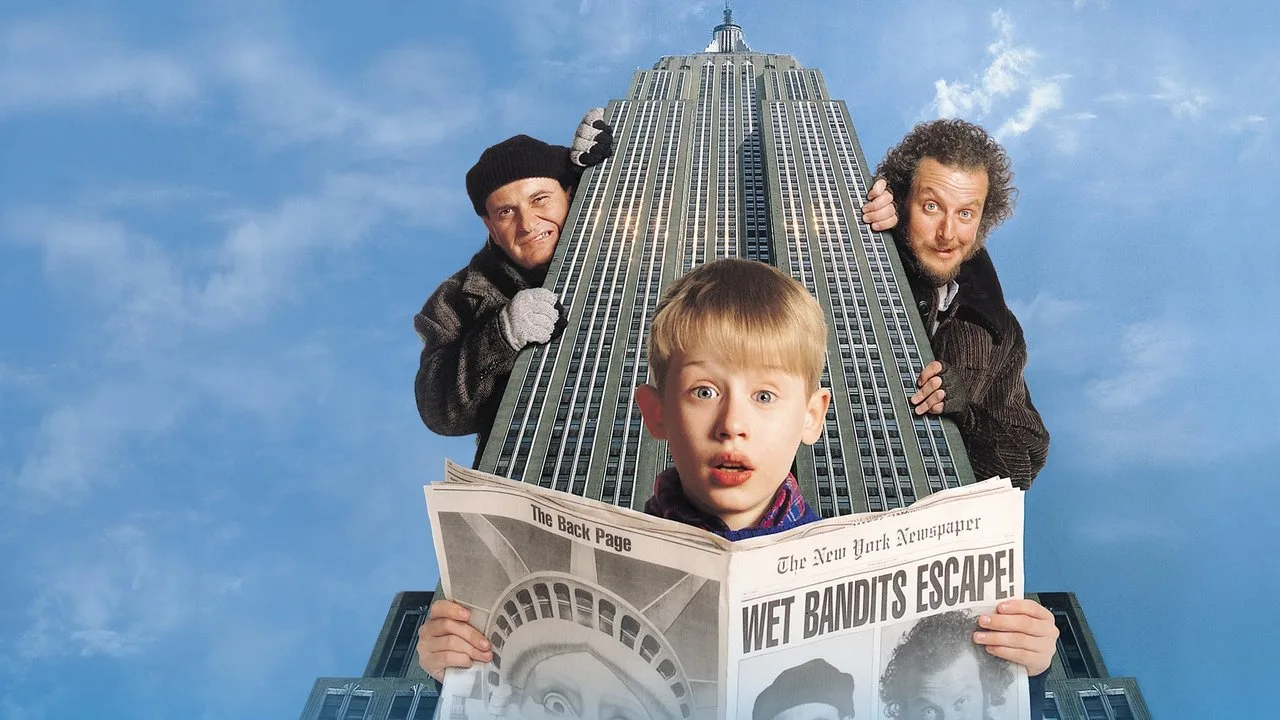
He's up past his bedtime in the city that never sleeps.
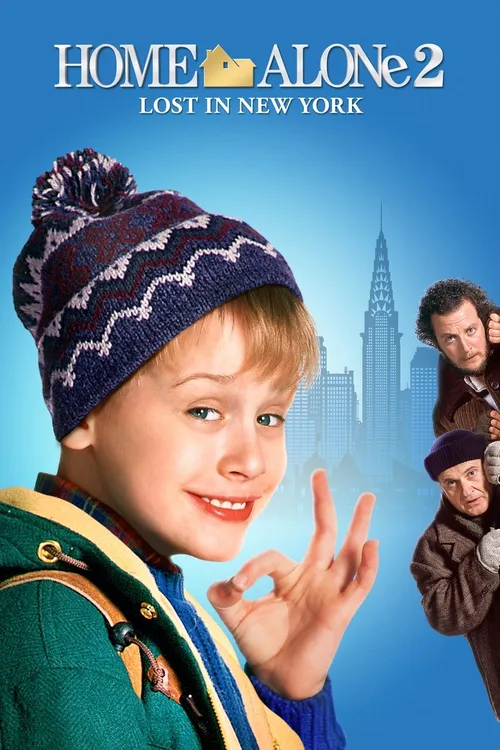
Home Alone 2: Lost in New York (1992)
Instead of flying to Florida with his folks, Kevin ends up alone in New York, where he gets a hotel room with his dad's credit card—despite problems from a clerk and meddling bellboy. But when Kevin runs into his old nemeses, the Wet Bandits, he's determined to foil their plans to rob a toy store on Christmas Eve.
 rating 7/10 User rating 10,463 votes 68%
 ❄ Christmas Connection
Set entirely during the Christmas season in New York City, the film revolves around Rockefeller Center's tree, the Plaza Hotel at the holidays, and a toy store donation to a children's hospital. Every frame drips with Christmas in Manhattan.
Where to Watch


Our Review
Home Alone 2: Lost in New York is, by any honest accounting, the same movie as the original. Kid gets separated from family. Kid outsmarts burglars. Burglars suffer injuries that should require hospitalization. And yet the 1992 sequel grossed $359 million worldwide, because sometimes doing the exact same thing in a bigger city is exactly what audiences want.
John Hughes wrote the script. Chris Columbus directed again. Macaulay Culkin returned as Kevin McCallister, now ten years old, armed with his dad's credit card and an even more elaborate set of booby traps. The only real change? The setting moved from suburban Chicago to midtown Manhattan during Christmas week. That turned out to be more than enough.
Home Alone 2 Cast and the New York Setup
The McCallister family is heading to Florida for Christmas this time. Kevin, distracted at the airport, boards the wrong plane and lands at LaGuardia instead of Miami. He talks his way into the Plaza Hotel using Peter McCallister's credit card, a scenario that would trigger about fifteen fraud alerts in 2026 but passed without question in 1992.
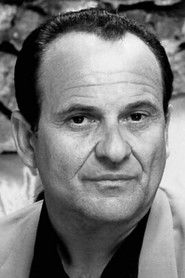
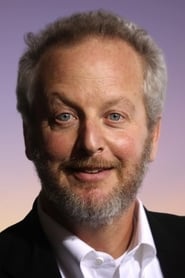
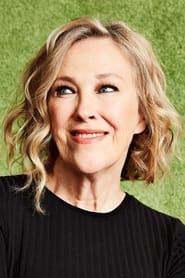
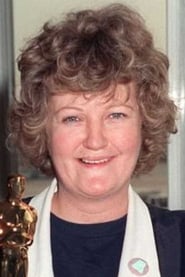
The returning cast does solid work. Joe Pesci and Daniel Stern are back as Harry and Marv, now calling themselves the Sticky Bandits. Catherine O'Hara once again plays the panicking mother. Tim Curry joins as the Plaza's suspicious concierge, delivering every line like he's in a different, better movie. Brenda Fricker rounds out the newcomers as the Pigeon Lady of Central Park, filling the Shovel Man role from the first film.
Rob Schneider shows up as a bellhop. Eddie Bracken plays Mr. Duncan, the kindly toy store owner. And yes, there is a brief cameo in the Plaza lobby from the building's then-owner, who points Kevin toward the lobby. That three-second scene has generated more discourse online than most actors' entire careers.
Christmas in New York: The Real Star of the Film
The movie's strongest asset is its location. Columbus and cinematographer Julio Macat shot on location throughout Manhattan in December 1991, and the results are gorgeous. The Rockefeller Center Christmas tree. The decorated storefronts of Fifth Avenue. Central Park blanketed in snow. Carnegie Hall lit up at night. This is Christmas in New York at its most idealized, and the film captures it with a warmth that still makes the city look magical.
The fictional Duncan's Toy Chest, modeled on FAO Schwarz, becomes a plot device with genuine heart. Mr. Duncan tells Kevin that the store's Christmas Eve proceeds go to a children's hospital. This gives Kevin a reason beyond survival to stop Harry and Marv, who plan to rob the store that night. It's a smarter motivation than the first film provided, connecting the slapstick to actual stakes.
John Williams' score deserves special mention. His arrangements of traditional Christmas music throughout the film, particularly during the tree-lighting scene and the Central Park sequences, elevate what could be pure comedy into something that actually feels like a Christmas movie. The moment Kevin stands alone in Rockefeller Center staring up at the tree, Williams' score swelling underneath, is one of the most purely Christmas images in 1990s cinema.
The Booby Traps: Bigger, Meaner, Less Believable
Hughes and Columbus clearly felt the need to escalate. The brownstone trap sequence in the third act makes the original's house of horrors look restrained. Bricks thrown from a rooftop hit Marv in the face four separate times. Harry's head gets set on fire. A staple gun, an electrified sink, and a toolbox on a rope all make appearances. Kerosene, a blowtorch, and an exploding toilet round out the arsenal.
The traps are funny in the way a Roadrunner cartoon is funny. They've completely abandoned any pretense of realism. A real person hit in the skull with a brick from three stories up would not get up and keep climbing. But Daniel Stern's physical comedy sells it. His scream after stepping on the electrified metal is genuinely hilarious, and he reportedly ad-libbed much of his pain reactions throughout the sequence.
The issue is diminishing returns. The first Home Alone's traps felt almost plausible, the work of a clever kid using household items. The sequel's traps feel like they were designed by a Looney Tunes writer with an unlimited budget. That's not necessarily a complaint. It's just a different kind of movie.
The Pigeon Lady and the Sentimental Core
Every Home Alone movie needs a misunderstood outcast who teaches Kevin something about connection. In the sequel, that's Brenda Fricker's Pigeon Lady, a homeless woman living in Central Park who feeds the birds and avoids human contact. Kevin befriends her, she shares her story about lost love, and she eventually saves him from Harry and Marv in the film's climax.
Fricker, who had won the Academy Award for Best Supporting Actress just two years earlier for "My Left Foot," brings genuine pathos to a role that could have been disposable. Her monologue about being afraid to love again after heartbreak is the most emotionally honest scene in either Home Alone film. It's a strange thing to find in a movie where a man gets electrocuted by a car battery five minutes later, but it works.
The final scene between Kevin and his mother at the Rockefeller Center tree is pure sentiment, but it earns its emotion through 100 minutes of a kid genuinely on his own in the largest city in the country. When Kevin opens his hand to show his mom the turtle dove ornament, the callback to the toy store scene lands because the film bothered to set it up properly.
Fun Facts
The production paid the Plaza Hotel $100,000 per day to film in the lobby and guest rooms. The hotel's operators considered it worthwhile for the global advertising the film would provide.
Macaulay Culkin was paid $4.5 million for the sequel, a massive jump from the roughly $100,000 he received for the original Home Alone. His salary made him the highest-paid child actor in history at the time.
Brenda Fricker spent hours each shooting day having pigeons placed on her by animal handlers. She later said in interviews that she was genuinely afraid of the birds throughout filming.
The brownstone used for the trap sequence was a real abandoned building on the Upper West Side. The production crew rigged it with mechanical effects over several weeks before filming the slapstick sequences.
Daniel Stern's scream when the staple gun hits him was real. According to Stern, the prop staple gun malfunctioned and actually fired a staple near his nose, and Columbus kept the genuine reaction in the final cut.
John Williams composed the original score in just three weeks to meet the film's tight post-production schedule. He reused and rearranged several themes from the first Home Alone score alongside new compositions.
The movie was the third highest-grossing film of 1992, behind "Aladdin" and "Batman Returns." It earned $173 million domestically and $186 million internationally.
Duncan's Toy Chest exterior was actually the FAO Schwarz store at 767 Fifth Avenue, dressed with additional signage for the film. The real FAO Schwarz closed that location in 2015.
Cast