

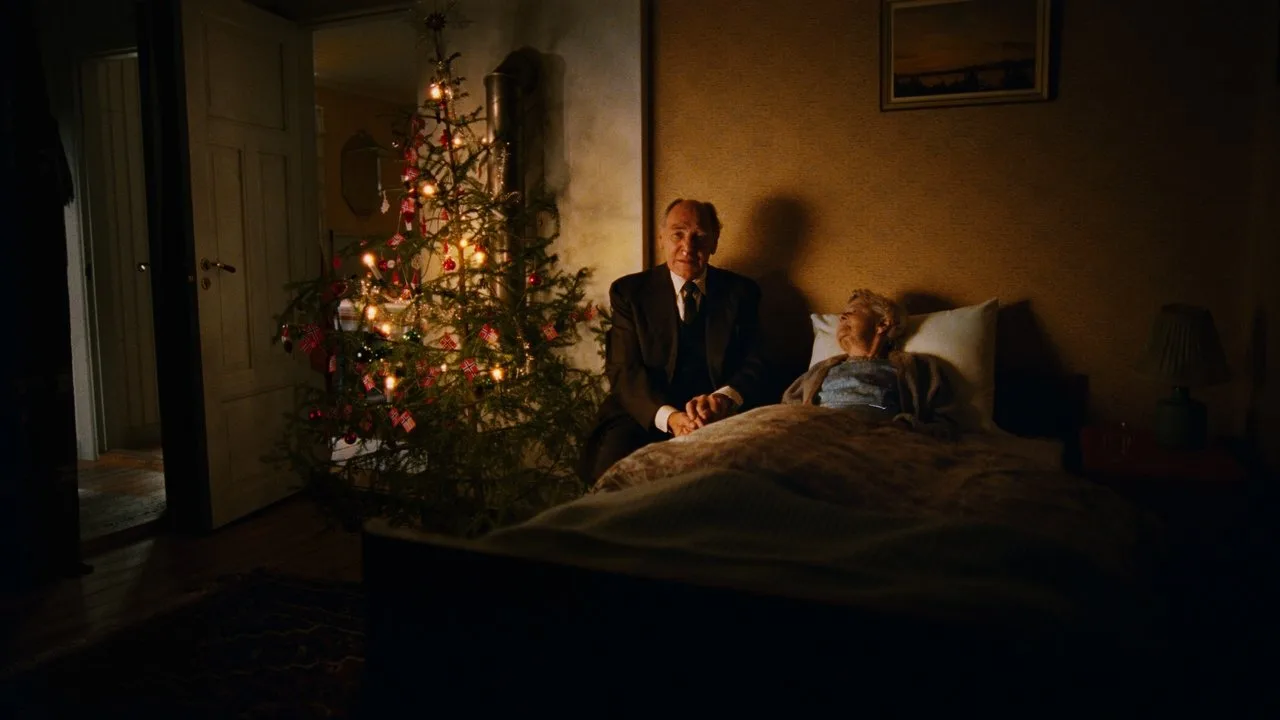

Home for Christmas (2010)
Adapted from a series of short stories by Norwegian author Levi Henriksen, Bent Hamers Home for Christmas weaves together the lives of people struggling to find their way home on a Christmas Eve, beneath the colors of the Northern Lights. The plot unfolds during a few afternoon hours on Christmas Eve. The individual stories, which at times intertwine, are set in the small town Skogli. The characters in the stories cover a great range in age and life situations, representing both reconciliation with their own lives and strong frustration. Some show the will to understand and do something about their lives, while others have given up. Deeply tragic and melancholy aspects are mixed with humour and rather frivolous solutions.
 rating 7/10 User rating 25 votes 57%
 ❄ Christmas Connection
The entire film takes place over a single Christmas Eve in a small Norwegian town, with every storyline driven by characters trying to get home, reconnect with loved ones, or simply survive the holiday. Christmas is not the backdrop here but the engine: the holiday's pressure to be somewhere and to be someone creates every conflict in the film.
Our Review
The film opens in war-torn Yugoslavia. A small boy named Goran drags a Christmas spruce through a deserted factory yard. A sniper's crosshairs find him. Then the film cuts to Norway, to snow, to ordinary people with ordinary problems, and you spend a moment recalibrating what kind of movie you're watching. That disorientation is deliberate. Home for Christmas (Norwegian: Hjem til jul), directed by Bent Hamer and released in 2010, is a film about the gap between the Christmas you imagine and the one you actually live.
Six Stories, One Christmas Eve
The film is built from short stories. Norwegian author Levi Henriksen wrote the source material, a collection called Only Soft Presents Under the Tree, which imagines the residents of a fictional small town called Skogli over a few hours on December 24. Hamer adapts six of them, running them in parallel, letting them occasionally graze each other before pulling apart again.
Dr. Knut (Fridtjov Saheim) gets pulled away from his Christmas Eve plans to deliver a baby. His friend Paul (Trond Fausa) is freshly separated and burning with the need to see his children. Karin (Nina Andresen Borud) spends the evening preparing for a night with her married lover, who has promised to leave his wife after Christmas. A bedraggled alcoholic named Jordan is trying to get home and runs into his childhood friend Johanne (Ingunn Beate Oyen). Schoolboy Thomas lies to his Muslim classmate Bintu about his family never celebrating Christmas so they can spend the holiday together. And Goran, now grown, has made it from Yugoslavia to Norway, still carrying something from that factory yard.
None of these stories resolves neatly. That's the point.
What Bent Hamer Does That Nobody Else Does
Hamer was born in Sandefjord in 1956 and trained at the Stockholm Film School. He is the kind of director critics reach for Aki Kaurismaki comparisons to describe, which is fair and also slightly lazy. His deadpan is distinctly Norwegian: quieter, less theatrical, more interested in the pause before someone speaks than in the speech itself. Film historian Peter Cowie has compared Hamer's characters to those of Jacques Tati, which gets closer to the truth. His people are not eccentric for effect. They are just slightly misaligned with the world around them.
Kitchen Stories (2003), his international breakthrough, sent Swedish efficiency researchers into Norwegian farmhouses to observe how bachelors use their kitchens. It won best film at the Amanda Awards, Norway's equivalent of the BAFTA, and was submitted as Norway's Academy Award entry. O'Horten (2007) followed a retiring train engineer through the strangest weeks of his life. Both films are recognizably from the same sensibility as Home for Christmas: quiet accumulation, small gestures carrying enormous weight, comedy that arrives without announcing itself.
The Christmas setting suits him perfectly. Christmas is, structurally, a Bent Hamer situation: enormous social expectations, people who don't quite fit together, rituals performed with varying degrees of sincerity, and the persistent suspicion that everyone else is having a better time.
Is It Actually a Christmas Movie?
More than most. The film does not use Christmas as atmosphere, the way a Hollywood film might drape tinsel over a story that could take place at any time of year. The holiday creates the specific pressure that drives every storyline. Paul needs to see his children because it is Christmas. Karin's married lover has made a promise keyed to the end of the Christmas season. Jordan needs to get home because it is Christmas. The holiday is not decoration. It is the mechanism.
The Variety review from the film's world premiere at the 2010 Toronto International Film Festival described the result as "highly sentimental but never sappy," which is an accurate summary. Hamer earns his warmth. The film's final movement pulls several threads together without forcing them into a bow. Christmas Eve ends. Some people are where they wanted to be. Some are not.
The Ensemble and the Town
The cast is almost entirely Norwegian actors who will be unknown to international audiences, which is part of why the film works. There are no stars to follow, no familiar face to use as an anchor. You have to pay attention to everyone, which means the town of Skogli starts to feel like a real place rather than a stage set. Joachim Calmeyer plays Simon. Cecilie A. Mosli plays Elise. Levi Henriksen himself appears as a security guard, the author inside his own fictional town.
The Northern Lights appear above Skogli at one point. Hamer does not linger on them. He gives them about as much screen time as the shot of a character walking to a car. That restraint is the whole film in miniature.
At 85 minutes, Home for Christmas does not overstay. It arrives, does what it came to do, and leaves before it becomes something more or something less than itself. That's rarer than it sounds.
Fun Facts
The film is based on stories from Levi Henriksen's collection Only Soft Presents Under the Tree, set in his fictional Norwegian town of Skogli. Henriksen also appears in the film as a security guard, casting the author inside his own invented world.
Bent Hamer was born on December 18, 1956, making him a winter-solstice baby who has spent much of his career filming in cold, snow-covered Scandinavian settings.
Home for Christmas had its world premiere at the 2010 Toronto International Film Festival in the Contemporary World Cinema section, and its European premiere at the 2010 San Sebastian International Film Festival.
The film is a Norway-Germany-Sweden co-production, involving BulBul Film, Pandora Film Produktion, Filmimperiet, and ZDF/ARTE, which explains why a story set entirely in a small Norwegian town required international financing from three countries.
The film opens in war-torn Yugoslavia, not Norway, following a young boy named Goran dragging a Christmas tree through a sniper's sights. Goran reappears as an adult in Norway, connecting the two geographies across decades of the same character's life.
Bent Hamer's breakthrough film Kitchen Stories (2003) won the Amanda Award for Best Film and was submitted as Norway's official entry for the Academy Award for Best Foreign Language Film. His work has since received comparisons to Finnish director Aki Kaurismaki and French director Jacques Tati.
Hamer received the Amanda Committee's Honorary Award in 2013 for his overall contributions to Norwegian film, one of the Norwegian film industry's highest recognitions.
Cast