
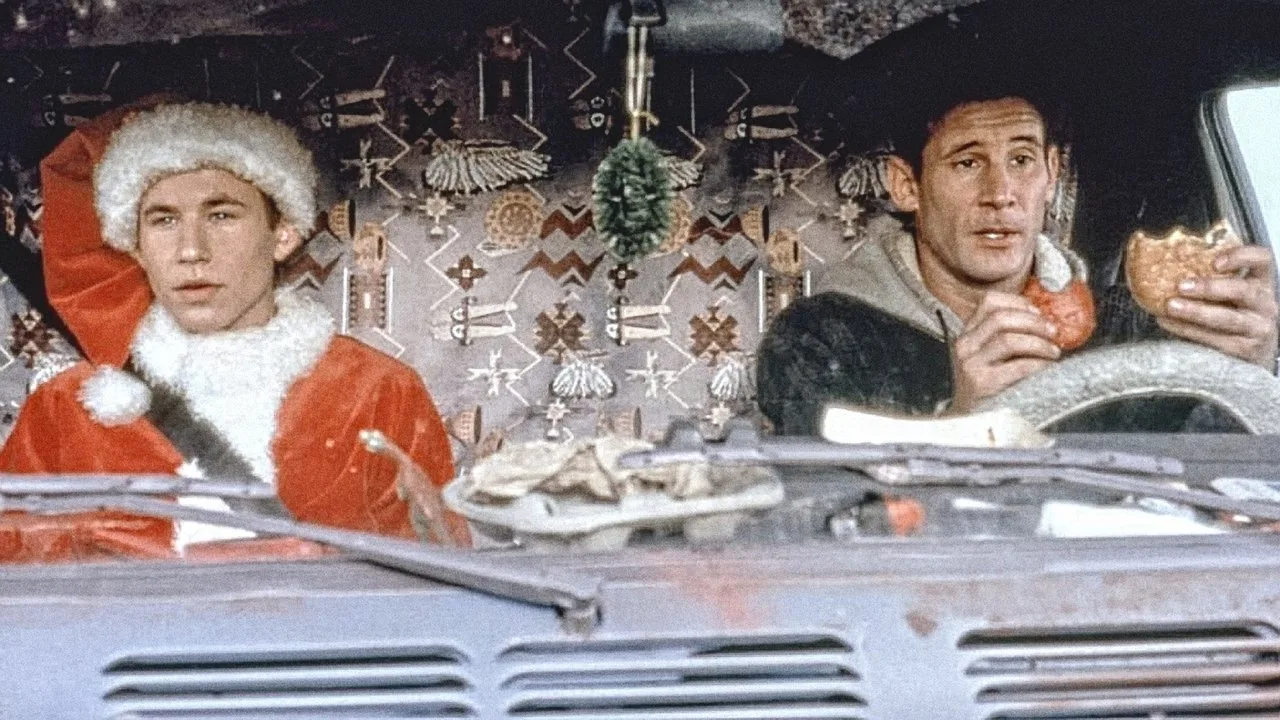

Somewhere between L.A. and N.Y. Jake found the meaning of Christmas.
I'll Be Home for Christmas (1998)
Estranged from his father, college student Jake is lured home to New York for Christmas with the promise of receiving a classic Porsche as a gift. When the bullying football team dumps him in the desert in a Santa suit, Jake is left without identification or money to help him make the journey. Meanwhile, his girlfriend, Allie, does not know where he is, and accepts a cross-country ride from Jake's rival, Eddie.
 rating 7/10 User rating 354 votes 60%
 ❄ Christmas Connection
The entire film is structured around Christmas as a deadline and a reckoning. Two elderly parents have organized their lives around the assumption that Christmas means family, and when that assumption collapses, the holiday becomes the pressure point that forces every unspoken tension into the open. Christmas here is not decoration. It is the mechanism that drives the drama.
Where to Watch


Our Review
"I'll Be Home for Christmas" (1988) is not the movie most people find when they search that title. That honor goes to the 1998 Jonathan Taylor Thomas comedy, which involves a donkey, a race across the country, and roughly zero emotional stakes. This one is different. Directed by Marvin J. Chomsky for CBS, the 1988 film is a character study about a retired couple, Jake and Grace Greer, who have built their retirement around the ritual of Christmas, only to learn that their adult children won't be making the trip home this year. What follows is quieter and more honest than most holiday television dares to be.
Hal Holbrook plays Jake with the particular stillness he brought to his best work. Eva Marie Saint plays Grace. Between the two of them, they have four Academy Award nominations and a combined acting career stretching back to the early 1950s. Chomsky knew what he had and mostly let them work.
What the Film Is Actually About
The premise sounds simple enough. The kids aren't coming. Jake and Grace have to figure out what to do with themselves. But the film is really about what happens to a couple when the role they've been performing for decades, the parents hosting Christmas, is suddenly taken off the table. Without that structure, who are they? The question isn't melodramatic. The film asks it quietly, over the course of a long December day, and resists the urge to answer it neatly.
Jake is the harder character to inhabit. He's a man who doesn't know how to say what he feels and has built a comfortable life around not having to. When the news arrives that the children won't be coming, his instinct is to minimize it. Grace doesn't buy the performance. Saint plays her without sentimentality, which is the right call. A lesser version of this role becomes a weeping mother waiting by the phone. Saint gives her something more specific: a woman deciding, carefully, how much disappointment she will actually allow herself to feel.
The film understands that the real subject here is not Christmas. It's the moment when parents realize their children have built lives that no longer center on them. Christmas just happens to be the annual event where this truth was always going to arrive.
Empty Nest Syndrome, Handled Without the Usual Fuss
Television in the 1980s handled empty nest stories with a predictable grammar. The children feel guilty, the parents suffer visibly, everyone reconciles by the end. This film earns some credit for not following that template. The reconciliation here, such as it is, doesn't require a dramatic airport scene or a tearful phone call. It's more modest than that, and more believable.
Jake and Grace end up spending Christmas together, just the two of them, and the film is interested in what that actually looks like. Two people who have been married long enough to know each other's rhythms, suddenly thrown back on each other's company without the buffer of family activity. It's not always comfortable. The film doesn't pretend it is.
Chomsky directs with restraint. He was primarily a television director, with credits that included the 1978 Holocaust miniseries, which won five Emmy Awards. He understood how to work within the constraints of network TV without letting those constraints flatten every scene. The film is shot and paced like something that trusts its actors, which is the right approach when your actors are Holbrook and Saint.
Where It Earns Its Rating
The film's best scenes are the ones where nothing much happens. Jake puttering in the garage. Grace going through Christmas cards with a kind of mechanical efficiency. A conversation at the kitchen table that starts about nothing and becomes, briefly, about everything. These scenes accumulate weight in a way that the more obviously emotional scenes don't quite match.
The weaker moments are the ones where the script reaches for broader statement. A subplot involving a neighbor registers as filler. One or two scenes push the dialogue toward the explicitly thematic in ways that undercut the quieter work the film has been doing. Television movies in this era had a tendency to explain their own meanings, and this film isn't entirely immune.
But Holbrook and Saint pull the film through its weaker stretches. By the time the final scene arrives, the film has made a modest, specific, and convincing argument that Christmas is not the same thing to every person in a family, and that this gap, this difference in what the holiday means to parents versus grown children, is a real source of grief that doesn't get discussed much. That's a sharper observation than the premise suggests.
Is It Worth Watching?
If you are looking for a Christmas movie with spectacle, skip it. If you are looking for something that treats adult emotion seriously, without condescending to it or wrapping it in a bow, this is a good option. It runs under two hours and asks almost nothing of the viewer except attention.
Holbrook was 62 when this aired. Saint was 64. They play people their own age, dealing with problems appropriate to that age. This alone makes the film unusual in the landscape of Christmas television, which tends to feature either children or younger adults. The 1988 version of "I'll Be Home for Christmas" is for people who have already spent many Christmases, who know the weight of a quiet house in December, and who recognize something true in the idea that the holidays can be the time when families finally admit how much has changed.
The last shot is just the two of them. It's enough.
Fun Facts
This 1988 CBS TV movie shares its title with the 1998 theatrical release starring Jonathan Taylor Thomas, which has led to decades of confusion in search results and rental queues. The two films have nothing in common except the holiday song that inspired both titles.
Hal Holbrook won an Emmy Award in 1970 for his performance in "The Bold Ones: The Senator" and earned an Academy Award nomination in 2007 for "Into the Wild." His television career spanned more than six decades.
Eva Marie Saint won the Academy Award for Best Supporting Actress for her debut film role in "On the Waterfront" (1954), making her one of very few actors to win an Oscar for their first film appearance.
Director Marvin J. Chomsky directed "Holocaust" (1978), the NBC miniseries that drew an estimated 120 million American viewers over four nights. It was one of the most-watched dramatic programs in US television history up to that point.
The song "I'll Be Home for Christmas" was written in 1943 by Kim Gannon and Walter Kent and recorded by Bing Crosby. It was written from the perspective of a soldier writing to his family, with the final line revealing the return home will only happen "in my dreams." Both films bearing this title play on that bittersweet undertone.
CBS television movies in the late 1980s regularly drew audiences of 15 to 25 million viewers, a figure that no streaming platform has replicated for a single title in a single evening. This film aired in a television landscape with far fewer alternatives competing for attention.
The empty nest phenomenon became a significant subject of American cultural discussion in the 1980s as the Baby Boom generation began reaching adulthood in large numbers, leaving their parents' households during roughly the same decade this film was made.
Cast