
Nothing is truly lost, we just need to know where to look.
Lost Christmas (2011)
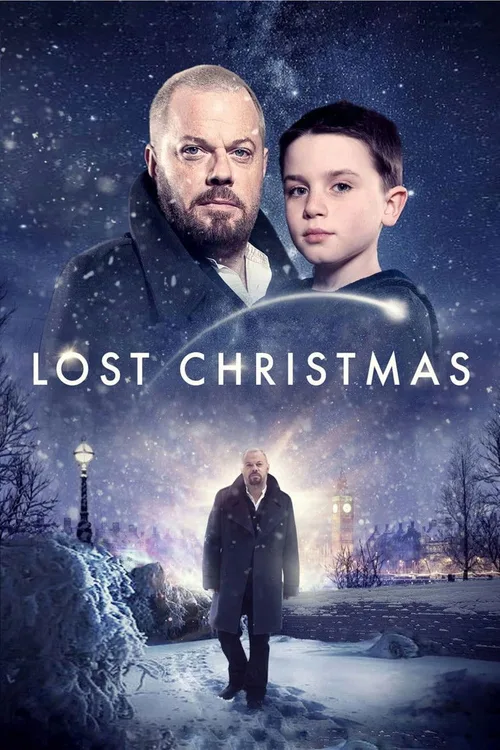
An Urban Fairy Tale set in Manchester. A story of how a series of tragic events, that blight a young boy's life on Christmas Eve, take him on a journey where a chance meeting with a mysterious stranger may have the key to help and give him a perfect Christmas.
 rating 8/10 User rating 41 votes 68%
 ❄ Christmas Connection
Lost Christmas is set entirely across two consecutive Christmas Eves in Manchester, with snow-covered streets, a missing dog, and a boy who lost his parents at Christmas as its central event. The holiday is not decorative backdrop but the engine of the whole story. Every encounter Anthony and Goose have is driven by what Christmas took from the people around them and what it might give back.
Where to Watch


Our Review
Most Christmas films resolve cleanly. The snow falls, the estranged family reunites, the music swells. Lost Christmas, the 2011 BBC drama directed by John Hay, does not do that. It sits in the wreckage of a boy's worst night, then slowly, carefully, picks through it. The result is one of the best British Christmas films made this century, and almost nobody has seen it.
Eddie Izzard plays Anthony, a man who surfaces on the streets of Manchester with no memory, no past, and no explanation. He can find lost things. Objects, people, whatever someone needs. He wanders the city on Christmas Eve like a secular angel doing piecework, each encounter small but precise. A stolen wallet. A missing cat. A husband who walked out years ago. Anthony turns up, asks the right question, and the world shifts a little.
The boy he attaches himself to is Goose, played with startling naturalism by Larry Mills. A year before the film's present, Goose hid his father's car keys on Christmas Eve. He wanted to keep his dad home. His mother used her own keys instead, drove his father to work, and both parents died in a crash ten minutes later. Goose is now eleven, shoplifting to look after his grandmother, carrying guilt that would buckle most adults. Mills was apparently the only child Hay auditioned for the role. Having seen the performance, that decision was correct.
Why the Manchester Setting Matters
Lost Christmas was described by its director as "a sort of Fairytale of New Manchester," a nod to the Pogues and Kirsty MacColl song that clearly haunted the production. That reference is revealing. The Pogues song is brutal about failure and tenderness in equal measure, and so is this film. Manchester here is not the Manchester of tourist brochures. It's council flats, rainy night markets, underpasses, charity shops. The city's texture gives the film an honesty that a London or studio setting would have destroyed.
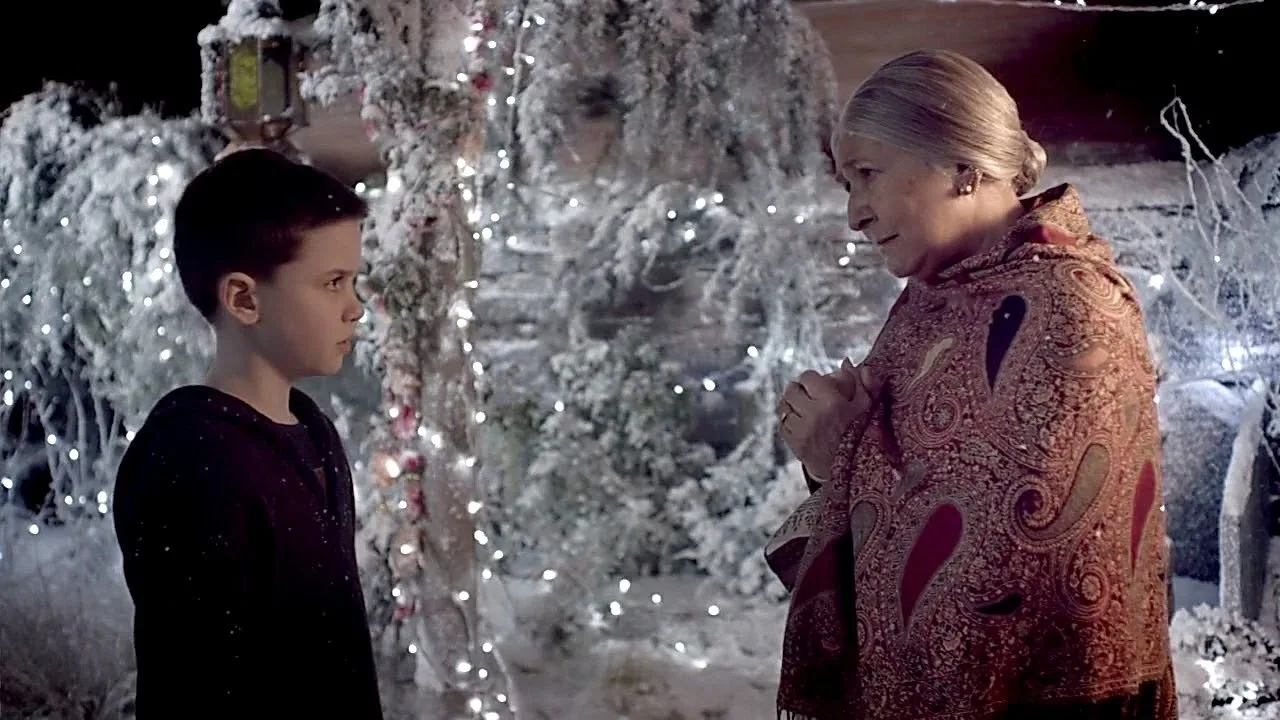
Cinematographer Graham Frake shot the film with deliberate cinematic ambition, an unusual choice for a BBC drama airing on a Sunday evening in December. The film earned its look. Snow-covered Manchester feels genuinely otherworldly without resorting to the artificial prettiness that sinks most Christmas productions.
Eddie Izzard and the Art of Restraint
Izzard was, at the time of filming, primarily known as a stand-up comedian with a sideline in historical drama roles. Anthony asks something different from him. The character is warm but unknowable, someone operating just outside normal human logic. Izzard plays it almost entirely through stillness, a choice that goes against every instinct of someone who built a career on verbal speed and physical energy.
The performance works because Izzard never tries to make Anthony likeable in the conventional sense. He's not cuddly. He asks blunt questions and hands people difficult truths. When he finally understands his own purpose in the story, the revelation lands because Izzard has given nothing away.
Jason Flemyng appears as Goose's uncle, a man with his own unresolved grief and some poor financial decisions behind him. Flemyng is one of those British character actors who improves every project he enters, and his scenes with Mills carry the film's emotional weight in its middle section.
The Grief at the Center
British Christmas drama has a strong tradition of sitting with loss rather than fleeing from it. A Christmas Carol, the original template, is fundamentally about a man confronting failure and regret. Lost Christmas follows that lineage without copying it. The supernatural element is light, almost casual. Anthony's abilities are never explained and the film is not interested in explaining them.
What the film is interested in is how guilt calcifies in children. Goose didn't cause his parents' deaths. He knows this. He also knows he contributed to the conditions that caused them, and ten-year-olds are not equipped to hold that distinction. Mills plays Goose's suppressed grief as hardness rather than sadness, which is exactly right. The boy doesn't cry much. He steals and protects his nan and keeps moving.
The film aired on BBC One on 11 December 2011, and later on CBBC on Christmas Eve. It was written by David Logan and John Hay, who also directed. It received warm reviews but limited international distribution, which explains why it's largely unknown outside the UK despite a 7.0 on IMDb and genuine critical affection from those who've found it.
Who It's For
This is not a film for small children, despite the child protagonist. The themes are adult: survivor guilt, grief that doesn't resolve, kindness as the only available response to loss. It works for older children and teenagers precisely because it doesn't condescend. It's also about 90 minutes, which is the right length.
Families who find standard Christmas fare too smooth will find something here. The film is bleak in places, funny in others, and genuinely moving at the end without being manipulative. When Goose finally understands what Anthony is there for, the scene doesn't announce itself. It happens quietly, and that's why it sticks.
Fun Facts
Director John Hay cast Larry Mills as Goose after a single audition, reportedly seeing no other child actors for the role. It was Mills's first major film performance.
Hay described Lost Christmas as "a sort of Fairytale of New Manchester," explicitly referencing the 1987 Pogues and Kirsty MacColl song "Fairytale of New York" as a tonal influence on the production.
Eddie Izzard was a two-time Emmy Award winner before taking the role of Anthony, having won for his HBO stand-up specials "Dress to Kill" (1999) and "Stripped" (2009). The BBC's DVD release actually lists these credentials on the packaging.
The film aired on BBC One on 11 December 2011 at around 5:30 pm, a Sunday evening slot typically reserved for light family entertainment. Its darker subject matter was unusual for that timeslot.
Jason Flemyng, who plays Goose's uncle, appeared the same year in X-Men: First Class as Azazel, making 2011 a notable year for a versatile actor comfortable in both American blockbusters and British TV drama.
Lost Christmas was released on DVD in November 2012, nearly a year after its BBC broadcast, reflecting the low-key commercial treatment of a film that deserved wider attention.
The film's central supernatural conceit, a man who can find lost things, was written by David Logan, who also wrote the novel on which the film is based. Both the novel and the film were released in 2011.
Cast