
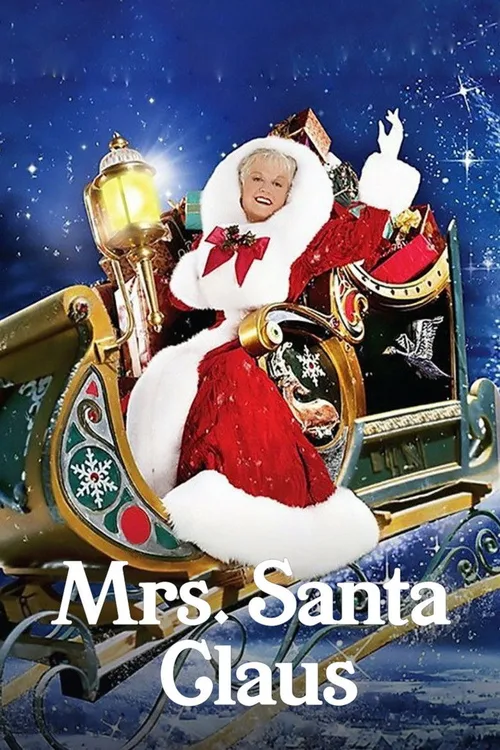
Mrs. Santa Claus is doing it for herself!
Mrs. Santa Claus (1996)
Neglected by her husband during the pre-Christmas rush, Mrs. Claus takes the reindeer and sleigh out for a drive, only to end up stranded in the neighborhood of Manhattan's Lower East Side.
 rating 7/10 User rating 29 votes 60%
 ❄ Christmas Connection
Mrs. Santa Claus is built entirely around Santa's household and the mythology of Christmas. The plot begins and ends at the North Pole, with Mrs. Claus literally piloting Santa's sleigh and caring for his reindeer. Christmas Eve is the ticking clock that drives the whole story.
Where to Watch


Our Review
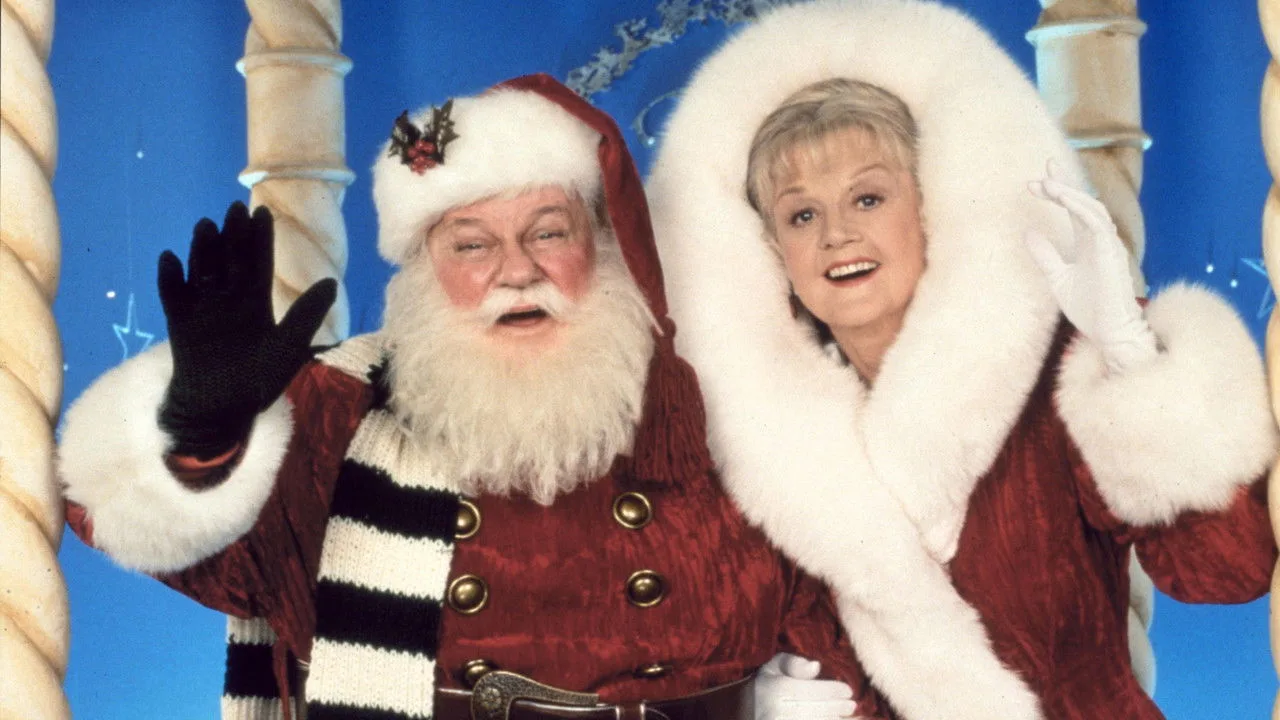
In 1996, CBS aired a made-for-TV Christmas musical in which Mrs. Claus pilots Santa's sleigh into a Manhattan snowstorm, crashes it on the Lower East Side, and spends the next hour and a half organizing garment district workers and marching with suffragettes. Angela Lansbury plays the title role. The songs were written by Jerry Herman, the man behind Hello, Dolly! and La Cage aux Folles. None of this is ironic. Mrs. Santa Claus means every word of it.
What Actually Happens in Mrs. Santa Claus
The setup is 1910. Santa (Charles Durning) is planning his Christmas Eve route the same way he always does, and Mrs. Claus quietly suggests a more efficient path through New York City. Santa dismisses her. She takes the sleigh out herself to prove the route works, a blizzard hits, and one of the reindeer strains a tendon. She's grounded in Manhattan for several days while Cupid heals.
During her stay, she takes a room with a Jewish immigrant family on the Lower East Side. She gets a job in a toy factory and immediately notices the children working there. She befriends Sadie (Teryl Rothery), a young suffragette trying to register women to vote. She teaches the neighborhood kids to make toys. She tries not to blow her cover as the actual Mrs. Claus.
It sounds like the premise of a children's book someone pitched after reading too much Howard Zinn. But the film commits to it seriously. The child labor reform subplot involves real historical texture: the Triangle Shirtwaist fire happened just one year after the story is set, and the film's portrait of factory conditions in lower Manhattan isn't entirely sanitized.
Angela Lansbury Carries Every Scene
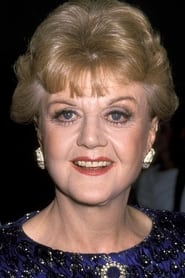
There is no version of this movie that works without Lansbury in the lead. She was 70 when filming, and she plays Mrs. Claus not as a sweet grandmotherly figure but as a competent woman who has spent centuries running an enormous operation while her husband gets all the credit. The character's frustration with being overlooked is the emotional engine of the film, and Lansbury plays it straight, without self-pity and without camp.
She also sings. This is not incidental. Jerry Herman's score gives her a proper leading-lady showcase, and she delivers it fully. The standout number, "Ave Maria," is a quieter moment that demonstrates what trained stage performers bring to material that lesser productions would treat as background noise. Lansbury had originated Mame on Broadway in 1966 and won her fourth Tony for Sweeney Todd in 1979. She was not coasting.
Charles Durning is warm and a little befuddled as Santa, which is exactly the right choice. He doesn't try to compete with Lansbury. He exists mainly to be wrong about the route and then to recognize what he's been missing.
Jerry Herman's Songs Deserve More Credit
Herman wrote the score specifically for this production, his last original musical. That fact alone should have generated more attention. The man responsible for "Hello, Dolly," "Mame," and "I Am What I Am" spent the last years of his career writing songs for a CBS Christmas movie, and the songs are good. They're structured like real musical theater numbers with internal logic and character motivation, not holiday filler.
Herman died in 2019. Mrs. Santa Claus doesn't appear prominently in his obituaries, but it was genuinely his work, done with craft. The score sits somewhere between his Broadway period and a children's musical, which is honestly exactly what the project required.
The Politics Are Sincere, Not Preachy
The suffragette storyline could easily become a vehicle for heavy-handed messaging. It doesn't. Mrs. Claus gets involved because she personally believes women should vote, and the film treats that position as obvious rather than radical. Sadie's arc has stakes: she risks her factory job by organizing. The child labor subplot isn't resolved with a miracle; Mrs. Claus uses her very specific skill set (toy-making, North Pole connections) in a way that's actually clever rather than convenient.
For a 1996 CBS holiday special, this is surprisingly willing to engage with actual history. The Lower East Side setting is rendered with some care. The immigrant community Mrs. Claus falls in with feels specific rather than generic.
The film is still fundamentally a family musical made for television. The production values reflect that. But within those limits, it takes its ideas seriously.
Is Mrs. Santa Claus Worth Watching?
Yes, if you have any tolerance for the genre. It's a well-made example of something that doesn't get made anymore: a TV musical with a real score, a genuine stage performer in the lead, and a script that assumes the audience can handle a point of view. It's not A Christmas Carol in terms of canonical weight, but it outperforms most of what fills the holiday schedule in any given year.
The Christmas content is genuine but not overwhelming. Christmas provides the frame; the story itself is about a woman finding that she has more to offer than she's been allowed to show. That's a workable December 25th theme.
At the end, Mrs. Claus returns to the North Pole, and Santa promises to take her suggested route. He does. It works.
Fun Facts
Angela Lansbury was 70 years old during production and performed all her own singing. She had previously won four Tony Awards on Broadway, including for Mame (1966) and Sweeney Todd (1979).
Jerry Herman, who wrote the original score, composed Mrs. Santa Claus as his final musical. His earlier shows included Hello, Dolly! (1964) and La Cage aux Folles (1983), both of which won the Tony Award for Best Musical.
Charles Durning, who plays Santa Claus, received two Academy Award nominations over his career (for The Best Little Whorehouse in Texas in 1982 and To Be or Not to Be in 1983) and was also a decorated World War II veteran who survived the Omaha Beach landing on D-Day.
The film is set in 1910, one year before the Triangle Shirtwaist Factory fire of March 1911, which killed 146 garment workers (mostly young immigrant women) in lower Manhattan and became a catalyst for major labor reform in the United States.
The Lower East Side neighborhood where Mrs. Claus lands was, in 1910, one of the most densely populated places on Earth, home to roughly 540,000 people per square mile, primarily Eastern European Jewish immigrants.
Terry Hughes, who directed the film, also directed the original Broadway production of Noises Off (1983) and several episodes of The Golden Girls, on which Lansbury's sister-in-law Rue McClanahan was a regular cast member.
The women's suffrage movement depicted in the film achieved its goal in the United States with the ratification of the 19th Amendment in August 1920, exactly a decade after the film's setting.
Cast