
A new level of terror.
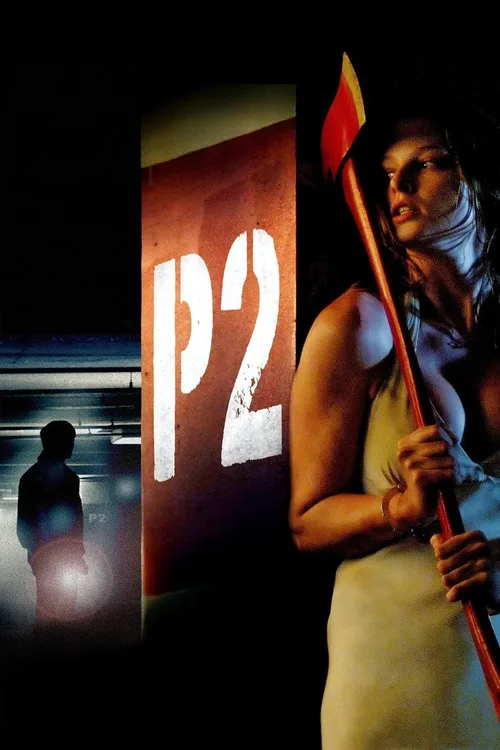
P2 (2007)
A businesswoman finds herself locked with a unhinged security guard in a parking garage after getting stuck working late on Christmas Eve.
 rating 6/10 User rating 914 votes 62%
 ❄ Christmas Connection
P2 takes place entirely on Christmas Eve in a Manhattan parking garage, making the holiday setting inseparable from the premise. The contrast between the warmth and festivity of Christmas and the cold concrete isolation of a parking structure is the film's central tension. Without Christmas Eve, there is no story: the near-empty building, the missed family dinner, and the decorations hanging in the wrong places are all load-bearing elements.
Where to Watch


Our Review
Christmas horror occupies a specific corner of the genre. Not the whimsical kind with evil Santas or demonic elves, but the kind that takes the holiday's actual emotional texture, the loneliness, the obligation, the suffocating pressure to be somewhere with someone, and turns it against you. P2, released in November 2007 and directed by Franck Khalfoun, is exactly that kind of film. It traps a woman in a parking garage on Christmas Eve and watches what happens when the person holding the keys is a sociopath who thinks he's being romantic.
What Is P2 About?
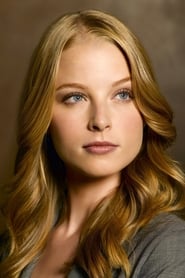
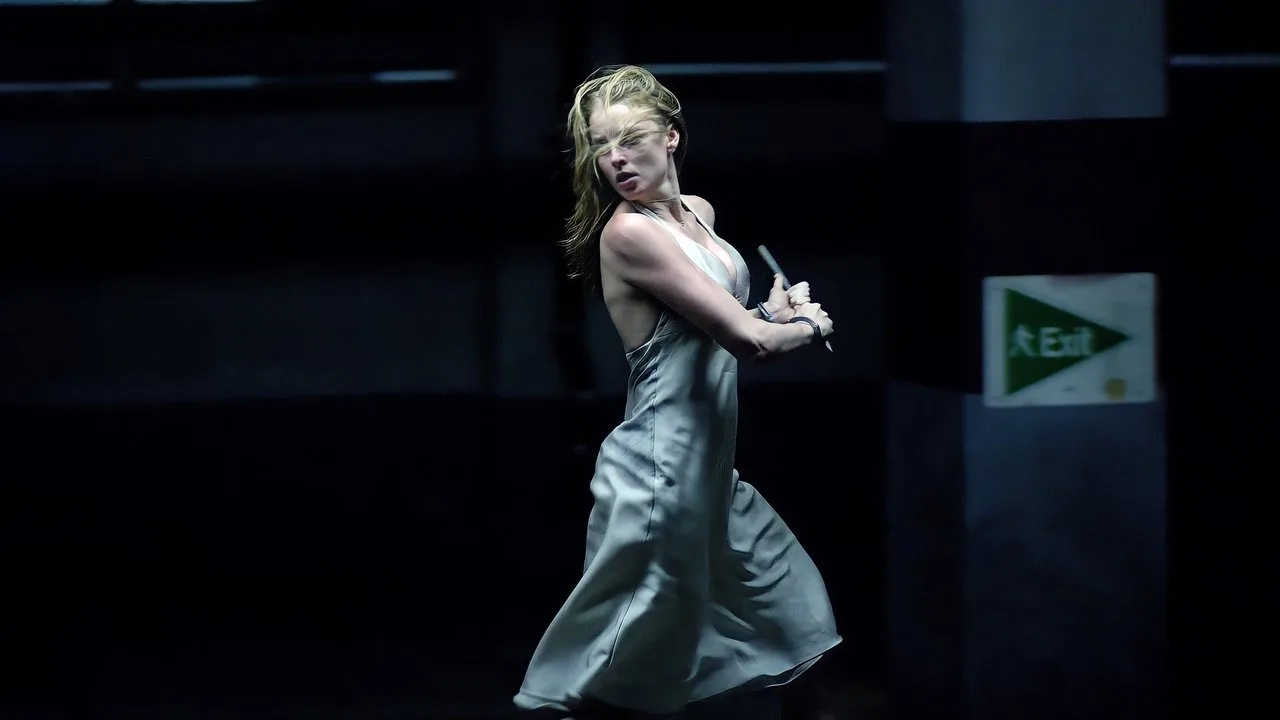
Angela Bridges (Rachel Nichols) is working late in her Manhattan office on December 24th. She's trying to get to her family's Christmas dinner. The parking garage is almost empty. Her car won't start. The security guard, Thomas (Wes Bentley), offers to help, and then things go wrong in the way these things go wrong in horror movies, except here with more zip ties and a large dog named Rocky.
The premise is brutally simple. One location, two characters, one very long night. Khalfoun and his co-writers, Alexandre Aja and Gregory Levasseur (the team behind High Tension), understood that constraint is a feature, not a limitation. The parking garage becomes its own world: fluorescent-lit, cement-grey, echo-filled, with Christmas decorations scattered around it like a sick joke.
Thomas has set up a candlelit dinner for two. He has a white dress for Angela to wear. He has opinions about her colleagues and her dating life, opinions formed from months of watching her on security cameras. The film doesn't try to explain him beyond what you can observe. That restraint is one of its better decisions.
Wes Bentley Makes This Film Worth Watching
Wes Bentley's performance is the reason P2 works as well as it does. He plays Thomas not as a snarling monster but as a man who has genuinely convinced himself his behavior makes sense. There's a dinner scene, filmed under flickering Christmas lights, where he chatters pleasantly about the holidays while Angela sits handcuffed to a chair across from him. Bentley keeps the character just plausible enough that the wrongness of every sentence lands harder.
The character is a study in small, specific delusions. Thomas believes Angela is fundamentally different from the people she works with. He believes he understands her better than they do. He's the kind of person who describes a kidnapping as "keeping you safe." Bentley plays all of this straight, no winking at the camera, no camp. It's a committed performance in a film that didn't get the attention it deserved on release.
Rachel Nichols, for her part, gives Angela real intelligence and stubbornness. She doesn't wait to be rescued. She looks for exits, creates distractions, improvises weapons. The film never reduces her to a passive victim, which matters more than it might seem in a premise this contained.
The Christmas Eve Setting Pulls Real Weight
P2 is set on Christmas Eve for structural reasons, not decorative ones. The building is nearly empty because everyone went home. Angela is there late because she prioritizes work over family, a character detail that comes back around. The holiday transforms what might otherwise be an anonymous thriller location into something with texture and irony.
The decorations Thomas has hung in the garage are the most unsettling detail in the film. Tinsel and string lights in a concrete tomb. It's a visual that does more work than any dialogue could. He's trying to make it feel like a home, which is exactly why it feels like nothing of the sort.
Khalfoun shoots the garage to emphasize its scale and emptiness. The camera finds long corridors and distant corners. The fluorescent lighting never flatters anyone. When the action sequences come, they're spatially coherent, which is rarer than it should be in this genre.
The Alexandre Aja Connection
Alexandre Aja produced and co-wrote P2 with his regular collaborator Gregory Levasseur, the same pair who made High Tension (2003) and The Hills Have Eyes (2006). The film has their DNA: efficient storytelling, genuine nastiness in the violence, and a willingness to commit to a single oppressive premise rather than opening things up. Aja was already developing a reputation for brutalist horror, and P2 fits neatly into that period of his career.
For Franck Khalfoun, it was his feature debut. He later directed Maniac (2012), another confined thriller with a troubled male lead, this time shot almost entirely from the killer's POV. The interest in claustrophobic spaces and psychological damage runs through both films. P2 is the earlier, rougher work, but the instincts are there.
Where P2 Falls Short
The third act loses some of what makes the first two-thirds work. The film shifts from psychological pressure to more conventional chase-and-fight mechanics. Some of what happens there strains credibility in ways the earlier scenes don't, and the shift in register doesn't quite hold together. Thomas becomes more visibly monstrous in the finale, which is accurate but less interesting than when his menace was delivered quietly over Christmas dinner.
The film also underuses its premise's emotional core. Angela's relationship with her family, her reasons for being there that night, the specific guilt of missing Christmas with people you love, all of it gets established efficiently but never developed into anything that hits harder. A few more minutes in that territory would have given the horror more to push against.
P2 earned a 5.9 on IMDb and about $4 million at the box office against a modest budget, making it a commercial failure. The critical response was mixed. None of that retroactively makes it a better or worse film. It's a tight, competent, occasionally very effective thriller that commits to an unpleasant premise and mostly delivers on it. The parking garage on Christmas Eve, lit like an afterthought, remains one of the grimmer holiday settings in recent horror memory.
Fun Facts
P2 was the first feature film ever distributed by Summit Entertainment, the studio that would later release the Twilight saga and go on to merge with Lionsgate in 2012.
The entire film was shot at night in a real, operating parking garage in Toronto, Canada, not a constructed set. The production used the actual facility during off-hours, meaning the crew worked exclusively overnight shifts.
The wardrobe department made fourteen separate copies of the white dress Rachel Nichols wears throughout the film, each representing a different stage of damage and deterioration as the night progresses.
Franck Khalfoun co-wrote the screenplay with Alexandre Aja and Gregory Levasseur, the same creative team behind High Tension (2003). The film's claustrophobic, single-location concept was partly inspired by a series of real attacks on women in Paris parking garages.
P2 averaged only $977 per theater in its opening weekend, making it one of the more emphatic box office underperformers of 2007, despite playing in over 1,200 theaters.
Wes Bentley, who plays the obsessive security guard Thomas, had largely stepped back from acting in the years following American Beauty (1999). P2 was one of the films that marked his gradual return to regular film work in the late 2000s.
The dog in the film, a Rottweiler named Rocky, functions as Thomas's primary companion throughout the story. Training the dog to perform specific actions on cue in the echoey, fluorescent-lit garage environment was one of the more logistically complex parts of the production.
Cast