
A Cat With A Heart of Gold
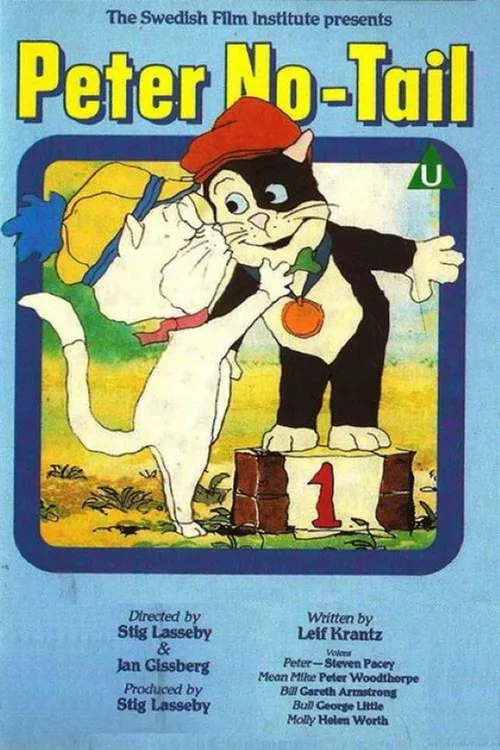
Peter-No-Tail (1981)
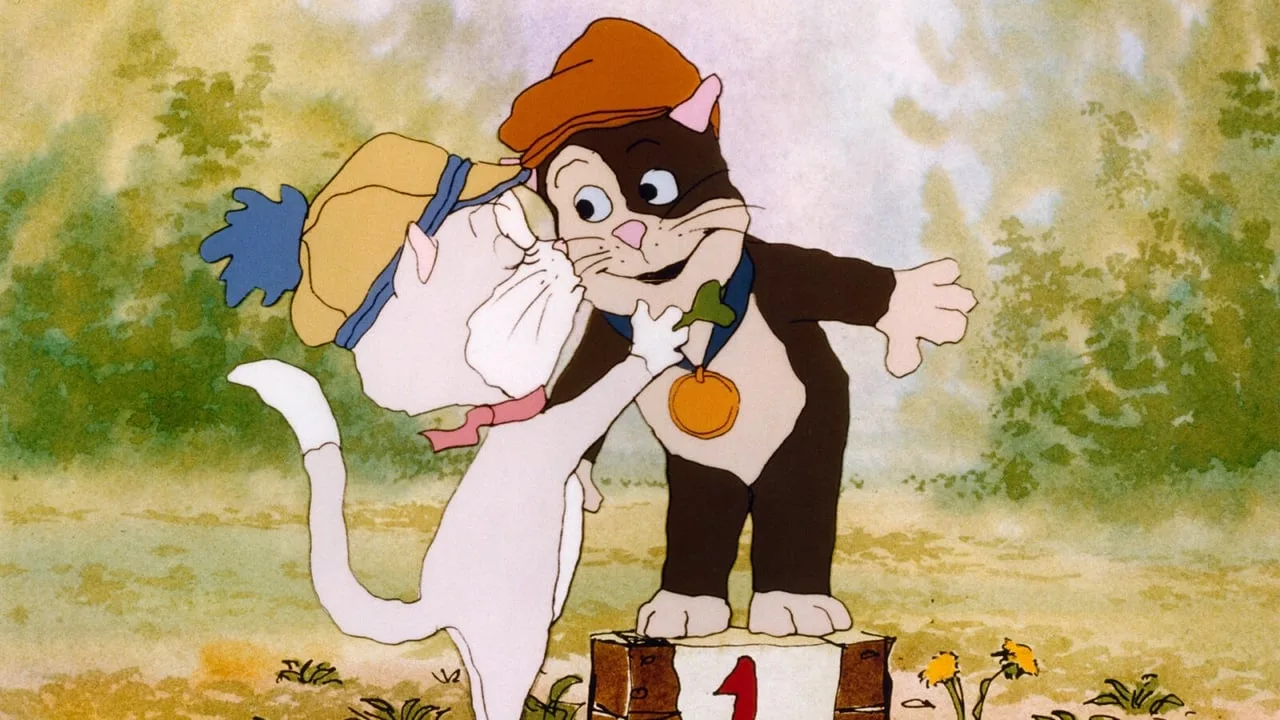
Peter-No-Tail is a cat who's born without a proper tail on a farm by the Swedish countryside. Due to economical difficulties, the farmer is forced to get rid of Peter. The farmer can't bring himself to drown the cat, so he sneaks Peter inside the car of a family who are renting a house close to the farm for their summer vacation. When the family finally reach their home in Uppsala, Sweden, they find Peter and decide to keep him. Without a tail, he becomes the talk of the town among the other cats and, especially Mike, who teases him cruelly. Mean Mike and his two companions, Bill and Bull, are notorious for the nasty tricks they like to play on other cats. Mike is currently trying to court Molly Silk-Nose, but his rough and silly approach does not impress her, since she becomes interested in the kind and gentle Peter. But Mike won't give up that easily and he has a plan for how he'll get his revenge.
 rating 7/10 User rating 30 votes 63%
 ❄ Christmas Connection
The Peter-No-Tail character is so tied to Swedish Christmas culture that SVT made him the star of their 1997 Christmas calendar series, airing one episode daily from December 1 through Christmas Eve. The 1981 animated film itself was released on Christmas Day and has been a holiday staple for Swedish families ever since. Christmas and this tailless cat have been inseparable in Scandinavia for decades.
Our Review
Sweden has given the world a remarkable amount of children's Christmas culture. There is Astrid Lindgren, who practically invented the template for warm-but-honest Swedish children's storytelling. There is the julkalender tradition, where public broadcaster SVT airs a new episode of a family serial every day from December 1 through Christmas Eve. And then there is Pelle Svanslös, a tailless cat from Uppsala who has been charming Swedish children since 1939 and shows absolutely no signs of stopping. The animated film Peter-No-Tail, released on Christmas Day 1981, brought him to the big screen. It turned out to be one of the most enduring pieces of Swedish Christmas culture the country has produced.
A Character With More History Than Most Countries' Christmas Traditions
Gösta Knutsson created Pelle Svanslös as a radio story in 1937, with the first book following in 1939. Twelve books in the series were published between 1939 and 1972. The setup is simple: Pelle is a good-natured cat living in Uppsala whose tail was bitten off by a rat when he was a newborn kitten. This physical difference makes him an outsider in a world of fully-tailed cats, especially to the bully Elake Måns, who makes Pelle's life difficult at every turn.
What the books are actually about is more interesting than talking cats in a cathedral town. Knutsson wrote them as a direct response to the rise of National Socialism in Sweden during the 1930s. The cats who look down on Pelle for being a "country cat," who is accused of threatening the livelihoods of the town cats, are not subtle. Knutsson was arguing for equal rights and against nationalism at a time when such arguments carried genuine risk. Swedish literary critics have noted this explicitly. A children's book about a cat with no tail was, in its moment, political writing.
The 1981 animated film strips away most of the political allegory and delivers a straightforward adventure. Pelle is born on a country farm and smuggled into Uppsala by a farmer who wants to save him from being abandoned. He finds friends, finds enemies, and finds love in the form of the elegant Maja Gräddnos. The bully Måns, voiced by Ernst-Hugo Järegård with an oiliness that made him one of Swedish animation's most memorable villains, pursues and torments Peter throughout. The animation is the warm, hand-drawn style of the period, unhurried and clearly crafted with care.
What the 1981 Film Gets Right
Järegård's voice performance deserves to be mentioned separately from the rest of the cast. He was one of Sweden's most celebrated stage and screen actors, and he brought an adult complexity to Måns that makes the character genuinely unpleasant rather than cartoonishly harmless. When Järegård passed away in 1998, Swedish newspapers ran his obituaries alongside references to his work as Måns. That is the measure of how much the performance meant to Swedish audiences.
The film is also honest about its Uppsala setting in a way that animated films rarely bother to be with real places. The cathedral district, the university atmosphere, the particular social hierarchies of a Swedish university town: these details come through in ways that make the film feel rooted rather than generic. Children watching it in Sweden recognized something real, even dressed up in cat fur.
The screenplay by Leif Krantz keeps the pace moving without rushing. At 81 minutes, the film does not overstay its welcome, which is more than can be said for many children's animated features from the same era that padded themselves to feature length with musical numbers and comic-relief sidekicks. Peter-No-Tail trusts its story.
The 1997 Christmas Calendar and the Character's Hold on Swedish Culture
The film's legacy is inseparable from what came after it. The 1985 sequel Peter-No-Tail in Americat sent the characters to the United States and is remembered in Sweden as considerably stranger than the original. Then, in 1997, SVT chose Pelle Svanslös as the subject of their annual Christmas calendar television series, a format that is one of Sweden's most significant broadcasting traditions. The 1997 series, directed by Mikael Ekman with a script by Pernilla Oljelund, was live-action, featuring actors including Björn Kjellman as Peter in cat costumes and makeup with mechanical, remote-controlled tails. It ran 24 episodes, one per day throughout December.
The SVT Christmas calendar is not a minor cultural event. It pulls enormous viewing figures, it is discussed seriously by Swedish television critics, and being selected as the year's Christmas calendar subject is considered a genuine honor for any property. The fact that Pelle Svanslös was chosen in 1997 confirms the character's status as a first-tier Swedish cultural institution. The series was subsequently released on VHS in 1998 and on DVD in 2001, and it continues to circulate as a Christmas reference point.
A 2020 animated remake, directed by Christian Ryltenius, brought Pelle back to cinema screens. It received mixed reviews, with critics noting the reliance on celebrity voice actors over traditional animation voice talent. The original 1981 film remains the definitive screen version for most Swedish audiences.
Is Peter-No-Tail a Christmas Movie?
The 1981 film is not set at Christmas. Its Christmas connection comes from its release date (December 25, 1981) and from the decades of association the character has built with Swedish Christmas culture through the 1997 TV calendar and countless holiday broadcasts. In Sweden, the tailless cat and Christmas have become genuinely linked in the cultural imagination. Outside Scandinavia, this connection is likely invisible, which makes Peter-No-Tail one of those films that tells you something about a country's Christmas that you cannot find in any tourist brochure.
Swedish children who grew up watching the 1997 calendar series are now adults in their thirties. They watched Björn Kjellman in a mechanical cat tail argue with Elake Måns every morning before school throughout December. That shared experience is what Christmas culture actually is when it works, and Peter-No-Tail has been delivering it reliably for more than four decades.
Fun Facts
Gösta Knutsson first introduced Pelle Svanslös as a character in a radio broadcast in 1937, making the character nearly two years old before he appeared in his first book in 1939.
The twelve Pelle Svanslös books were published over 33 years, from 1939 to 1972, with the first eleven illustrated by Lucie Lundberg.
Ernst-Hugo Järegård, who voiced the villain Elake Måns in the 1981 film, was one of Sweden's most acclaimed theater and film actors. His death in 1998 prompted Swedish obituaries to cite his Måns performance as one of his defining roles.
The 1981 animated film was produced on a budget of approximately 48,740 USD and went on to earn around 955,401 USD, making it a significant commercial success relative to its cost.
The 1997 SVT Christmas calendar series featured actors wearing mechanical, remote-controlled tails as part of their cat costumes, a practical effects solution that Swedish audiences found charming enough to make the series a lasting favorite.
SVT's Christmas calendar tradition, of which the 1997 Pelle Svanslös series was part, is one of the most-watched annual broadcasting events in Sweden, with the format dating back to the 1960s.
The books about Pelle Svanslös have been translated into Finnish, Danish, Norwegian, German, Latvian, Ukrainian, Polish, and English, giving this Uppsala-based cat a wider European readership than most Swedish children's characters.
The 1997 Christmas calendar was released on DVD in November 2001, four years after it first aired, reflecting the sustained demand from Swedish families who wanted to rewatch it each December.
Cast