

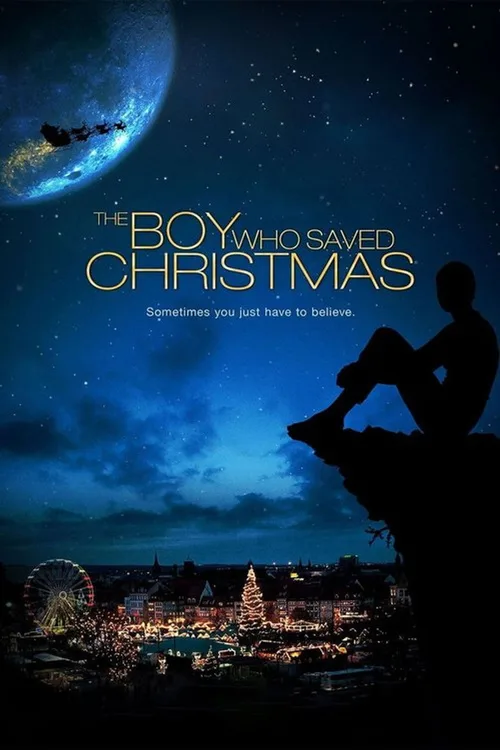
Sometimes you just have to believe.
The Boy Who Saved Christmas (1998)
Santa's evil twin kidnaps Santa, planning on reversing Christmas forever, not counting on the courage of a boy and his friends who embark on an adventure to rescue Santa.
 rating 6/10 User rating 7 votes 33%
 ❄ Christmas Connection
The movie is literally about how Christmas traditions arrived in America, following Sinterklaas and his companion Pete as they sail from the Netherlands to colonial New Amsterdam. It dramatizes the origin story of American Christmas customs, from gift-giving to the figure who became Santa Claus. The holiday is not incidental; it's the entire point of the film.
Where to Watch


Our Review
Most Christmas movies take the mythology as given. Santa exists, elves exist, the North Pole exists, and the whole apparatus runs on belief and goodwill. The Boy Who Saved Christmas, the 1998 CBS TV movie also released under the title Santa and Pete, does something different. It asks where the mythology came from in the first place, and it finds an answer rooted in real history.
The film adapts Christopher Moore's 1992 children's book Santa and Pete, which drew on the actual historical figure of Sinterklaas and his companion Zwarte Piet, a character whose origins remain genuinely contested among historians and whose portrayal has grown increasingly controversial in the Netherlands and Belgium. The movie sidesteps the most fraught aspects by making Pete a Moorish sailor, played by James Earl Jones, who accompanies the Dutch bishop Sinterklaas, played by Hume Cronyn, to the shores of New Amsterdam in the 1600s.
What "Santa and Pete" Is Actually About
The framing device is a grandfather, played by Jones, telling his grandson the story of how American Christmas traditions began. The story itself follows young Nicholas (a different Nicholas from Sinterklaas, confusingly), a Dutch boy in colonial New Amsterdam who befriends Pete and helps reunite him with Sinterklaas after the two are separated during their voyage from the Netherlands.
The central argument the film makes is historically grounded. Dutch settlers in New Amsterdam did bring Sinterklaas traditions to what would become New York, and those traditions did influence the American version of Christmas over the following two centuries. The word "Santa Claus" derives directly from the Dutch "Sinterklaas." That's not invented mythology for the sake of a children's film; that's documented cultural history.
Pete's role in the story is to serve as cultural bridge and keeper of knowledge about the traditions. The film treats him as an equal partner to Sinterklaas, not a servant, and James Earl Jones brings enough gravity to the role that this reads as earned rather than token. His voice alone could make a reading of the phone book feel significant.
The Casting Does Most of the Heavy Lifting
Hume Cronyn was 87 when this film was made. He plays Sinterklaas not as a jolly fat man but as a serious, somewhat austere Dutch bishop who genuinely cares about children and tradition. It's an interesting choice. The performance strips the character back to something older and stranger than the Coca-Cola Santa most viewers know, which fits the film's historical framing perfectly.
Jones, by contrast, radiates warmth. The dynamic between the two men works because they feel like genuine colleagues with history between them. You believe these two have sailed across the Atlantic together, argued about logistics, and shared meals for decades. The movie doesn't oversell the relationship; it lets the actors do the work.
The child actors are adequate, which is about as much as you can expect from a made-for-television production with a modest budget. The colonial New Amsterdam sets look exactly like what they are: a period production that spent its money carefully and hoped nobody looked too closely at the edges.
A Christmas Movie With Something to Actually Say
The multicultural angle in Santa and Pete is not grafted on for contemporary optics. Moore's original book was published in 1992 specifically to offer children of color a connection to Christmas mythology, and the film inherits that intent. The argument the movie makes is that the traditions Americans associate with Christmas have always been a mixture of contributions from different peoples and cultures, not a monolithic inheritance from a single source.
This is historically defensible. American Christmas as we know it was assembled from Dutch, German, English, and Nordic sources over roughly two centuries. The Sinterklaas-to-Santa-Claus transformation happened through multiple cultural intermediaries, including Washington Irving's satirical writings and Clement Clarke Moore's 1823 poem, which itself borrowed from Dutch folk traditions Moore had encountered in New York. The movie condenses and dramatizes this but doesn't fundamentally distort it.
For a CBS holiday special, that's a higher intellectual ambition than most. It doesn't entirely succeed as cinema, but it succeeds as an argument.
The Limits of the Made-for-TV Format
Director Duwayne Dunham had worked as an editor on Star Wars and Blue Velvet before moving into family television, most notably directing Homeward Bound: The Incredible Journey (1993). He brings a professional, unshowy competence to Santa and Pete. The film moves, the performances are handled with care, and nobody embarrasses themselves.
What the format can't provide is any real visual ambition. The colonial New Amsterdam of the film looks like a backlot, because it is. The ship arriving in harbor is handled with the bare minimum required to sell the scene. None of this is disqualifying for a TV movie, but it does mean that anyone hoping for the production values of a theatrical Christmas release will be disappointed.
The script is also uneven. Some scenes are quietly effective, particularly those between Jones and Cronyn. Others feel rushed in the way that television holiday specials often feel rushed, as though several beats were cut to hit a runtime.
Still, the movie earns its place in the Christmas catalogue. It offers something most holiday films don't bother with: a plausible account of how a tradition traveled across an ocean and changed in the crossing. That's worth an hour and a half of anyone's December.
Fun Facts
The movie is based on Christopher Moore's 1992 children's book Santa and Pete, which was written to give African American children a connection to the historical origins of American Christmas traditions.
Hume Cronyn, who plays Sinterklaas, was 87 years old during filming. He had been acting since the 1930s and this was one of his final major television roles before his death in 2003.
The word "Santa Claus" is a direct anglicization of the Dutch "Sinterklaas," which is itself a contraction of "Sint Nikolaas" (Saint Nicholas). Dutch settlers in New Amsterdam brought the Sinterklaas tradition to what would become New York in the 1600s.
The historical Zwarte Piet figure in Dutch tradition has origins that remain disputed: some historians trace him to a demon or devil that Sinterklaas defeated, while others argue the character acquired Moorish characteristics through contact with Spanish colonial influence during the period when Spain ruled the Netherlands.
Director Duwayne Dunham cut his teeth as a film editor, having worked on Star Wars: Return of the Jedi (1983) and David Lynch's Blue Velvet (1986) before transitioning to directing family films.
Washington Irving's 1809 satirical history A History of New York was one of the first American texts to describe Sinterklaas in a form resembling the modern Santa Claus, depicting him flying over rooftops and dropping gifts down chimneys. The film draws on this same colonial New York setting that Irving satirized two centuries earlier.
The broadcast title The Boy Who Saved Christmas was used for some airings and home video releases, while Santa and Pete was used for others, matching the title of Moore's original book. The dual titling caused confusion that persists in streaming catalogues today.