
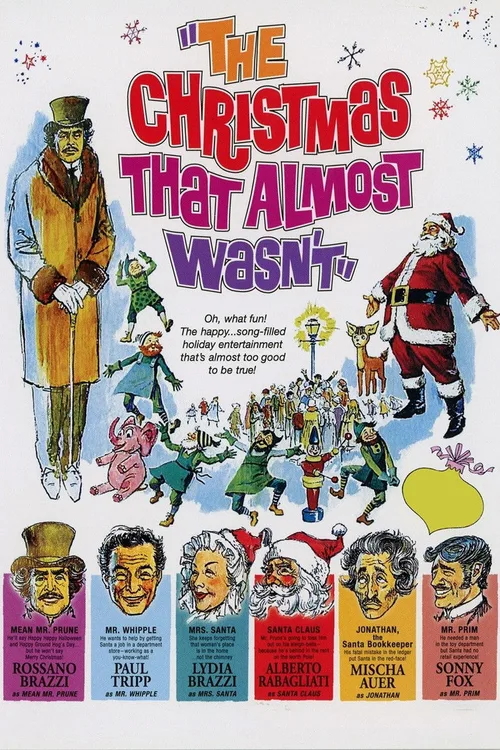
A more wonderful...more magical...more musical entertainment than this - there just isn't!
The Christmas That Almost Wasn't (1966)
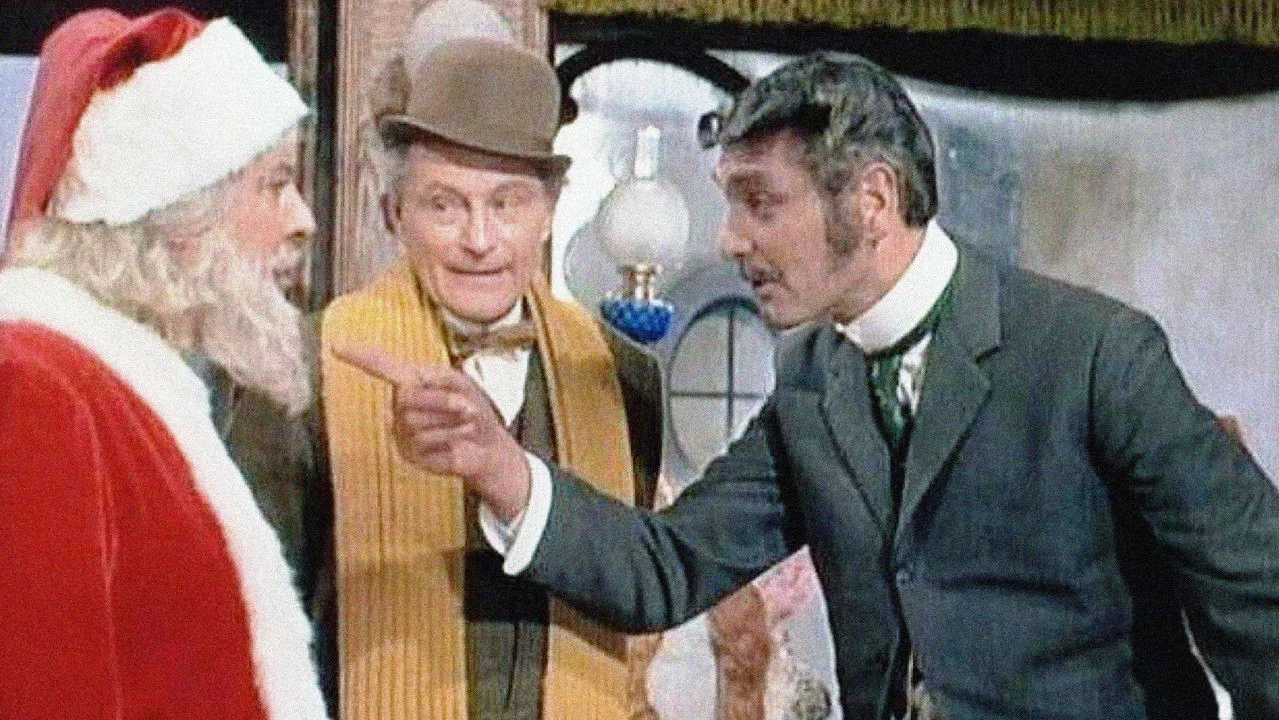
Sam Whipple, an attorney in once-upon-a-time-land, is startled to receive a visit from Santa Claus shortly before Christmas. It seems that when he was a child, Sam wrote a letter thanking Santa for the presents he'd received, and offering to return the favor someday. That day is now - a mean old soul named Phineas Prune, who holds the deed to the North Pole, is demanding back rent. Otherwise, he's going to evict Santa, Mrs. Claus and the elves and take all the Christmas toys. It's up to Sam and Santa to find a way to pay off Prune and prevent Christmas from being canceled.
 rating 5/10 User rating 31 votes 29%
 ❄ Christmas Connection
The entire plot turns on whether Christmas will survive at all. An evil landlord threatens to evict Santa from the North Pole unless he can pay back rent, which means no toy workshop, no sleigh, no Christmas. The movie has nothing to offer except its Christmas premise.
Where to Watch


Our Review
In 1966, Italian actor and director Rossano Brazzi made a Christmas musical in which Santa Claus is served an eviction notice by a landlord named Phineas T. Prune. If that sentence does not immediately tell you whether this film is for you, nothing will. The Christmas That Almost Wasn't (originally titled Il Natale che quasi non fu) is a low-budget Italian-American co-production that was quickly forgotten by most people who saw it and fervently remembered by a small number who saw it at exactly the right age.
It is a strange film. Not strange in an unsettling way, but strange the way a dream is strange: internally consistent, cheerfully illogical, and populated by adults behaving in ways no adult would behave.
The Plot, Which Is Exactly What It Sounds Like
Phineas T. Prune (played by Rossano Brazzi himself, in a performance of committed villainy) owns the North Pole. Santa Claus has been renting it. Prune, who hates Christmas for reasons that are gestured at but never fully excavated, has decided to collect on years of unpaid rent. If Santa can't pay, he's out. No North Pole, no workshop, no Christmas.
Santa turns to a young lawyer named Sam Whittler, played by American actor Alberto Rabagliati's son, to help him find a solution. The solution involves Santa taking a department store job to earn money in time. This is the kind of plot that makes complete sense when you are six years old.
The screenplay, co-written by Brazzi and Paul Tripp, doesn't belabor the stakes. It trusts the audience, which consists almost entirely of children, to accept that Christmas will be canceled if a real estate dispute isn't resolved by December 24th. The film moves at a brisk pace that leaves no room for questions like "why does Santa need to pay rent" or "who exactly is this landlord's landlord."
Rossano Brazzi: The Wrong Man for the Right Part
Brazzi is the reason this film exists at all. He produced, directed, and starred in it, which is the kind of creative control that either produces a masterpiece or a monument to unchecked impulse. The Christmas That Almost Wasn't is not a masterpiece.
By 1966, Brazzi was best known internationally for Summertime (1955) with Katharine Hepburn and his appearance in South Pacific (1958). He was a handsome, earnest leading man with genuine screen presence. As Phineas T. Prune, he plays against that entirely, leaning into theatrical menace with what appears to be great personal satisfaction. His Prune is not scary. He's too theatrical for that. But he's committed, which is the next best thing in a film like this.
The disconnect between Brazzi's evident talent and the material he chose to direct is one of the film's genuine pleasures. He treats every scene with the seriousness of a man who believes he is making something important. The film benefits from this. A director who winked at the camera throughout would have produced something unwatchable.
A Musical in the Loosest Sense
The film contains songs. They are original compositions by Paul Tripp and Ray Carter, performed with the kind of theatrical gusto common to children's entertainment of the era. None of them became standards. None of them will lodge in your head the way genuinely memorable holiday songs do. But they serve the story, which is the minimum requirement.
The production design reflects the budget honestly. The North Pole looks like a television studio set, which it essentially was. Elves wear outfits that suggest someone had access to a good fabric store and a limited number of patterns. Santa's workshop looks like a workshop rather than a magical realm, which is either charming or deflating depending on what you bring to it.
Why People Remember It
The film had a long afterlife on Italian and American television in the 1970s and 1980s, which is how cult Christmas movies acquire their cults. Children watching it during those years had no context for the oddness of Brazzi directing himself as a villain in a low-budget fantasy. They simply absorbed it.
The film was released on home video and later found its way to streaming platforms, where a second generation encountered it. The reaction is reliably split: people who saw it as children experience a specific kind of nostalgia that has nothing to do with the film's quality. People encountering it fresh as adults find it baffling in an entertaining way.
Neither response is wrong. The film occupies the category of things that are genuinely bad but not boring, which is a harder achievement than it looks.
Should You Watch It
If you have children under the age of eight who will accept any Christmas-themed content placed in front of them, yes. The film is short (about 90 minutes), it has a villain with a great name, and the central conflict is legible to anyone old enough to understand that evictions are bad.
If you are an adult watching alone, you need to approach this as a document of a specific moment in Christmas entertainment history: the era when Italian filmmakers were producing English-language holiday content for international markets, when Rossano Brazzi thought this was a good use of his post-South Pacific career, and when a landlord named Phineas T. Prune seemed like a reasonable antagonist for a children's film.
The film ends with Christmas saved, Prune reformed, and children singing. It earns none of this conventionally. That's part of the appeal.
Fun Facts
Rossano Brazzi wore three hats on this production: he produced it, directed it, and played the villain Phineas T. Prune, marking one of the few times a film's primary creative force spent the entire runtime trying to cancel the holiday the film celebrates.
The film was a co-production between Italy and the United States, shot partly in Rome at Italian studios and partly in the United States. The original Italian title, Il Natale che quasi non fu, translates word-for-word to "The Christmas That Almost Wasn't."
Paul Tripp, who co-wrote the screenplay and songs, was an American children's entertainer best known for the television show Mr. I. Magination, which ran on CBS from 1949 to 1952. The Christmas That Almost Wasn't was an attempt to translate that sensibility to feature film.
Rossano Brazzi had appeared in South Pacific (1958) as Emile de Becque, a role that brought him major international recognition. Choosing to follow that with a low-budget Christmas fantasy in which he played a landlord who hates Santa remains one of the stranger career pivots of 1960s Hollywood.
The film was largely forgotten after its initial release but was revived through Italian and American television broadcasts during the 1970s and 1980s, which is how it accumulated the cult audience it has today. Home video release extended that audience further.
The name "Phineas T. Prune" follows the Victorian tradition of naming villains after unpleasant or shriveled things, a convention visible in Dickens and carried forward into children's entertainment through the 20th century.
The movie was released in 1966, the same year as the first broadcast of How the Grinch Stole Christmas (December 18, 1966), a television special with a structurally similar premise: a creature opposed to Christmas attempts to stop it and fails. Brazzi's film predated the Grinch broadcast by weeks but reached a much smaller audience.
Cast