
The Greatest Store in the World (1999)
Geraldine and her two daughters, Livvie and Angeline, are living rough on the streets on London. When their van blows up, they must find an alternative place to stay. At first, they live in temporary housing, but the conditions are unbearable. Geraldine reacts quickly and the family decides to take up residence in Scottley's, the best department store in London. They must keep it a secret from doorman Brian (whom the girls call Mr. Whiskers), and a couple of bumbling thieves who want to rob the store safe of its jewels.
 rating 7/10 User rating 6 votes 48%
 ❄ Christmas Connection
The entire story takes place inside a department store in the weeks before Christmas, using the festive consumer spectacle as both setting and thematic backdrop. The family's homelessness is thrown into sharp relief by the abundance of goods surrounding them during the most gift-obsessed time of year. The film aired on Christmas Eve 1999 on BBC One as a seasonal special.
Our Review
On Christmas Eve 1999, BBC One aired a 74-minute film for children that begins with a girl in police custody. That's the setup. Not Santa, not baubles, not a jolly montage of decorating a tree. A child, alone, being questioned by police on Christmas morning while her mother is somewhere in the building. The Greatest Store in the World earns its title by being something rarer than its premise suggests: a BBC Christmas special that actually has something on its mind.
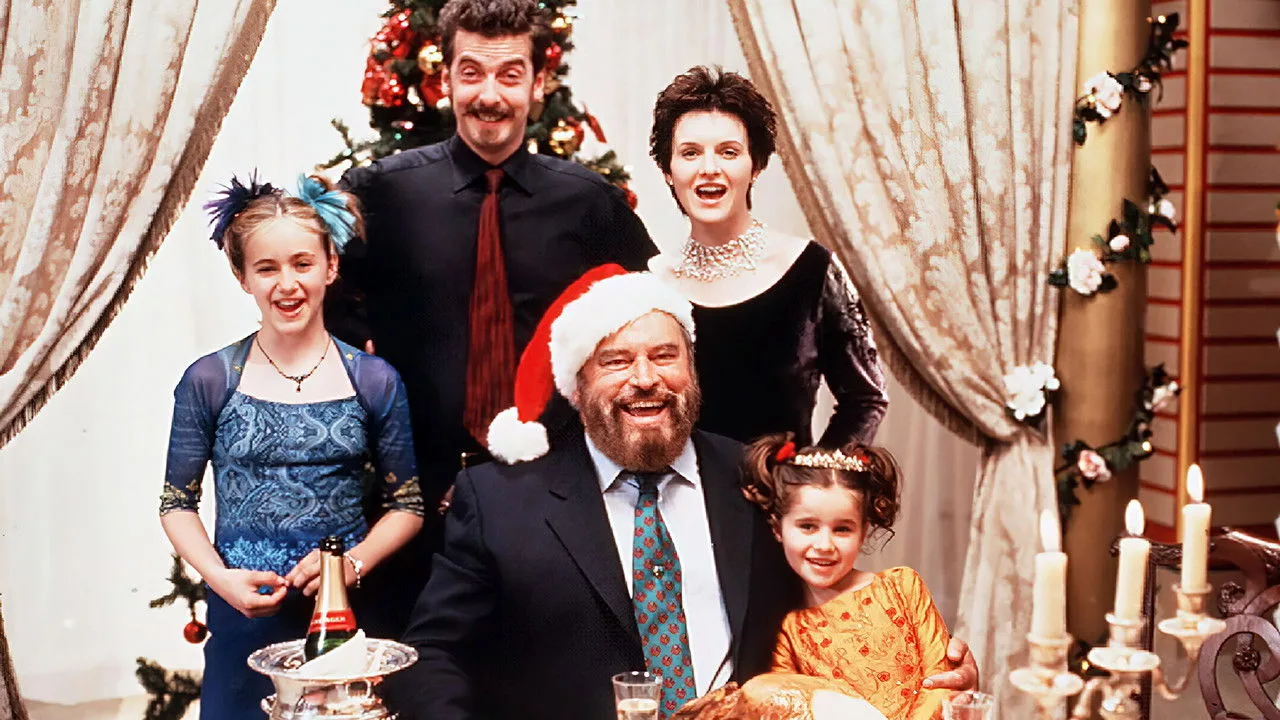
The story, adapted by Alex Shearer from his own novel, follows Geraldine (Dervla Kirwan), a single mother whose camper van explodes, leaving her and her two daughters, Livvie (Elizabeth Earl) and young Angeline (Holly Earl), without shelter in the weeks before Christmas. Their solution is pragmatic and quietly desperate: move into Scottley's, a vast luxury department store modelled unmistakably on Harrods, where they actually filmed. They sleep in a camping tent display, eat from the food hall, wash in the changing rooms, and vanish into the stockrooms before the doors open each morning.
What the Cast Does With the Material
Dervla Kirwan, then best known to British audiences from Goodnight Mister Tom and Ballykissangel, plays Geraldine with the kind of controlled exhaustion that child-targeted television rarely asks of its lead performers. She's not a saintly struggling mother. She's scattered, resourceful, occasionally selfish in the way that survival forces people to be, and genuinely funny. The film trusts her to carry that tension without resolving it into easy warmth.
Peter Capaldi, fifteen years before the TARDIS, plays Mr. Whiskers, the doorman who suspects something is wrong and slowly becomes the family's unlikely ally. It's a small role written as a comic foil, but Capaldi makes the transition from suspicious authority figure to soft-hearted accomplice feel earned rather than convenient. He understood very early in his career how to do a lot with limited screen time.
The film is, in honesty, stolen by the Earl sisters. Elizabeth and Holly Earl, who are sisters in real life, play Livvie and Angeline with a grounded naturalism that sidesteps every temptation toward cuteness. Holly Earl, who was seven at the time of filming, would go on to roles in Humans and Cuckoo. The raw material was clearly there.
Brian Blessed plays the store's owner, Mr. Scottley, at full Blessed volume. Ricky Tomlinson is the store's Father Christmas, who turns out to be planning to rob the safe with his elf accomplice (Sean Hughes). These are the film's comic villains, and they work because neither actor is trying to be menacing.
The Homelessness Angle Nobody Mentions
Children's Christmas films tend to bracket poverty as a solvable problem. A kind stranger appears. A miracle occurs. The family gets the thing they were missing. The Greatest Store in the World is more complicated than that. Geraldine and her daughters are not waiting for magic. They have already exhausted legitimate options. Their situation is the result of specific, mundane bad luck compounded by a housing system that has no room for them.
The store's abundance sits directly against this fact throughout the entire film. Geraldine's daughters press their faces against glass cases full of toys they cannot have. They walk through a food hall that could feed a street for a week while being careful not to take more than they need. The film never editorialises. It simply places these things next to each other and lets the audience feel the gap.
Shearer's novel apparently went deeper into the social commentary than a 74-minute children's special could sustain, but director Jane Prowse keeps enough of the friction intact that the film never becomes a cosy fantasy. The happy ending is genuinely hard-won, and it doesn't pretend that Geraldine's problems are fully solved.
A BBC One Christmas Eve at 4:15pm
The film aired on Christmas Eve 1999 at 4:15 in the afternoon, slotted precisely for the moment when children are at maximum anticipation and parents need 74 minutes of quiet. That context matters. The BBC took that slot seriously. They did not fill it with whatever was cheap. They commissioned something original, filmed it in Harrods (which required the production to work around actual trading hours), scored it with Carl Davis, and gave it a cast that included at least four recognisable British faces from completely different registers of fame.
There is also a S Club 7 cameo, because it was 1999 and S Club 7 were on every BBC programme that year. Brian Blessed dances with them. It is exactly what it sounds like.
The film was nominated for a BAFTA for Best Children's Drama at the 2000 ceremony. It did not win, but the nomination tells you something about how the industry read it at the time. This was not considered a throwaway commission.
Fun Facts
The film was shot on location inside Harrods in Knightsbridge, London, which required the production to film around the store's regular trading hours. The department store appears as the fictional "Scottley's" throughout the film.
Holly Earl, who played the younger daughter Angeline, was born in 1992, making her approximately seven years old during production. She later appeared as a main cast member in seasons of Humans (2018) and the recurring comedy series Cuckoo (2012-2016).
The film was broadcast on BBC One on 24 December 1999 at 4:15pm, a slot that was one of the most watched afternoon time periods of the year due to pre-Christmas scheduling.
Alex Shearer wrote both the original novel and the screenplay adaptation, making this one of the rarer cases of an author adapting their own children's book for BBC television in the same year the novel was published.
The score was composed by Carl Davis, a veteran film and television composer best known for his work on silent film accompaniments, including the definitive score for Napoleon (1927).
The film was nominated for Best Children's Drama at the BAFTA Children's Awards ceremony in 2000, two months after its Christmas Eve broadcast.
Pop group S Club 7, who were at the peak of their BBC-backed media presence in 1999, appear in a cameo sequence alongside Brian Blessed's character Mr. Scottley. It was their first appearance in a feature-length drama.
Peter Capaldi, who plays doorman Mr. Whiskers, would later return to BBC One in an equally memorable Christmas broadcast when he made his debut as the Twelfth Doctor in the Doctor Who Christmas special "Last Christmas" in December 2014.
Cast