
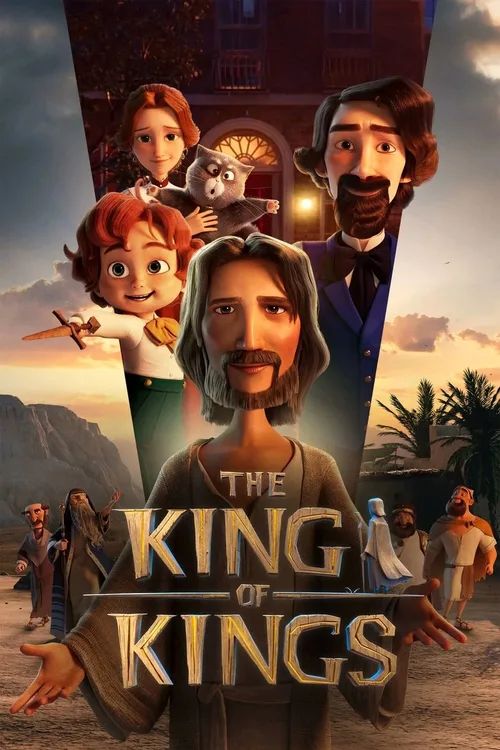
A father's greatest joy is raising his son.
The King of Kings (2025)
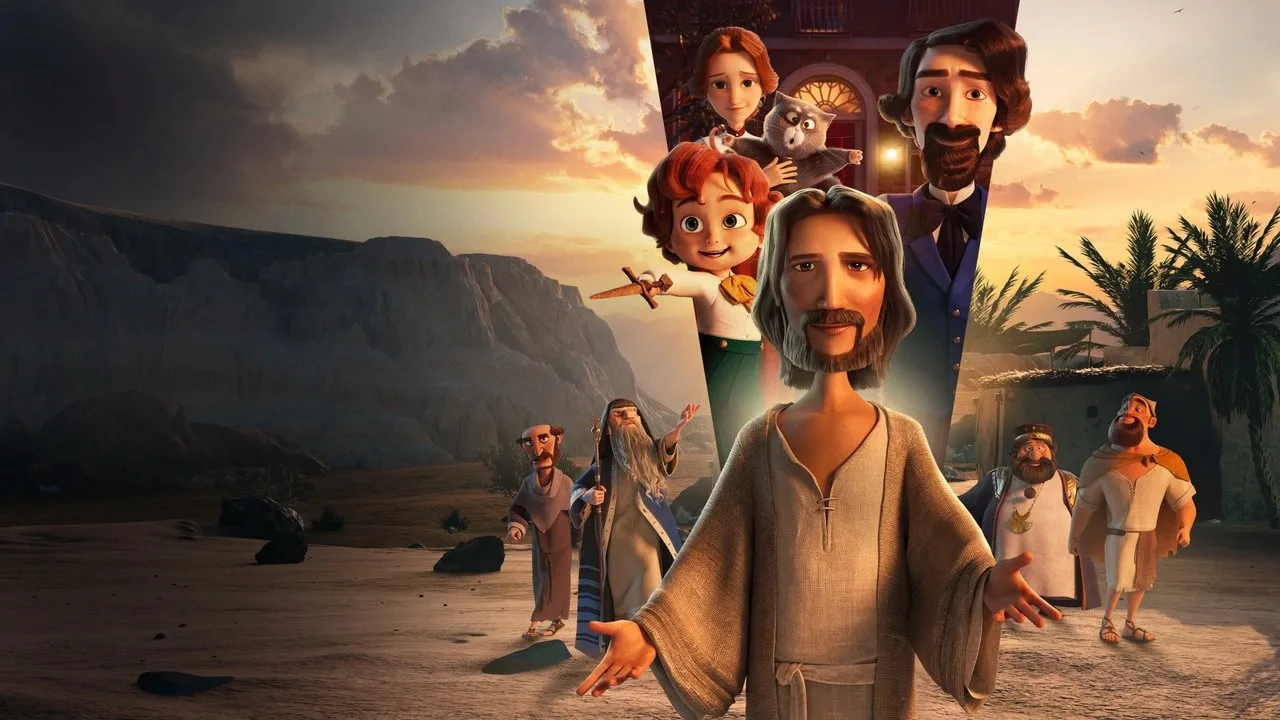
Charles Dickens tells his young son Walter the greatest story ever told, and what begins as a bedtime tale becomes a life-changing journey. Through vivid imagination, the boy walks alongside Jesus, witnessing His miracles, facing His trials, and understanding His ultimate sacrifice.
 rating 6/10 User rating 143 votes 83%
 ❄ Christmas Connection
The film is built directly on Charles Dickens' private manuscript The Life of Our Lord, which Dickens wrote between 1846 and 1849 exclusively to read aloud to his children every Christmas. That family tradition is the narrative spine of the movie. The story opens with Dickens disrupting a Christmas Carol performance to tell his son Walter a story, making Christmas the literal occasion for the entire film.
Where to Watch


Our Review
Charles Dickens wrote a book about Jesus that he refused to publish. He wrote it between 1846 and 1849 as private reading material for his children, gathered the family every Christmas, and read it aloud. He forbade publication so strictly that he begged his sister-in-law to ensure no copy ever left the house. The manuscript stayed hidden inside the Dickens family for 64 years after his death, finally appearing in print in 1934 only after the last of his children died. That story alone is more gripping than most biopics ever manage.
The King of Kings, the 2025 animated film from South Korean studio Mofac and distributed by Angel Studios, takes that remarkable premise and builds a Christmas-adjacent family film around it. The result is a film that cannot quite decide what it wants to be: a theological primer, a Dickens character study, or an animated spectacle. It tries to be all three. It fully succeeds at none of them. But it is, despite the hedging in that sentence, genuinely worth watching.
The Framing Device and Why It Both Works and Doesn't
The setup is clever enough on paper. Kenneth Branagh plays Dickens, performing A Christmas Carol on stage in London when his young son Walter (voiced by Roman Griffin Davis, the kid from Jojo Rabbit) causes backstage chaos and ruins the show. Rather than punishing Walter, Dickens sits down and tells the boy about a king greater than King Arthur. That king is Jesus, and the film then becomes Dickens narrating the Gospels to his son.
Branagh is very good here. He brings warmth and weight to Dickens without tipping into pantomime, and the dynamic between father and son has genuine tenderness. The problem is that the Dickens frame keeps interrupting the Jesus narrative at inconvenient moments, with Walter and even his cat somehow materializing inside biblical scenes. Critics were divided on whether this is charming or simply distracting. It is mostly the latter. The Gospel story has enough momentum on its own. Every time the film cuts back to Victorian London, you feel the air going out of the room.
The Voice Cast: Star Power, Uneven Results
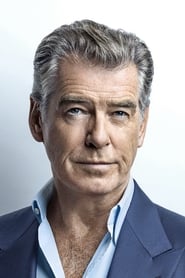
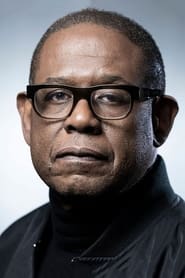
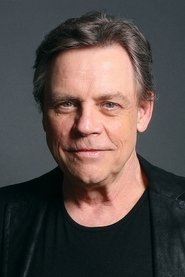
For a production budgeted at roughly 36 billion Korean won (about $25 million before marketing), the filmmakers assembled a voice cast that would embarrass most live-action productions. Oscar Isaac voices Jesus. Pierce Brosnan plays Pontius Pilate. Mark Hamill is King Herod. Forest Whitaker voices Peter. Ben Kingsley plays the High Priest Caiaphas. Uma Thurman voices Catherine Dickens. These are not small names cashing an easy paycheck; the performances are audibly engaged.
Hamill is the unexpected highlight. His Herod is menacing and slightly theatrical in exactly the right way, and Hamill has enough range from decades of voice work to make the character feel dangerous rather than campy. Kingsley's Caiaphas is dignified and cold. As for Isaac, reviews split sharply. Some critics found his Jesus appropriately serene. Others found him monotone and emotionally distant. My read: Isaac is playing the character as written, and the character as written does not give him much room. Jesus in this film is more emblem than person.
The Animation: Competent but Generic
Director Seong-ho Jang spent his career in Korean visual effects before making this, his debut as a director, and his background shows. The film has impressive large-scale sequences. Bethlehem looks like a real place. The crowd scenes are handled with more confidence than most productions at this budget level. The landscape compositions have a studied quality that works in the film's favor.
The character animation is where things unravel. The human figures have the oversized-head, hyper-smooth-skin look that gives away lower-tier CG animation immediately. Lip-sync reportedly suffers in places, likely because the film was originally produced in Korean and later dubbed. These are not fatal flaws, but they are visible ones, and in a film asking you to emotionally invest in the last days of Christ, visible technical seams are a problem.
Is It a Christmas Movie?
Yes and no. The film released on April 11, 2025, timed for Holy Week and Easter. Its box office strategy was entirely built around that calendar position. The film opened to $19.4 million, broke the record for the highest opening weekend for an animated biblical film (the previous record holder was The Prince of Egypt's $14 million opening in 1998, which had stood for 27 years), and eventually earned $80.6 million worldwide.
But the Christmas connection is real and not incidental. Dickens wrote The Life of Our Lord as a Christmas tradition. The film opens during a performance of A Christmas Carol. The framing device is explicitly Christmas. If you are looking for tinsel and carols, this is not that film. If you are interested in how Christmas and the Nativity story have been kept alive in Western culture, this is a genuine artifact of that tradition, packaged for modern family audiences.
What the Film Gets Right
Two things work consistently well. First, the story of Dickens and his manuscript is genuinely moving when the film remembers to use it properly. The image of a famous author, wealthy and publicly celebrated, choosing to keep the most personally important thing he ever wrote entirely private because it was meant only for his family is a quiet and powerful idea. The film does not fully excavate it, but you can feel it underneath.
Second, the film respects its young audience. This is children's storytelling, but it does not condescend. The crucifixion is handled with restraint but not dishonesty. The film trusts that children can handle difficult material if it is presented with care. That trust is earned.
The Roger Ebert site's Matt Zoller Seitz observed that the material could have been handled with more passion and imagination, which is fair. But "more passion was possible" is a different criticism than "this fails." The film does not fail. It aims at something modest and mostly achieves it.
Fun Facts
Charles Dickens wrote The Life of Our Lord between 1846 and 1849 strictly for private family use. He forbade publication during his lifetime, and the manuscript was not published until 1934, 64 years after his death, once the last of his children had died.
The film's $19.4 million opening weekend broke a record that had stood for 27 years: The Prince of Egypt held the top opening weekend for an animated biblical film since its $14 million debut in December 1998.
The production is South Korean (Mofac Animation), with visual effects handled by Animost Studio in Vietnam and post-production completed at SunJive Studios in Adelaide, Australia.
Director Seong-ho Jang spent his career as a VFX supervisor on Korean film productions before making The King of Kings, which is his debut as a feature film director.
The original score was composed by Kim Tae Seong, whose previous credits include the Korean sci-fi film Space Sweepers and the Netflix series Gyeongseong Creature.
Roman Griffin Davis, who voices young Walter Dickens, became famous at age 11 playing the lead in Taika Waititi's Jojo Rabbit (2019), which won the Academy Award for Best Adapted Screenplay.
The film's total production budget was approximately 36 billion Korean won (around $25 million USD), making it a high-stakes bet on a global English-language market from a Korean animation studio with no prior US theatrical experience.
Angel Studios, which distributed the film, also distributed Sound of Freedom (2023), which earned $250 million worldwide on a $14.5 million budget, establishing the company as a major player in faith-based theatrical releases.
Cast