
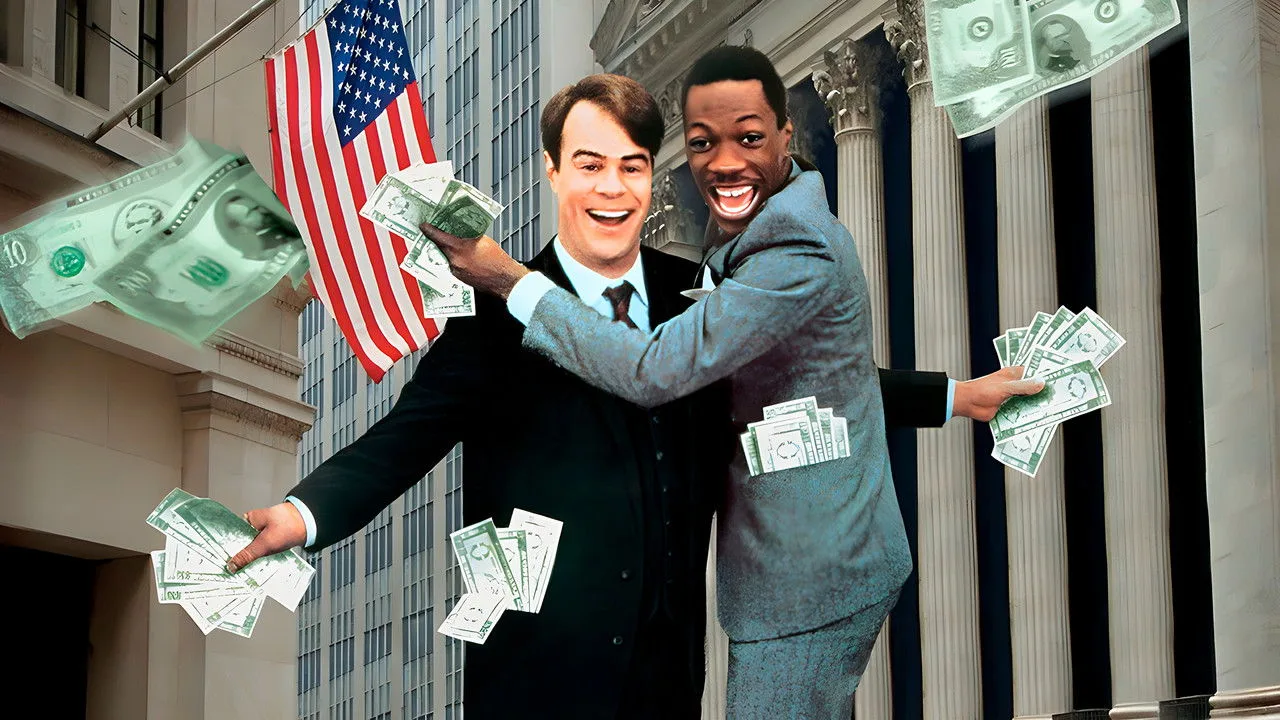
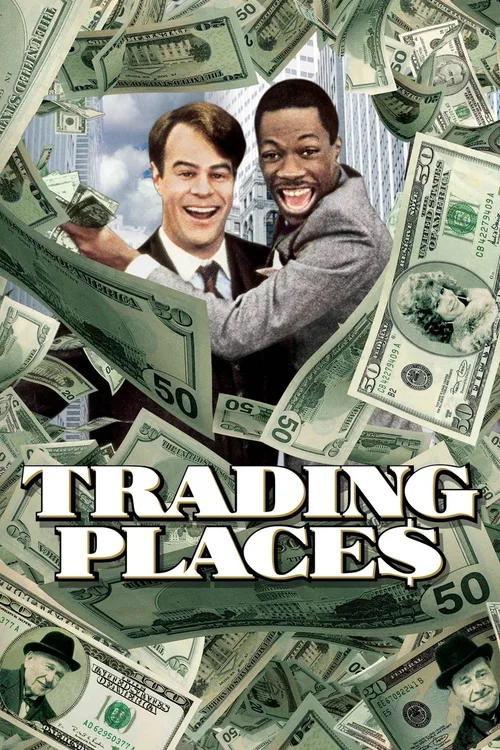
They're not just getting rich... They're getting even.
Trading Places (1983)
A snobbish investor and a wily street con-artist find their positions reversed as part of a bet by two callous millionaires.
 rating 8/10 User rating 3,588 votes 72%
 ❄ Christmas Connection
Christmas in Trading Places isn't just a backdrop. The holiday party is where the bet's cruelty becomes fully visible, and the New Year's Eve train sequence sets up the entire revenge plot. The movie uses Christmas as the pivot point between downfall and redemption.
Where to Watch


Our Review
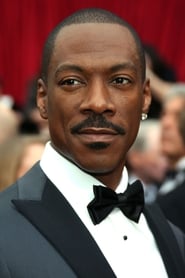
Trading Places opens with a split screen of two Philadelphias. One is the wood-paneled world of the Heritage Club, where Randolph and Mortimer Duke debate nature versus nurture over brandy. The other is a freezing sidewalk where Billy Ray Valentine, played by Eddie Murphy at 22, hustles spare change by pretending to be a blind, legless veteran. By Christmas, these two worlds will collide in one of the sharpest social comedies Hollywood has ever produced.
Is Trading Places a Christmas Movie?
This question comes up every December, and the answer is yes, with a caveat. Trading Places doesn't have the sentimental warmth of a traditional Christmas movie. There's no redemption arc driven by holiday spirit, no child learning the meaning of giving. Instead, the film uses Christmas the way Dickens used it: as a lens for examining class, greed, and the paper-thin line between comfort and ruin.
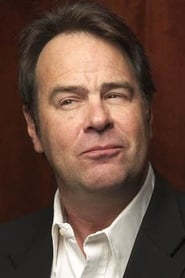
The holiday setting isn't decorative. Christmas is when Louis Winthorpe III (Dan Aykroyd) hits bottom, showing up to the Heritage Club party in a filthy Santa suit with a stolen salmon stuffed down his coat. It's when Billy Ray, installed in Winthorpe's old life, overhears the Dukes revealing that their entire social experiment was settled for a one-dollar bet. Christmas is the mechanism that strips away every illusion.
The One-Dollar Bet That Drives Everything
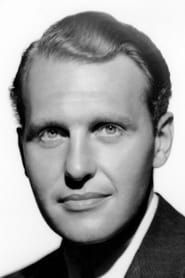
The genius of Trading Places is its premise. Randolph Duke (Ralph Bellamy) believes environment shapes a person. Mortimer (Don Ameche) believes breeding is destiny. To settle the argument, they arrange for Winthorpe to be stripped of his job, home, money, and reputation while Valentine is handed all of it. The cost of this experiment to the two old men? One dollar.
Director John Landis never lets you forget the casual cruelty of that bet. The Dukes don't hate Winthorpe or Valentine. They simply don't regard either man as fully human. The brothers treat people the way they treat pork belly futures: as positions to be opened and closed.
That indifference is what makes the film's satire land harder than most comedies from 1983. The Dukes aren't villains in any dramatic sense. They're just rich enough to be bored.
Eddie Murphy, Dan Aykroyd, and the Cast
Murphy was coming off 48 Hrs. and Saturday Night Live when he took on Billy Ray Valentine. He's electric in every frame, but what makes the performance remarkable is its restraint. Billy Ray is smart from the first scene. Murphy doesn't play him as a fool who gets lucky; he plays him as someone whose intelligence never had anywhere profitable to go.
Aykroyd does the opposite arc with equal precision. Winthorpe starts as a smug, oblivious snob and descends into genuine desperation. The Christmas party scene, where he pulls a gun and considers ending his life, is played for dark comedy but lands with real weight.
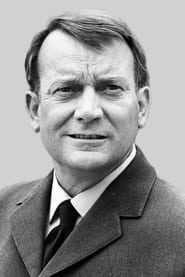
Jamie Lee Curtis as Ophelia, the sex worker who takes Winthorpe in, gives the film its warmest human moments. She's nobody's fantasy and nobody's victim. She runs a business, assesses risk like a trader, and decides Winthorpe is worth investing in. Denholm Elliott as the butler Coleman rounds out the revenge squad with quiet, dignified loyalty.
The Revenge Plot and That Ending
Once Billy Ray and Winthorpe discover they've both been played, they team up for one of the great revenge sequences in American comedy. The plan targets the Dukes where they actually live: their money. The frozen concentrated orange juice scheme on the commodities trading floor is genuinely clever, rooted in real market mechanics. Landis reportedly consulted actual traders to get the sequence right.
The final trading floor scene is chaotic, loud, and satisfying in a way that feels earned. The Dukes lose everything. Billy Ray and Winthorpe end up on a beach. Coleman pours drinks. It's not a Christmas ending, but it rhymes with one: the mighty are humbled, and the meek inherit a very comfortable retirement portfolio.
Why It Holds Up 40 Years Later
Trading Places was released in June 1983 and grossed over $90 million domestically. Its staying power as a Christmas movie came from television. For years, Italian television aired Trading Places every Christmas Eve, turning it into a holiday tradition on par with It's a Wonderful Life in the U.S. The tradition became so embedded in Italian culture that the film was broadcast on Christmas Eve on La7 for over a decade straight.
The movie's class commentary has only gotten sharper with time. The idea of billionaires treating ordinary people as pawns in a private wager doesn't feel like satire anymore. It feels like the business section.
Landis shot Philadelphia's real streets, real trading floors, and real social clubs. The city is a character, and the contrast between its marble-and-mahogany elite world and its frozen, indifferent streets does more work than any monologue could. The last time we see the Dukes, Mortimer is begging Randolph for money. It's December. Nobody's offering them a Santa suit.
Fun Facts
Eddie Murphy was just 22 years old during filming, making Trading Places only his second feature film after 48 Hrs. (1982).
The "Eddie Murphy Rule" (Rule 4c-1) was informally named after this film. It was included in the 2010 Dodd-Frank Act to ban insider trading in commodities futures markets.
Ralph Bellamy and Don Ameche reprised their roles as the Duke brothers in a brief cameo in Eddie Murphy's Coming to America (1988), where they appear as homeless men and Billy Ray's bet payoff comes full circle.
Jamie Lee Curtis was not the first choice for Ophelia. The role was originally offered to several other actresses before Curtis lobbied for it, wanting to break away from her horror film image.
The frozen concentrated orange juice (FCOJ) trading scheme at the end is based on real commodities trading mechanics. The crop report that drives the plot mirrors how USDA reports actually move agricultural futures.
In Italy, Trading Places (titled "Una poltrona per due," meaning "A Chair for Two") became a Christmas Eve television tradition. RAI and later La7 broadcast it annually on December 24th for decades, drawing millions of viewers each year.
The Heritage Club scenes were filmed at the real Union League of Philadelphia, one of the oldest private clubs in the United States, founded in 1862.
Cast