
THE MOST FABULOUS MUSIC-AND-MIRTH SHOW IN MOTION PICTURE HISTORY!
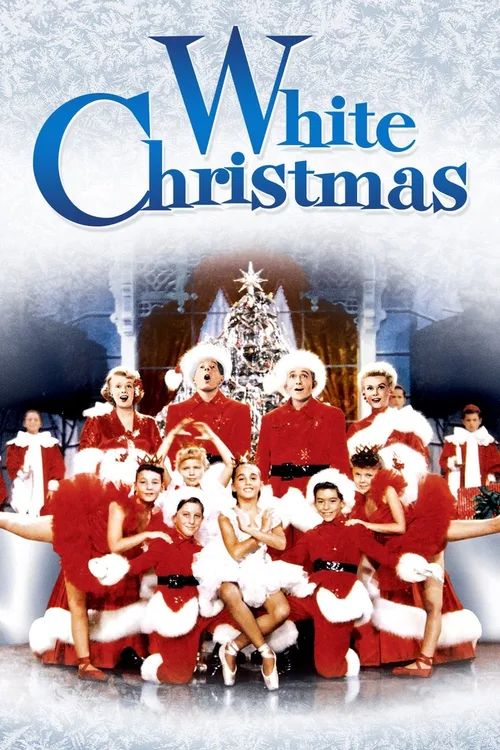
White Christmas (1954)
Two talented song-and-dance men team up after the war to become one of the hottest acts in show business. In time they befriend and become romantically involved with the beautiful Haynes sisters who comprise a sister act.
 rating 8/10 User rating 570 votes 72%
 ❄ Christmas Connection
The entire film builds toward a Christmas Eve show at a Vermont inn, with the holiday serving as both the narrative climax and emotional resolution. Irving Berlin's "White Christmas" is performed as the film's centerpiece, and the final scene delivers an actual white Christmas as snow falls on the cast.
Where to Watch


Our Review
White Christmas was not supposed to exist. Paramount had already built one film around Irving Berlin's Oscar-winning song, the 1942 musical Holiday Inn starring Bing Crosby and Fred Astaire. That film did well. The song did better. "White Christmas" became the best-selling single of all time, moving over 50 million copies worldwide. Twelve years later, Paramount decided the song deserved a bigger vehicle. The result was the first movie ever filmed in VistaVision, Paramount's widescreen answer to CinemaScope, and the highest-grossing film of 1954.
The White Christmas Cast and the Star Who Almost Wasn't
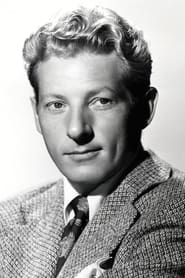
The role of Phil Davis was written for Fred Astaire. He turned it down. Donald O'Connor was cast next, but a bout of illness forced him to drop out. Danny Kaye stepped in, and the film is better for it. Where Astaire would have brought elegance and O'Connor would have brought acrobatic comedy, Kaye brought something stranger: a loose, improvisational energy that plays beautifully against Crosby's unshakable cool.
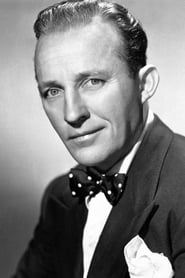
Bing Crosby was 51 during filming and already the biggest entertainer in America. He doesn't stretch himself here. He doesn't need to. Crosby plays Bob Wallace as a version of himself: relaxed, charming, capable of making any song sound like he's singing it for the first time. His performance of "White Christmas" at the film's climax is so effortless it almost disguises how technically precise his phrasing actually is.
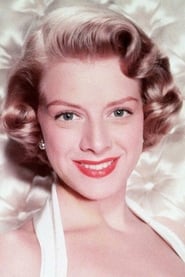
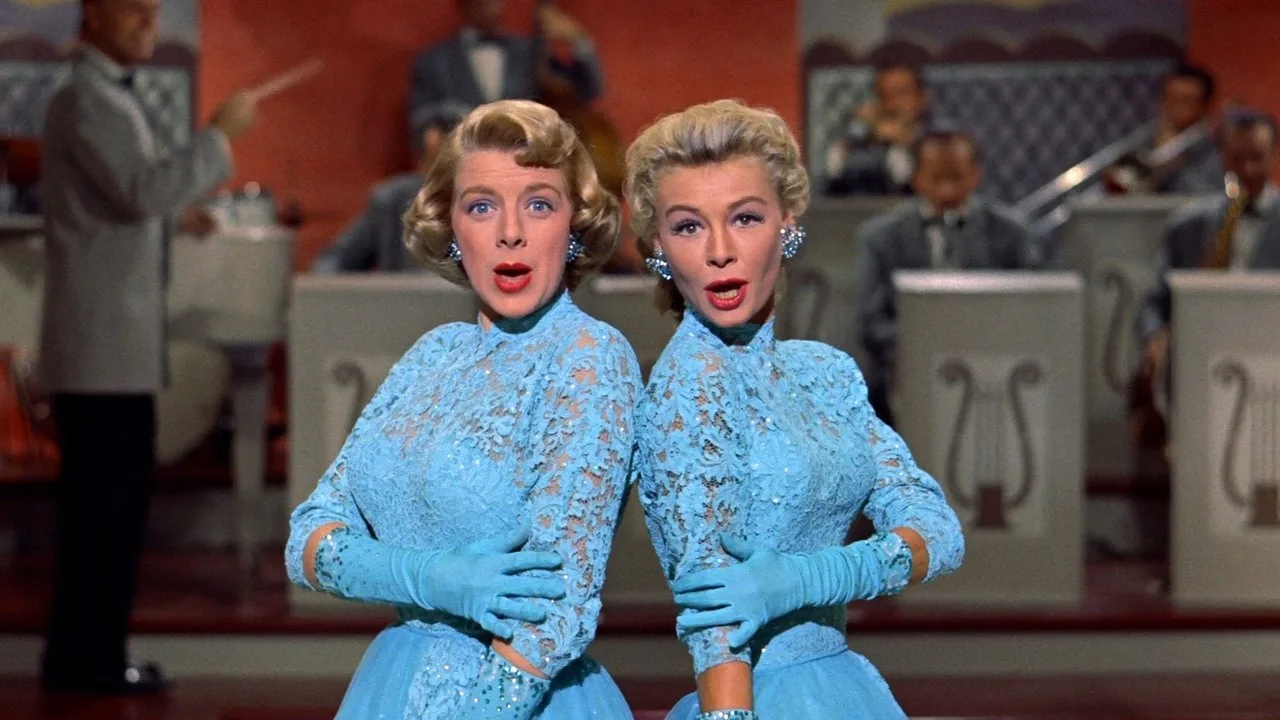
Rosemary Clooney plays Betty Haynes, the more serious of the sister act. Clooney was a legitimate recording star at the time, with "Come On-a My House" and "Mambo Italiano" on her resume. She brings real vocal power to the role, and her performance of "Love, You Didn't Do Right by Me" in a low-cut black dress is one of the film's few moments of genuine sultriness.
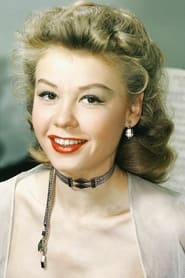
Vera-Ellen plays the younger sister Judy Haynes. She was one of the finest dancers in Hollywood at the time, but her singing was dubbed by Trudy Stevens throughout the film. Vera-Ellen's waist, rumored to measure just 17 inches, became the subject of Hollywood legend. The costume department designed every outfit to emphasize it.
Irving Berlin's White Christmas Soundtrack
Berlin wrote the original "White Christmas" for Holiday Inn in 1942, but for this film he composed an entirely new surrounding score. "Sisters" became a comedy staple, especially in the scene where Crosby and Kaye lip-sync to a recording of Clooney and Vera-Ellen performing it, complete with feathered fans. "Count Your Blessings Instead of Sheep" earned an Academy Award nomination for Best Original Song. "Snow" opens the second act with a breezy train number.
Berlin was 66 years old during production and still writing songs by hand on a custom transposing piano that could shift keys mechanically, since he only played in F-sharp. He visited the set regularly and maintained strict control over how his songs were arranged and performed. When Berlin didn't like how a number was staged, the director listened. Berlin's name above the title wasn't decorative. He had contractual approval over the musical sequences.
VistaVision and the Look of the Film
White Christmas was Paramount's test case for VistaVision, a process that ran 35mm film horizontally through the camera instead of vertically, producing a negative with roughly double the resolution. The format was designed to compete with 20th Century Fox's CinemaScope without requiring theaters to install new anamorphic lenses. Director Michael Curtiz, who had won an Oscar for Casablanca a decade earlier, used the wider frame to stage elaborate musical numbers that fill every corner of the screen.
The "Choreography" number, where Kaye leads a modern dance parody, uses the full width of the VistaVision frame to pack in dozens of dancers. The "Minstrel Show" sequence stages a full theatrical performance within the film, with Crosby and Kaye performing in period costume. These numbers were designed to sell the new format to theater owners, and they succeeded. Paramount rolled out VistaVision to hundreds of screens on the strength of this film's box office.
The Plot Nobody Watches For
The story is functional, nothing more. Two army buddies turned entertainers, Bob Wallace and Phil Davis, meet a sister act, fall in love, and end up at a struggling Vermont inn run by their former commanding general. The general is too proud to accept help, so the boys organize a big show to save the business. Phil schemes to matchmake Bob and Betty. A misunderstanding about a television publicity stunt creates a third-act conflict that resolves within ten minutes.
None of this matters, and the film knows it. White Christmas exists to deliver musical numbers, Technicolor spectacle, and the emotional payoff of its title song. The plot is scaffolding. Dean Jagger plays General Waverly with quiet dignity, giving the film's one genuinely affecting dramatic performance. His face when he sees his former soldiers filling the inn on Christmas Eve earns the sentiment that the rest of the film coasts on.
Why White Christmas Still Works
The film's longevity has little to do with its script and everything to do with atmosphere. Curtiz and cinematographer Loyal Griggs create a version of Christmas that feels like a memory even on first viewing: snow falling on a Vermont lodge, red and green costumes against warm wooden interiors, Crosby's voice filling a room. It's idealized to the point of fantasy, and it works precisely because it doesn't pretend otherwise.
The final sequence delivers exactly what the title promises. The barn doors of the inn open to reveal snow falling outside while Crosby sings "White Christmas" one last time. The entire cast assembles in holiday costumes. It's pure spectacle with zero irony. The song plays over the credits while the snow keeps falling, and for roughly three minutes, the movie becomes the Christmas card it always wanted to be.
Fun Facts
Irving Berlin's "White Christmas" single, first recorded by Bing Crosby in 1942, has sold an estimated 50 million copies worldwide, making it the best-selling single of all time by most accounts.
White Christmas was the first film shot entirely in VistaVision, Paramount's widescreen process that ran 35mm film sideways through the camera for higher resolution. The format was used for over 100 films before being phased out in the early 1960s.
Fred Astaire was the original choice for Danny Kaye's role. Astaire declined because he felt the part was too similar to his role in Holiday Inn (1942), the earlier film built around the same song.
Vera-Ellen's singing voice was entirely dubbed by Trudy Stevens. Vera-Ellen had been a trained singer earlier in her career, but a reported thyroid condition had damaged her vocal range by the time of filming.
The film grossed $12 million in 1954, making it the highest-grossing movie of the year. Adjusted for inflation, that's roughly $140 million in today's dollars.
Irving Berlin could only play the piano in the key of F-sharp. He used a custom-built transposing piano with a lever that mechanically shifted the keys so he could play in any key while his fingers stayed on F-sharp.
Rosemary Clooney later said that filming White Christmas was one of the most difficult experiences of her career, citing tensions with director Michael Curtiz, who she described as cold and dismissive toward actors.
The Vermont inn exteriors were actually filmed on a Paramount soundstage in Hollywood. No location shooting was done in Vermont. The snow was a mixture of gypsum, plastic, and shaved ice.
Cast