
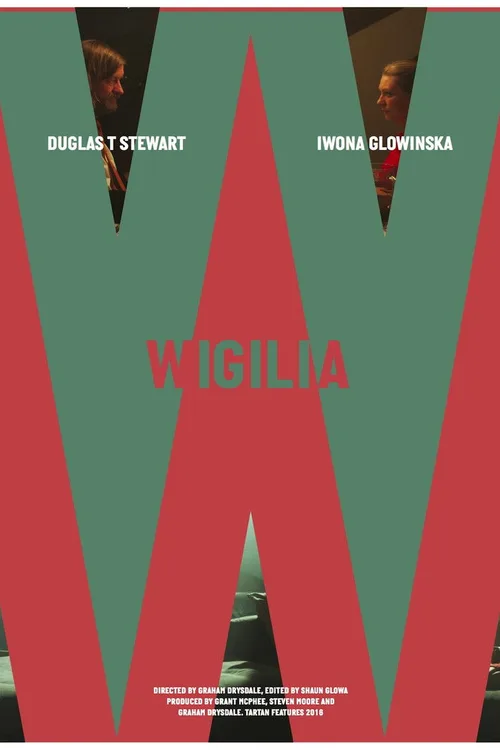
Wigilia (2014)
A traditional Polish feast on Christmas Eve, Wigilia includes an extra place at the table should an unknown wandering pilgrim arrive.
 rating 6/10 0
 ❄ Christmas Connection
Wigilia is named after Poland's most important Christmas tradition: the ceremonial Christmas Eve supper held on December 24th. The entire film is built around the ritual of one woman preparing and sharing that meal far from home. Every structural beat of the story turns on the custom of the empty place setting left for the unexpected pilgrim.
Where to Watch


Our Review
Wigilia is a 2014 Scottish-Polish drama that runs 72 minutes, cost approximately €4,000 to make, and is set almost entirely inside a single Glasgow house on Christmas Eve. On paper that reads like a student project. On screen it is something more honest than that.
The title is the Polish word for Christmas Eve, but more specifically it names the ceremonial supper that Poles regard as the year's most important meal. Not Christmas Day. Not a church service. December 24th, at dusk, with a white tablecloth and twelve meatless dishes and an empty place left at the table for whoever arrives without warning. Director Graham Drysdale, a lecturer at Queen Margaret University and veteran of Scotland's micro-budget scene, built his debut feature entirely around that tradition. The structure of the film is the structure of the ritual.
The Plot Follows the Empty Chair
Agata is a Polish woman working as a housekeeper in Glasgow. Her boss has left for the holidays and she has the house to herself, which she uses to prepare a proper wigilia in quiet solitude. She strings the extra place setting. She starts the cooking. She is alone, and she has arranged it so that she will not be.
Then Robbie turns up. He is her boss's brother, Scottish, unaware she would be there, unaware of what he has stumbled into. The film becomes a two-hander: a woman who has carried a tradition thousands of miles from home meeting a man who has no idea what he has been invited to.
Drysdale cast Iwona Glowinska (Polish, based in Glasgow) as Agata and Duglas T. Stewart as Robbie. Stewart is better known outside film circles as the frontman of the Glaswegian indie pop band BMX Bandits, a group Kurt Cobain once described as the one other band he would most want to be in. Neither performance is showy. Both are grounded in what the two actors actually know: Glowinska contributed her own experience of navigating Polish identity in Scotland; Stewart brought the specific texture of the Glasgow man who doesn't quite know what room he is in. Drysdale encouraged extensive improvisation, and much of the dialogue in the film emerged from those conversations rather than from a fixed script.
What the Film Gets Right About Wigilia
The empty place at the table is not a minor detail. Polish families have set it for centuries, but its meaning has shifted across generations. Before Christianity fully absorbed the winter solstice customs, that place was for ancestral spirits. Under Catholicism it became a seat for the wandering stranger, the unexpected guest who should never be turned away. During the Second World War and the partitions before it, Polish families used it to mark absent relatives who might never come back. The custom holds all of those meanings simultaneously.
Drysdale understood this well enough to make it the engine of the plot. Robbie does not arrive because the script needed conflict. He arrives because the empty place exists. That is the tradition working exactly as intended, and the film knows it.
The twelve dishes of wigilia are meatless by Catholic tradition, observing the fast before Christmas Day. Beet broth with little dumplings. Herring in various forms. Carp, which in Poland is purchased alive days in advance and kept in the bathtub until Christmas Eve. Poppy seed cake. Honey cookies. The film does not linger on food as spectacle, but the preparation gives Agata something to do with her hands during the first act, and what she is making carries the weight of everything she has left behind.
The Limits of £4,000
The film was produced through Tartan Features, a Scotland-based collective founded to prove that micro-budget feature filmmaking was viable without waiting for Creative Scotland funding. Their ethos is borrowed directly from the DIY ethics of the independent record industry: make it, screen it, prove the infrastructure exists. Wigilia was one of their early productions.
At €4,000 the seams show. Some critics noted that the music choices are poor, that the film takes too long to get started, and that a late revelation lands with more sentimentality than the rest of the film earns. These are fair complaints. The pacing in the first twenty minutes asks for patience that not everyone will give it.
But the performances hold. Glowinska carries the film's emotional logic without ever explaining it, which is the right instinct. And the decision to let the actors build their characters from their own biographical material rather than from a fully written script gives the central relationship a texture that more expensive productions often miss.
The film was later screened as part of GRAMNet's community film series in Glasgow, programmed alongside other works about migration and integration in Scotland. That is the context where Wigilia makes the most sense: a small, precise story about what it costs to maintain a cultural practice in a place where nobody else knows what you are doing or why.
Is This a Christmas Movie?
Yes, without reservation. Christmas films are usually American, usually loud, and usually organized around the restoration of a family that never quite fell apart. Wigilia is set at Christmas because the tradition it portrays only exists at Christmas. Remove December 24th and the entire film dissolves. The wigilia supper is not backdrop. It is the film's argument.
What the film says, quietly, is that the most important thing about the extra place setting is not who sits in it. It is that you still set it, even when you are alone, even when you are four hours from home by plane, even when nobody around you knows what you are doing. The tradition is the thing that proves you are still who you were.
Robbie sits down at that table and the film earns its ending.
Fun Facts
Duglas T. Stewart, who plays Robbie, is the frontman of BMX Bandits, a Glasgow indie pop band formed in 1985. Kurt Cobain named them as the band he would most want to join if he were not in Nirvana.
The word "wigilia" derives from the Latin "vigilia," meaning vigil. The Polish Christmas Eve supper takes its name from the religious practice of keeping watch through the night before a holy day.
Wigilia was produced for approximately €4,000 through Tartan Features, a Scottish filmmaking collective that released it digitally on Christmas Eve 2014, the same date as the meal it depicts.
The tradition of the empty place setting at wigilia predates Christianity in Poland. Its earliest form was a seat for ancestral spirits during the winter solstice, absorbed into Catholic practice as a place for the unexpected wandering pilgrim.
Much of the film's dialogue was improvised. Director Graham Drysdale worked with both actors on their character backgrounds before shooting, using Iwona Glowinska's real experience as a Polish woman living in Glasgow and Stewart's knowledge of Glasgow identity to shape the scenes.
The traditional wigilia supper comprises twelve meatless dishes, one for each of the Twelve Apostles, eaten before midnight. Meat is forbidden because the day is technically a fast day under the Catholic calendar.
The film was later screened by GRAMNet, the Glasgow Refugee, Asylum and Migration Network, as part of a series on stories of migration and integration in Scotland, alongside documentaries about other immigrant communities.
Iwona Glowinska, who plays Agata, is also a musician. She has performed as part of the Glasgow-based band Featherwest, making Wigilia the rare film in which both leads have parallel careers in music.
Cast