
Three Kings Day: History, Traditions and Celebrations
Long before Santa cornered the gift-giving market, three mysterious travelers from the East set the standard. Their feast day on January 6 still outranks Christmas morning across much of the Spanish-speaking world.
Three Kings Day falls on January 6, twelve days after Christmas, and it marks the end of the Christmas season with one of the oldest gift-giving traditions in the Christian world. Known formally as the Feast of the Epiphany, this holiday commemorates the moment when three Magi from the East arrived in Bethlehem bearing gifts for the infant Jesus. For hundreds of millions of people across Spain, Latin America, and parts of Europe, January 6 is the real gift-giving day, not December 25.
Contents
- 1. Who Were the Three Kings?
- 2. What Do Gold, Frankincense, and Myrrh Symbolize?
- 3. How Is Three Kings Day Celebrated in Spain?
- 4. What Is Rosca de Reyes?
- 5. Three Kings Day Traditions in Mexico
- 6. Three Kings Day in Puerto Rico
- 7. How Does Three Kings Day Compare to Christmas Gift-Giving?
- 8. Frequently Asked Questions
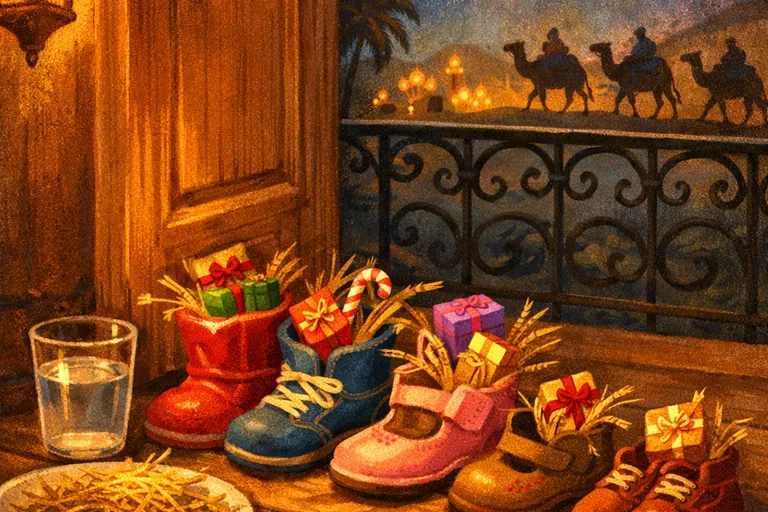
The word "Epiphany" comes from the Greek epiphaneia, meaning "manifestation" or "revelation." Before the Western church settled on December 25 for the Nativity sometime in the fourth century, January 6 served as the primary celebration of Christ's birth. The date never lost its weight. In Spain, Mexico, Puerto Rico, and dozens of other countries, children still wake up on the morning of January 6 to find presents in their shoes, left not by a red-suited man from the Arctic but by three kings on camels.
Who Were the Three Kings?
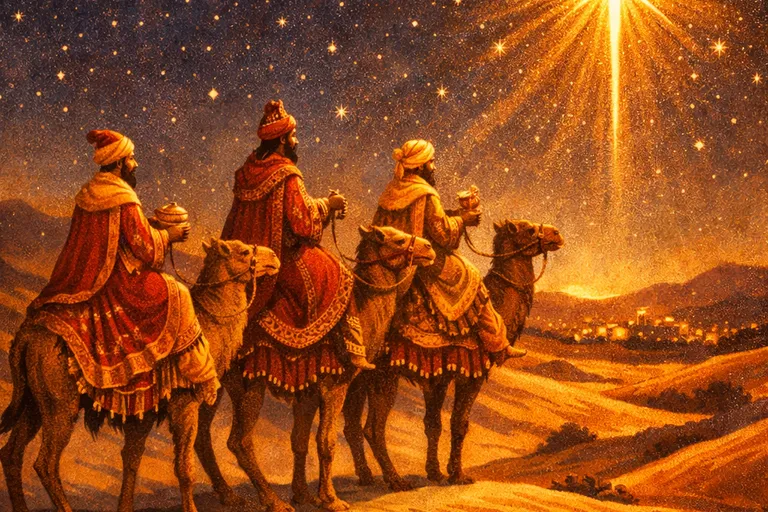
The Gospel of Matthew mentions "wise men from the East" who followed a star to find the newborn Jesus. That's about all the Bible offers. Matthew never says how many there were, never names them, and never calls them kings. The number three comes from the three gifts: gold, frankincense, and myrrh. The royal titles were a later addition, influenced by Old Testament prophecies about kings bringing tribute.
Their familiar names, Melchior, Caspar, and Balthasar, don't appear in any text until roughly the sixth century. Emperor Justinian commissioned mosaics in the Church of Sant'Apollinare Nuovo in Ravenna, Italy, that depicted the Magi with these names inscribed beneath them. That settled it for Western Christianity, though other traditions had entirely different names. Syrian Christians called them Hormizdah, Yazdegerd, and Perozadh. Ethiopian Christians knew them as Hor, Karsudan, and Basanater.
By medieval times, the three were commonly depicted as representing three different ages and three different continents: Europe, Asia, and Africa. This was deliberate theology made visual, a way of saying the message was universal.
What Do Gold, Frankincense, and Myrrh Symbolize?
The three gifts weren't random. Each carried layered meaning that early Christian theologians spent centuries unpacking.
- Gold symbolized kingship. It was the standard tribute to a sovereign, an acknowledgment that this child would be a ruler.
- Frankincense signified divinity. This aromatic resin was burned as incense in temples, marking the child as the Son of God.
- Myrrh pointed to mortality. Used in embalming and burial rites, it foreshadowed the crucifixion decades before it happened.
The gifts also had a practical side. According to the Biblical Archaeology Society, gold, frankincense, and myrrh were all enormously valuable trade goods in the ancient Near East. Some scholars have suggested the Magi's gifts gave Joseph the financial means to flee with his family to Egypt, escaping King Herod's massacre of infant boys in Bethlehem.
These three gifts also gave Three Kings Day its traditional colors. Gold is self-explanatory. Frankincense connects to white or silver, the color of sacred ritual. Myrrh is associated with deep red or burgundy, the color of sacrifice. You'll see these tones repeated in Three Kings Day decorations, parade floats, and church vestments across the Catholic world.
How Is Three Kings Day Celebrated in Spain?
In Spain, January 6 is the gift-giving day. Full stop. While Santa Claus has made inroads in recent decades, particularly in shopping malls, the Reyes Magos remain the main event. Spanish children write their wish lists not to Papa Noel but to the Three Kings.
The celebration kicks off on the evening of January 5 with the Cabalgata de Reyes Magos, a massive street parade held in virtually every city and village in the country. The tradition dates to the late nineteenth century. One of the earliest documented parades took place in Alcoy, in the province of Alicante, in 1885, with Barcelona following closely behind. Today, Madrid's Cabalgata draws hundreds of thousands of spectators to watch elaborately decorated floats roll through the city center, climaxing at the Cibeles Palace where actors playing Melchior, Caspar, and Balthasar address the crowd.
The parade is also a candy blitz. Participants on the floats throw sweets into the crowd by the ton. Madrid's procession alone distributes up to 12 tons of candy each year. Children bring bags to collect as much as they can carry.
After the parade, Spanish families go home, and children leave their shoes by the door or on the balcony, alongside a dish of water and hay for the camels, and perhaps a glass of sherry and some turron for the kings themselves. In the morning, good children find gifts in their shoes. Bad children find carbon, lumps of coal. Today's supermarkets sell sugar-shaped lumps of "coal" in tiny burlap sacks for parents who want to deliver the message gently.
Breakfast on January 6 centers on the Roscon de Reyes, Spain's version of the king cake. More on that below.
What Is Rosca de Reyes?
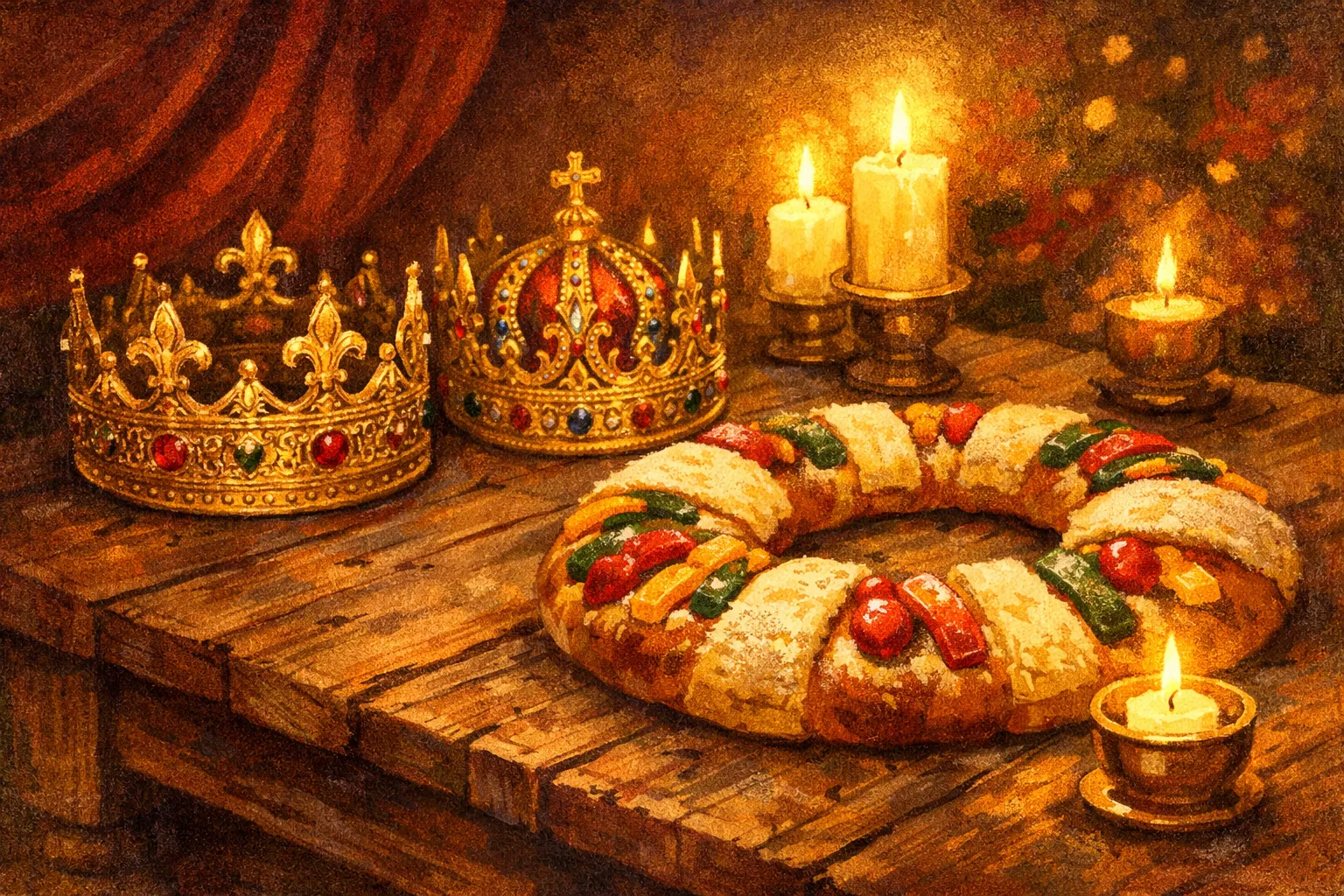
The Rosca de Reyes, or Kings' Bread, is a sweet, ring-shaped pastry eaten on January 6 across Spain and Latin America. "Rosca" means wreath or ring, and "Reyes" means kings. The circular shape is said to represent either the crowns of the three kings or the eternal nature of God's love, depending on who you ask. The colorful dried fruits and candied toppings symbolize the jewels on the Magi's crowns.
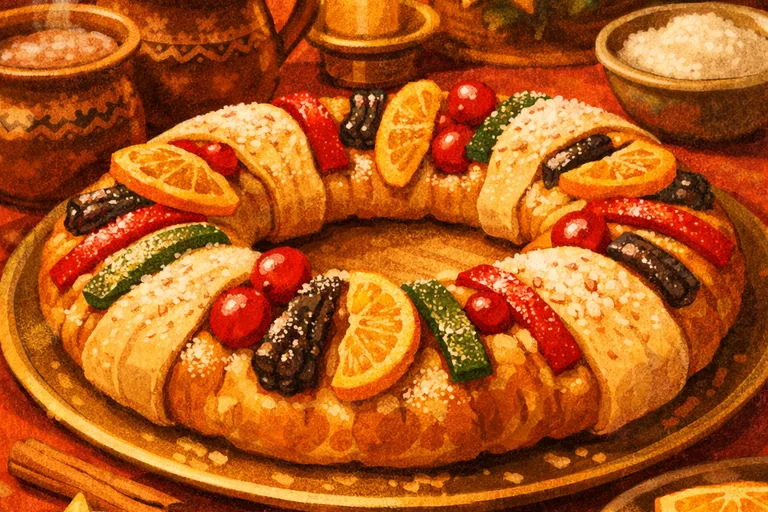
Hidden inside the bread is a small plastic figurine of the baby Jesus. In Mexico, whoever finds the figurine in their slice is obligated to host a tamale party on February 2, Candlemas (Dia de la Candelaria). In Spain's version, the Roscon de Reyes, the cake often contains both a figurine and a dried bean. Find the figurine and you're crowned king or queen for the day. Find the bean and you pay for the cake.
The custom of hiding something inside a festive bread has ancient roots. According to the Smithsonian Center for Folklife and Cultural Heritage, the tradition traces back to the Roman festival of Saturnalia, when a bean was baked into a round cake made with honey and figs. Over centuries, the bean became a Christ figurine, the honey cake became a sugar-dusted bread ring, and Saturnalia gave way to Epiphany. The container changed. The thrill of finding the hidden prize did not.
Three Kings Day Traditions in Mexico
Mexico treats Three Kings Day as a major family holiday, second only to Christmas Eve in the holiday season's hierarchy. On the night of January 5, children write letters to the Magi requesting toys. Some families follow a beautiful custom: the child ties the letter to a helium balloon and releases it into the sky, trusting the kings will intercept it. Others tuck the letter inside a shoe left under the Christmas tree.
The next morning, children find small gifts in their shoes, or increasingly, under the tree alongside where the letter was placed. The family then gathers to share Rosca de Reyes with hot chocolate, the centerpiece of the Three Kings Day feast. Street vendors and bakeries across Mexico sell millions of roscas in the days leading up to January 6. Large bakery chains report it as one of their biggest sales days of the year.
In Mexican communities, the day also features live music, traditional dances, and shared meals of tamales and champurrado, a thick corn-based hot chocolate. The celebration has a communal warmth that distinguishes it from the more private gift-opening of December 25.
Three Kings Day in Puerto Rico
Puerto Rico's version of Three Kings Day is one of the most distinctive in the Americas. On January 5, children head outdoors with their parents to cut fresh grass, which they pack into shoeboxes and place under their beds or beside the Christmas tree. The grass is meant as food for the Magi's horses (not camels, in Puerto Rican tradition). In the morning, the grass is gone, replaced by gifts and candy.
The celebration extends well beyond the household. Parrandas, Puerto Rico's version of Christmas caroling, continue through Three Kings Day. Groups of friends and family roam from house to house, singing traditional songs, playing guitars and guiros, and stopping at each home for food, conversation, and sips of coquito, a coconut-and-rum drink that functions as Puerto Rico's answer to eggnog. Anyone can join a parranda in progress. The more people, the better.
The island also hosts public festivals and parades on January 6. In the town of Juana Diaz, known as "La Ciudad de los Reyes Magos" (The City of the Three Kings), the celebration draws visitors from across the island for one of the largest Three Kings Day festivals in the Caribbean.
How Does Three Kings Day Compare to Christmas Gift-Giving?
In the United States and much of Northern Europe, December 25 is the undisputed gift-giving day. Santa Claus, a figure with roots in the Dutch Sinterklaas and the British Father Christmas, dominates the season. But in the Spanish-speaking world, Three Kings Day has historically held that role, and it still does in many households.
The difference is more than calendar timing. Christmas Day in traditionally Catholic countries like Spain and Mexico has long been a religious observance centered on the Nativity, midnight mass, and family meals. The commercial gift exchange belonged to January 6, when the Magi's journey provided the scriptural basis for giving presents.
That separation has been eroding. Globalization and American cultural exports have pushed Santa Claus into markets where the Three Kings once reigned unchallenged. Many Spanish and Latin American families now exchange gifts on both dates, December 25 and January 6. According to NBC News, some Latino families in the United States describe a tug-of-war between the two traditions, with children increasingly expecting presents on Christmas morning while grandparents insist on maintaining January 6.
The result, in many households, is the best of both worlds: two gift-giving days separated by twelve days of anticipation.
Frequently Asked Questions
When is Three Kings Day?
Three Kings Day is celebrated on January 6 every year. It falls exactly twelve days after Christmas Day, marking the end of the traditional Twelve Days of Christmas and the Christian feast of Epiphany.
What is the connection between Epiphany and Three Kings Day?
Epiphany and Three Kings Day are two names for the same feast. Epiphany, from the Greek word for "manifestation," commemorates the moment the Magi visited the infant Jesus. Western Christian churches celebrate it on January 6, making it synonymous with Three Kings Day in Spain, Latin America, and other Catholic regions.
Why do people eat Rosca de Reyes on Three Kings Day?
Rosca de Reyes is a ring-shaped sweet bread eaten on January 6 to honor the Three Kings. Its circular shape represents the kings' crowns, and a hidden baby Jesus figurine inside connects to the biblical story. The tradition of baking a prize into festive bread dates back to the Roman festival of Saturnalia.
What do gold, frankincense, and myrrh represent?
Gold symbolized Jesus' kingship, frankincense represented his divinity as incense burned in worship, and myrrh foreshadowed his death since it was used in burial rites. Together, the three gifts acknowledged Jesus as king, God, and mortal.
Do children get presents on Three Kings Day?
Yes. In Spain, Mexico, Puerto Rico, and many Latin American countries, children receive gifts on the morning of January 6. They leave their shoes out the night before, along with food and water for the Magi's animals, and find presents in them the next morning. In many households, this is the primary gift-giving day of the holiday season.
Is Three Kings Day a public holiday?
Three Kings Day is a public holiday in Spain, Mexico, Puerto Rico, and several other countries including Colombia, Peru, and the Philippines. Schools and many businesses close, and families gather for meals, parades, and celebrations centered on the Rosca de Reyes.