
Bethlehem: The Birthplace of Christmas
One small town gave Christmas its origin story. Two thousand years later, it still draws pilgrims, tourists, and the curious to Manger Square on December 24, while a city in Pennsylvania borrowed its name and became America's Christmas capital.
Bethlehem is the town where, according to the Gospels of Matthew and Luke, Jesus Christ was born. That single claim has made this small city in the West Bank the spiritual ground zero of Christmas for two billion Christians worldwide. Every December 24, thousands of visitors crowd into Manger Square to attend Midnight Mass at the Church of the Nativity, standing on the same limestone ground where pilgrims have gathered for over 1,600 years.
Contents
But Bethlehem's Christmas story has layers most people don't expect. The town hosts three separate Christmas celebrations on three different dates. Its most famous church survived by accident. And 9,000 kilometers away, another Bethlehem, this one in Pennsylvania, was deliberately named on Christmas Eve in 1741 and has since built an entire identity around being America's "Christmas City."
What Does Bethlehem Mean?
The name Bethlehem comes from the Hebrew Beit Lechem, which translates to "House of Bread." The Arabic name, Beit Lahm, is sometimes translated as "House of Meat," though most scholars believe the Arabic form is simply a phonetic adaptation of the original Hebrew rather than an independent etymology.
The "House of Bread" name likely reflects the town's agricultural roots. Bethlehem sits in the fertile Judean hill country about 10 kilometers south of Jerusalem, at an elevation of roughly 775 meters. The region was known for grain cultivation in antiquity. In the Book of Ruth, Bethlehem is described as a farming community where Ruth gleaned barley in the fields of Boaz.
The town's association with kingship predates Christianity. The Hebrew Bible identifies Bethlehem as the birthplace and hometown of King David, Israel's most celebrated ruler. The prophet Micah (5:2) foretold that a future ruler of Israel would come from Bethlehem, a passage that early Christians interpreted as a prophecy of Jesus's birth. That connection between David's city and the Messiah's birthplace is the reason Matthew and Luke both place the nativity in Bethlehem rather than Nazareth, where Jesus grew up.
History of Christmas in Bethlehem
The earliest recorded Christmas celebration in Bethlehem took place in 339 AD, when Emperor Constantine's newly built Church of the Nativity was consecrated. Constantine's mother, Helena, had traveled to the Holy Land around 326-328 AD to identify the sites of key events in Jesus's life. Local tradition pointed her to a cave beneath what was then a Roman temple dedicated to Adonis. Constantine ordered the temple demolished and a basilica built over the grotto.
That original church was destroyed during the Samaritan revolts of 529 AD. Emperor Justinian I rebuilt it, and his 6th-century structure is essentially what stands today. That makes the Church of the Nativity one of the oldest continuously operating churches in the world. One reason it survived: when Persian forces invaded in 614 AD and destroyed nearly every Christian building in the region, they reportedly spared the Church of the Nativity because a mosaic on its facade depicted the Magi in Persian clothing. The invaders recognized their own people and left the building intact.
Beneath the main altar, a 14-pointed silver star set into the marble floor marks the spot traditionally identified as the birthplace of Jesus. The star bears a Latin inscription: Hic de Virgine Maria Jesus Christus natus est ("Here Jesus Christ was born of the Virgin Mary"). The star was placed there in 1717 by the Catholic Franciscans, removed in 1847 (an act that contributed to tensions leading to the Crimean War), and restored in 1853. The number 14 is believed to reference the 14 generations listed in Matthew's genealogy of Jesus.
UNESCO designated the Church of the Nativity as a World Heritage Site in 2012. It was the first site to be listed under the name of Palestine.
What Is Visiting Bethlehem During Christmas Like?
Bethlehem today has a population of roughly 30,000 and sits in the West Bank under Palestinian Authority governance. Access requires passing through an Israeli checkpoint, and the city is bordered on its northern side by the Israeli West Bank barrier. None of this stops tens of thousands of visitors from arriving each December.
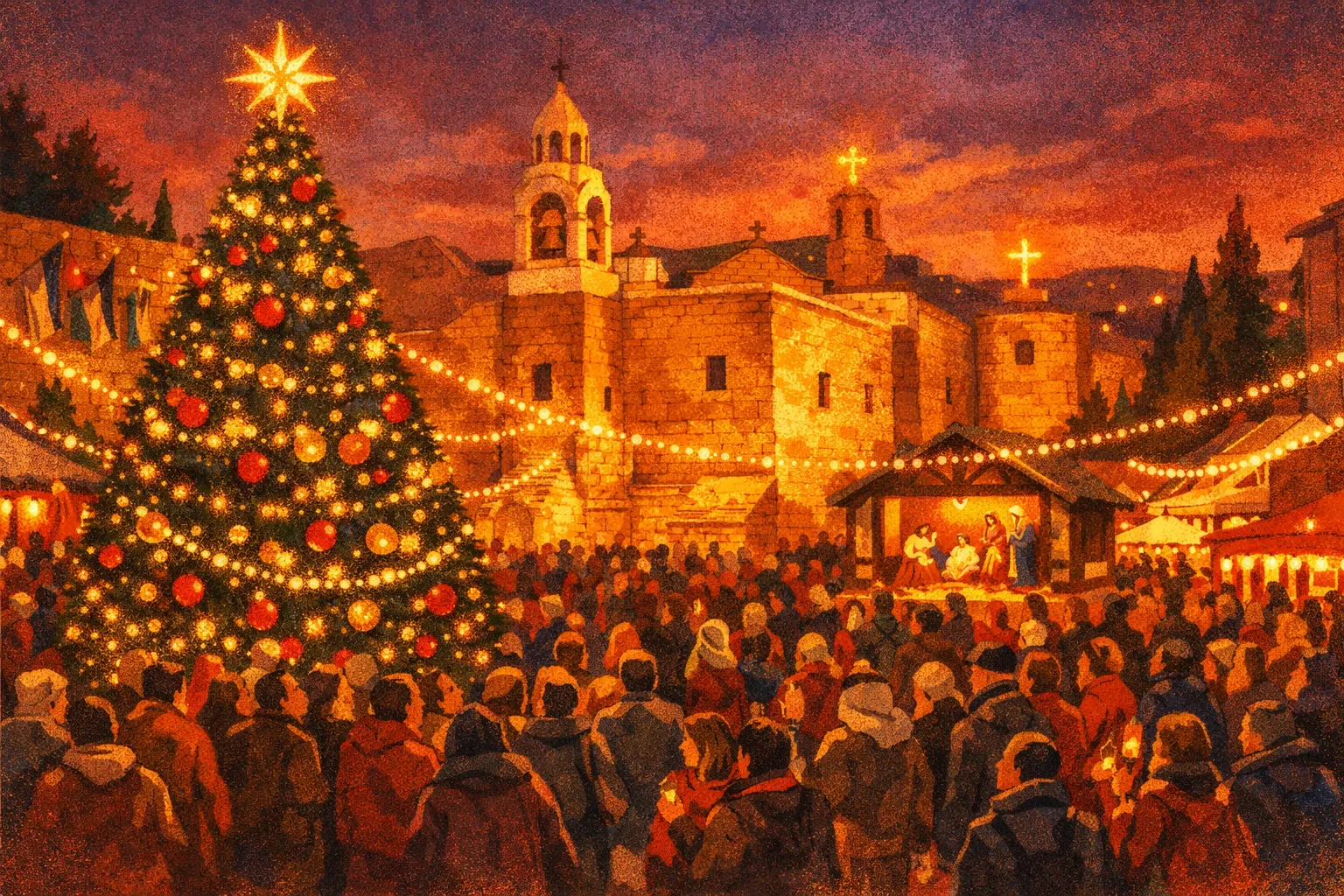
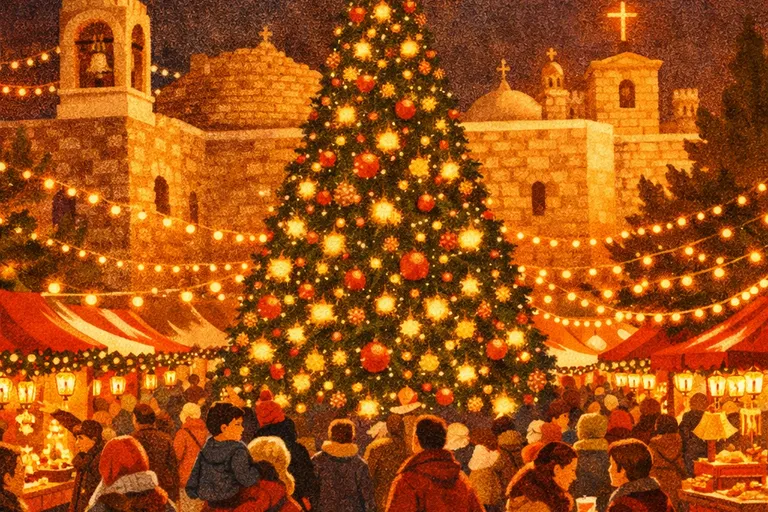
The centerpiece is Manger Square, the public plaza directly in front of the Church of the Nativity. In the weeks before Christmas, the square fills with a large decorated tree (often donated by a European country), food vendors, and stages for live performances. The Palestinian Authority and the city's Christian community organize the celebrations jointly, and the atmosphere is closer to a street festival than a solemn vigil.
Three Christmases, three dates
Bethlehem doesn't celebrate Christmas once. It celebrates three times. The Roman Catholic and Protestant churches observe Christmas on December 25. The Greek Orthodox church celebrates on January 7, following the Julian calendar. And the Armenian Apostolic Church, which maintains a chapel inside the Church of the Nativity, celebrates on January 18 (January 6 in the Julian calendar, their traditional date for the Feast of the Epiphany, which they observe as the birth of Christ).
This means the Christmas season in Bethlehem effectively stretches for nearly a month. Each community holds its own processions, liturgies, and Midnight Mass. For visitors, this triple calendar means it's possible to experience a Bethlehem Christmas celebration on dates when the rest of the world has already packed away its decorations.
The Latin Patriarch's procession
On December 24, the Latin Patriarch of Jerusalem leads a procession from Jerusalem to Bethlehem along a route that passes through the checkpoint. The procession arrives at Manger Square in the early afternoon, greeted by scouts, marching bands, and crowds. The Patriarch then enters the Church of the Nativity, where he celebrates Midnight Mass. The service is broadcast live by Palestinian and international television networks. Access to the church during the Mass is by ticket only, distributed by the Franciscan Custody of the Holy Land.
Practical considerations
Visitors arriving independently typically enter Bethlehem through Checkpoint 300 north of the city. Tour groups from Jerusalem can make the trip in under an hour. Hotels in Bethlehem fill months in advance for the December 24 celebrations, and many visitors stay in Jerusalem and travel to Bethlehem for the day. The city's tourism infrastructure includes restaurants, souvenir shops (olive wood carvings are the signature local craft), and guided tours of the Church of the Nativity, the Milk Grotto, and Shepherds' Field.
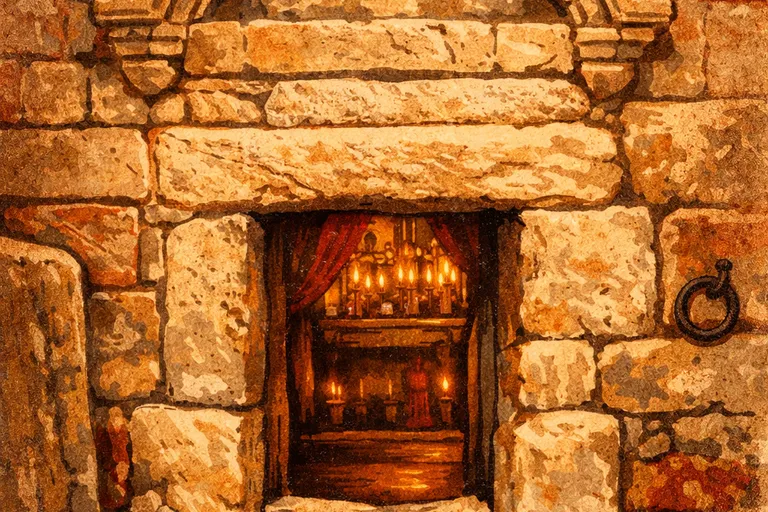
Outside the Christmas season, the Church of the Nativity is open year-round. Visitors enter through the Door of Humility, a notoriously low entrance (about 1.2 meters high) that was reduced in size during the Ottoman era, reportedly to prevent soldiers from riding horses directly into the church. Everyone who enters Bethlehem's most sacred building does so by bowing.
Bethlehem, Pennsylvania: America's Christmas City
On Christmas Eve 1741, a group of Moravian settlers gathered in a log house along the Monocacy Creek in eastern Pennsylvania. Their leader, Count Nikolaus Ludwig von Zinzendorf, named the settlement Bethlehem during a worship service, inspired by the Christmas hymn they were singing. The town has been running with that name ever since.
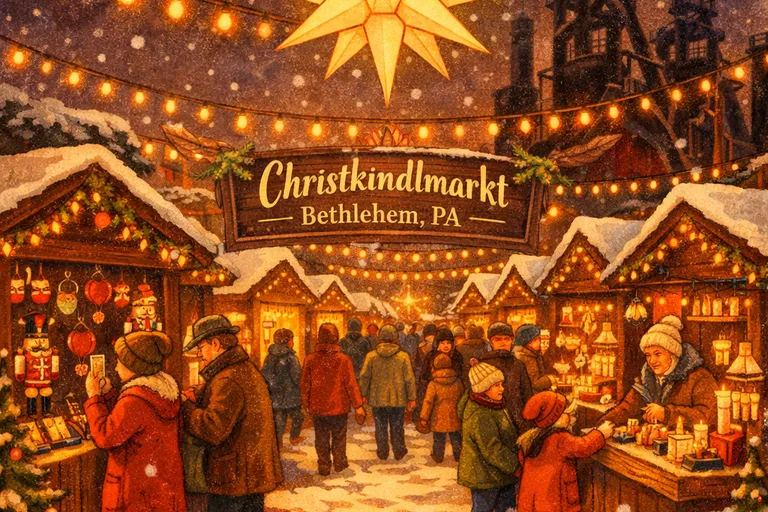
Bethlehem, Pennsylvania, trademarked the title "Christmas City, USA" and has turned the holiday into its primary cultural export. The town's annual celebrations draw over a million visitors. The centerpiece is the Christkindlmarkt, a German-style outdoor Christmas market that opened in 1993 on the grounds of the former Bethlehem Steel plant. The market features over 150 artisan vendors, live glass-blowing and candle-making demonstrations, and traditional German food.
The Moravian Star is the town's signature symbol. These multi-pointed illuminated stars (typically 26 points) were originally made by Moravian schoolchildren as geometry exercises in the early 1800s. Today, a massive Moravian Star sits atop South Mountain overlooking the city, lit every year from the Friday before Thanksgiving through Epiphany on January 6. The star is visible for miles and has become the icon most associated with Bethlehem, PA.
The Night Light Holiday Walking Tour takes visitors through the historic Moravian district, past 18th-century limestone buildings decorated for the season. The Central Moravian Church holds a Christmas Eve vigil featuring hundreds of beeswax candles. And the town's live Advent calendar, projected onto a downtown building, reveals a new image each evening in December.
Bethlehem, Pennsylvania, has roughly 76,000 residents. It has never produced a messiah. But it has managed something almost as improbable: transforming a former steel town into a Christmas destination that draws visitors from across the Eastern Seaboard, powered by a name that a German count chose on a winter night 284 years ago.
Frequently Asked Questions
Where is Bethlehem located?
The biblical Bethlehem is located in the West Bank, about 10 kilometers (6 miles) south of Jerusalem. It sits at an elevation of roughly 775 meters in the Judean hill country. There is also a Bethlehem in eastern Pennsylvania, USA, founded in 1741 by Moravian settlers.
Can you visit Bethlehem during Christmas?
Yes. Tens of thousands of visitors travel to Bethlehem each Christmas Eve to attend celebrations in Manger Square and Midnight Mass at the Church of the Nativity. Access from Jerusalem requires passing through an Israeli checkpoint. Hotels book months ahead, so many visitors make it a day trip from Jerusalem.
Why does Bethlehem celebrate Christmas three times?
Three Christian denominations maintain a presence at the Church of the Nativity, each following a different calendar. Roman Catholics and Protestants celebrate on December 25. Greek Orthodox Christians celebrate on January 7 (December 25 in the Julian calendar). Armenian Christians celebrate on January 18. This gives Bethlehem a Christmas season lasting nearly a month.
What does the name Bethlehem mean?
Bethlehem comes from the Hebrew Beit Lechem, meaning "House of Bread." The name reflects the town's origins as an agricultural settlement in the fertile Judean hills. The Arabic form, Beit Lahm, is generally considered a phonetic adaptation of the Hebrew name.
What is the Bethlehem Christmas Village in Pennsylvania?
Bethlehem, Pennsylvania, calls itself "Christmas City, USA" and hosts major annual celebrations including the Christkindlmarkt (a German-style Christmas market), the Moravian Star on South Mountain, holiday walking tours through the 18th-century Moravian district, and a candlelight Christmas Eve vigil. The city draws over a million holiday visitors each year.
How old is the Church of the Nativity?
The current Church of the Nativity was built by Emperor Justinian I in the 6th century, making it roughly 1,500 years old. The original church was constructed by Emperor Constantine around 327-339 AD. It is one of the oldest continuously operating churches in the world and became a UNESCO World Heritage Site in 2012.