
Christmas in Israel
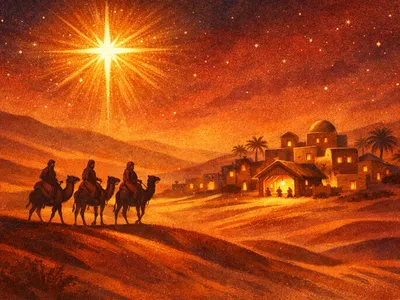
Christmas in Israel is celebrated by a small but historically significant Christian minority, roughly 2% of the population. The holiday's center is Bethlehem (in the Palestinian Territories) and Nazareth, where Jesus spent his childhood. For the millions of Christian pilgrims who visit the Holy Land each December, Christmas in Israel means walking the streets where the original story took place.
There is nowhere else on earth where Christmas carries the weight it does in the Holy Land. When pilgrims stand in the Grotto of the Nativity in Bethlehem, they are standing on the spot that tradition holds as the birthplace of Jesus Christ. When they walk through Nazareth, they walk streets that the historical Jesus knew. The theology is contested, the politics are complex, and the security is tight, but the emotional impact of celebrating Christmas where the story began is something that no other location can replicate.
Bethlehem: Where It All Started
The Church of the Nativity in Bethlehem is a 4th-century basilica built by Emperor Constantine over the cave traditionally identified as the birthplace of Jesus. The Grotto of the Nativity, marked by a 14-pointed silver star set in the marble floor, is Christianity's holiest Christmas site. On December 24, the Latin Patriarch of Jerusalem leads a procession from Jerusalem to Bethlehem and celebrates Midnight Mass in the church. Thousands attend. Millions watch on television.
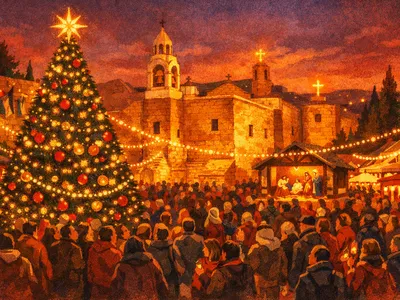
Bethlehem lies in the Palestinian Territories, and access requires passing through Israeli checkpoints. Despite the political complexity, the city's Christmas celebration continues, organized by the Palestinian Authority and the Franciscan Custody of the Holy Land. Manger Square fills with a Christmas tree, market stalls, and crowds of pilgrims and locals.
Three Christmases in One Place
The Holy Land celebrates Christmas three times. Catholics and Protestants observe December 25. Greek Orthodox, Russian Orthodox, and other Eastern churches follow the Julian calendar and celebrate on January 7. The Armenian Apostolic Church, which has maintained a community in Jerusalem for over 1,500 years, celebrates on January 18-19, combining Christmas with Epiphany as the Armenian tradition has done since the 4th century.
Frequently Asked Questions
Can you visit Bethlehem at Christmas?
Yes. Bethlehem is in the Palestinian Territories and is accessible from Jerusalem. Midnight Mass tickets at the Church of the Nativity are allocated through the Latin Patriarchate and are in high demand. Manger Square hosts public celebrations open to all visitors. Security checks at checkpoints should be expected.
Why are there three Christmas dates in Israel?
Different Christian denominations follow different calendars. Catholics and Protestants use the Gregorian calendar (December 25). Most Eastern Orthodox churches use the Julian calendar (January 7). The Armenian Apostolic Church celebrates on January 18-19, combining Christmas with Epiphany.
Traditions & Customs
Bethlehem Midnight Mass
The Midnight Mass at the Church of the Nativity in Bethlehem, built over the traditional site of Jesus' birth, is the most symbolically significant Christmas service in the world. The Latin Patriarch of Jerusalem leads the Mass.
Three Christmas Dates
Catholics and Protestants celebrate December 25. Greek Orthodox celebrate January 7. Armenian Orthodox celebrate January 18-19. The result is a Christmas season that stretches nearly a month in the Holy Land.
Nazareth Christmas Market
Nazareth, Jesus' childhood home and the largest Arab city in Israel, hosts the country's main Christmas celebration. The market fills the streets around the Basilica of the Annunciation with food, music, and a parade.
Pilgrimage
Millions of Christian pilgrims visit the Holy Land during Christmas. The Via Dolorosa in Jerusalem, the Sea of Galilee, and the Church of the Nativity in Bethlehem are the primary destinations.
Hanukkah Overlap
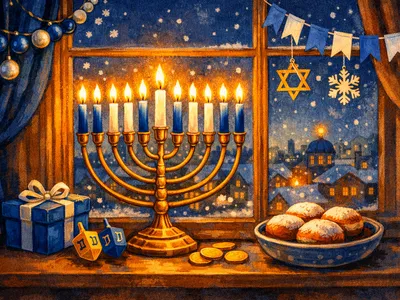
The Jewish festival of Hanukkah often overlaps with Christmas, creating a period when menorahs and Christmas trees coexist in shared public spaces. In cities like Haifa, both holidays are celebrated publicly.
Christmas Markets
Nazareth Christmas Market
The largest Christmas celebration in Israel, centered around the Basilica of the Annunciation. Arab Christian families host festive events, and the city decorates with lights and a large tree.
Haifa Holiday of Holidays
Haifa celebrates a joint festival honoring Christmas, Hanukkah, and other winter holidays. The German Colony neighborhood hosts a market reflecting the city's multicultural identity.
Key Dates
Catholic/Protestant Christmas
Midnight Mass at the Church of the Nativity in Bethlehem is the centerpiece. Nazareth holds its main celebrations. Pilgrims fill churches across the Holy Land.
Orthodox Christmas
Greek Orthodox, Russian Orthodox, and other Eastern churches celebrate Christmas. Services at the Church of the Holy Sepulchre in Jerusalem and the Church of the Nativity draw large congregations.
Armenian Christmas
The Armenian Apostolic Church celebrates Christmas on January 18-19 in Jerusalem's Armenian Quarter. The community has maintained a presence in Jerusalem for over 1,500 years.
Christmas Carols
O Little Town of Bethlehem
Written by Phillips Brooks in 1868 after visiting Bethlehem. The carol has special resonance when sung in its namesake city. It is performed at Midnight Mass at the Church of the Nativity.
Silent Night
Various languagesSung in Arabic, Armenian, Greek, Latin, and English at Christmas services across the Holy Land. The multilingual performance reflects the diversity of Christian communities in the region.