
Star of Bethlehem: History, Meaning and Mystery
For two thousand years, a single celestial event has kept astronomers, theologians, and botanists arguing. The Star of Bethlehem remains one of Christmas's most enduring puzzles.
The Gospel of Matthew mentions the Star of Bethlehem in just twelve verses. That's it. A few hundred words in ancient Greek, and the result is twenty centuries of scientific papers, theological arguments, planetarium shows, and at least one NASA study published in December 2024. No other celestial object in history has generated this much debate from so little source material.
Contents
- 1. What Does the Bible Say About the Star of Bethlehem?
- 2. What Was the Star of Bethlehem? The Astronomical Theories
- 3. The Star of Bethlehem in Christian Art
- 4. Why Do We Put a Star on Top of the Christmas Tree?
- 5. The Star of Bethlehem Flower and Plant
- 6. What Does the Star of Bethlehem Symbolize?
- 7. The Debate That Won't Be Settled
- 8. Frequently Asked Questions
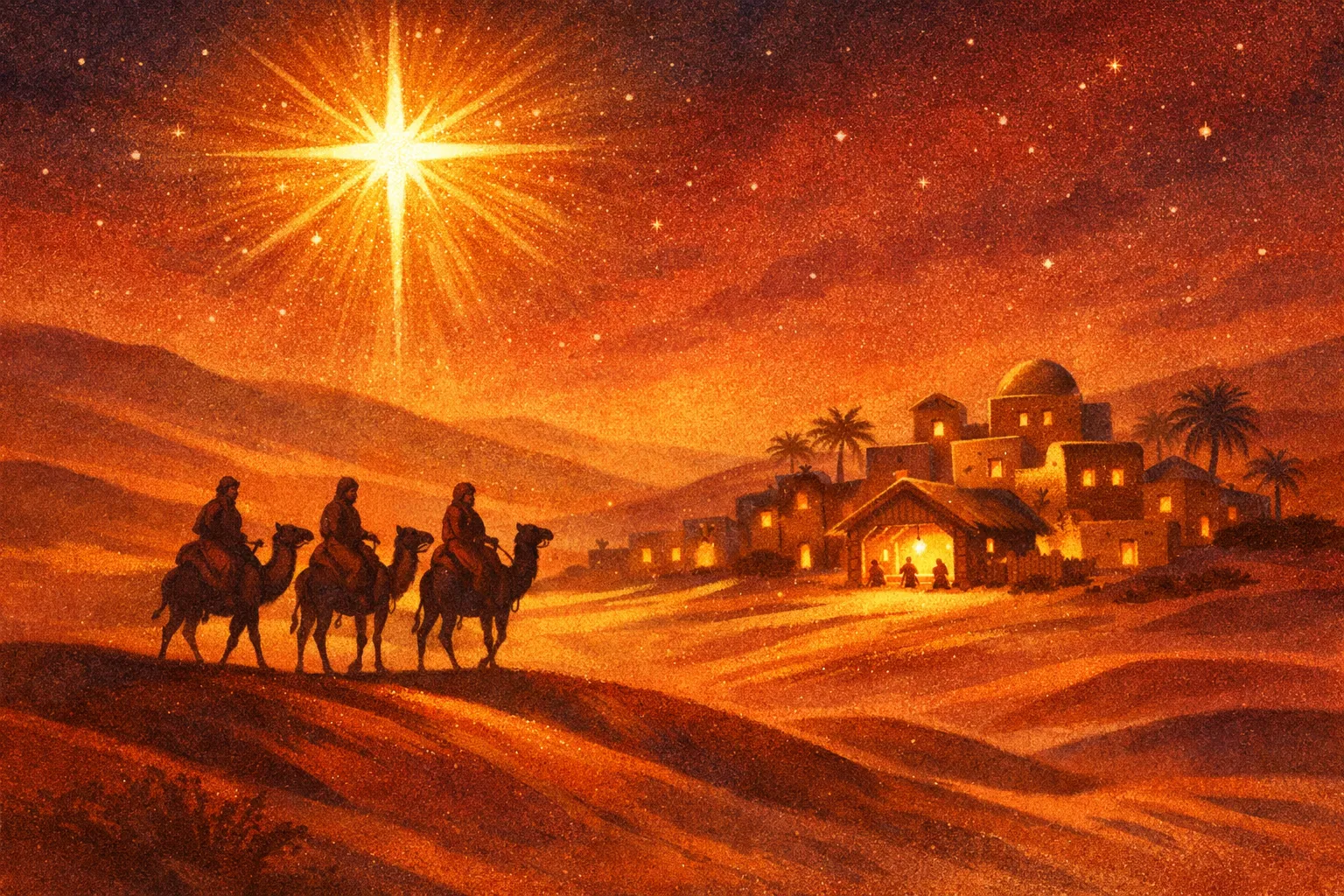
The star appears only in Matthew's account, not in the other three Gospels. It guides the Magi, unnamed and unnumbered, from "the East" to Jerusalem, and then to Bethlehem, where it "stood over" the place where the child was. Matthew doesn't say it was bright. He doesn't say it had a tail. He doesn't say it moved across the sky in any ordinary way. These omissions are precisely what make it so difficult to identify, and so irresistible to anyone with a telescope or a theory.
What Does the Bible Say About the Star of Bethlehem?
Matthew 2:1-12 tells the story plainly. Magi from the East arrive in Jerusalem asking, "Where is he who has been born king of the Jews? For we saw his star when it rose and have come to worship him." King Herod, alarmed, consults his priests and scribes. They cite the prophet Micah: the Messiah would be born in Bethlehem. Herod secretly sends the Magi south, asking them to report back. The star reappears, goes before them, and stops over the place where Jesus is. They present gold, frankincense, and myrrh. Warned in a dream not to return to Herod, they go home by another route.
Two details matter most for any scientific investigation. First, the star "rose" or appeared at a specific time, suggesting it was a new or unusual phenomenon. Second, it "stood over" a specific location, which is not how stars, planets, or comets normally behave. These two facts have shaped every astronomical theory since Johannes Kepler first tried to solve the puzzle in 1614.
What Was the Star of Bethlehem? The Astronomical Theories
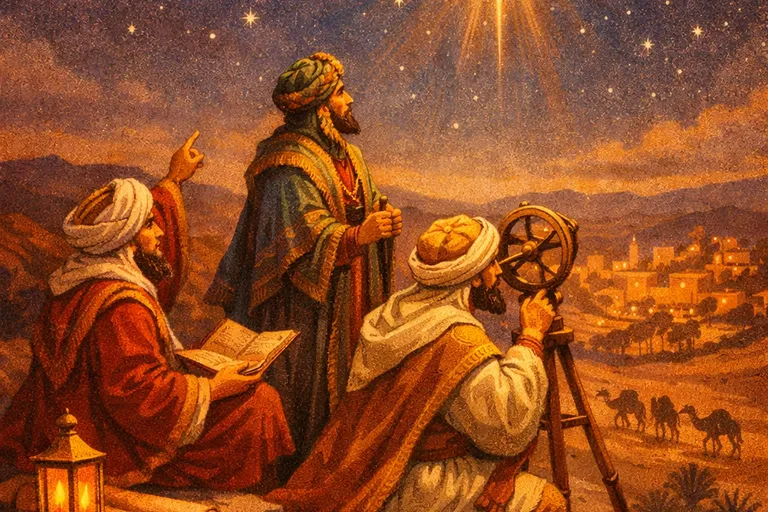
Astronomers have been trying to identify the star since at least the early 1600s, when Kepler proposed that a series of planetary conjunctions might explain it. The leading candidates fall into four categories, and none of them fits perfectly.
The Jupiter-Saturn Conjunction of 7 BC
This is the most widely cited theory. In 7 BC, Jupiter and Saturn aligned three times in the constellation Pisces: on May 27, October 6, and December 1. A triple conjunction in Pisces happens only once every 800 years. For ancient astrologers, the symbolism would have been powerful. Jupiter was the "king's planet." Saturn was associated with the Jewish people by some traditions. And Pisces was linked astrologically to Israel and the land of Palestine.
Kepler was the first to connect these conjunctions to the Bethlehem star in his 1614 work "De anno natali Christi." But the theory has a significant weakness. Modern calculations show the planets never came closer than about one degree apart, roughly twice the apparent diameter of the full moon. They would not have appeared as a single brilliant object. Visually, it wasn't particularly dramatic.
Jupiter's Occultation in Aries, 6 BC
Astronomer Michael Molnar of Rutgers University took a different approach in his 1999 book "The Star of Bethlehem: The Legacy of the Magi." While studying ancient coins, he found one depicting Aries the Ram looking back at a star, a symbol of Judea at the time. Molnar proposed that the Magi were practicing astrologers who would have been watching for Jupiter (the royal planet) to be occulted by the Moon in Aries, the zodiacal sign of Judea.
Using computational astronomy, he identified two such occultations on March 20 and April 17 of 6 BC. The April event was especially significant because Jupiter was "in the east," matching Matthew's description, and the occultation would have been invisible to the naked eye. Only trained astrologers would have known it occurred. This neatly explains why Herod's advisors, who didn't practice astrology, hadn't noticed anything unusual. Harvard astronomer Owen Gingerich called Molnar's case persuasive, though he noted some unresolved technical questions.
Halley's Comet and the Comet Theory
Comets were long considered a strong candidate. They're visible, dramatic, and they move across the sky in a way that could seem like "guiding." Halley's Comet passed through in 12-11 BC and was recorded by Chinese astronomers. But the timing is off by several years, and comets in the ancient world were almost universally regarded as omens of disaster, not of a newborn king.
The most significant recent contribution came from NASA planetary scientist Mark Matney, who published a study in the Journal of the British Astronomical Association in December 2024. Matney analyzed Chinese astronomical records that describe an unusual object appearing in 5 BC and remaining visible for over 70 days. He constructed a plausible orbit for a comet that, if it passed extremely close to Earth (roughly the distance of the Moon), could have appeared to rise in the east and then "stand still" overhead for about two hours as seen from the road between Jerusalem and Bethlehem.
"I remember sitting there and thinking, I can think of one thing that can behave that way," Matney told Scientific American, describing a planetarium show that had claimed no astronomical object could match Matthew's description. Astrophysicist Ralph Neuhaeuser of Friedrich Schiller University Jena publicly disputed Matney's reading of the Chinese records. Matney's own assessment: "plausible but not proven."
Supernova
The idea that a star literally exploded in time for the Nativity sounds compelling but doesn't hold up. A supernova would have left a detectable remnant, a cloud of expanding gas visible through modern telescopes. Astronomers have searched and found nothing datable to the right period. Chinese and Korean records from 5 BC describe an object in the constellation Aquila, but its 70-day visibility is more consistent with a comet or nova than a supernova.
The Star of Bethlehem in Christian Art
However uncertain the science, artists never hesitated to paint the star. The most consequential depiction belongs to Giotto di Bondone, whose "Adoration of the Magi" fresco in the Arena Chapel in Padua, painted around 1305, replaced the traditional many-pointed star with a strikingly realistic comet. Art historian Roberta Olson demonstrated convincingly that Giotto painted what he'd actually seen: Halley's Comet, which blazed across European skies in October 1301, just a few years before he began work on the chapel.
It was the first time anyone depicted the Star of Bethlehem as a comet, and Giotto rendered the tail streaming upward, away from the sun, exactly as a real comet's tail behaves. The European Space Agency later named its 1986 Halley's Comet mission "Giotto" in tribute.
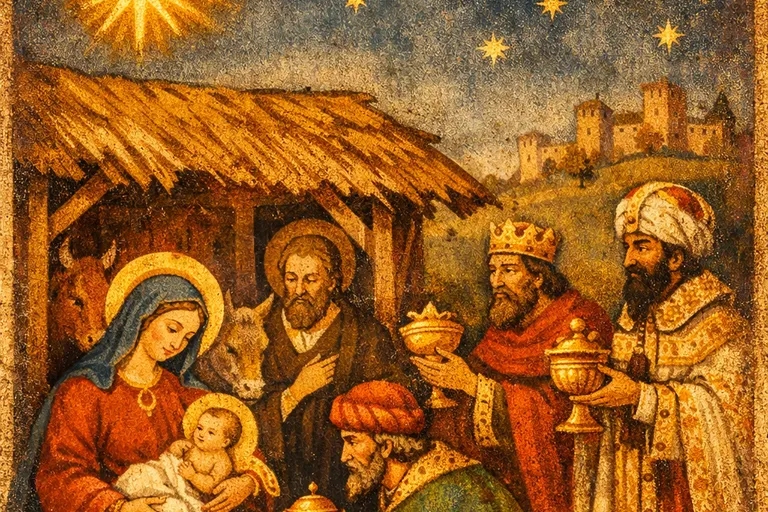
Before Giotto, and for centuries after, the standard depiction was a radiant multi-pointed star, usually gold, with rays descending toward the Christ child. Byzantine mosaics at Ravenna and manuscript illuminations across medieval Europe follow this pattern. The five-pointed star became the dominant form, though six-pointed and eight-pointed variants appear regularly in Orthodox and Eastern Christian traditions.
Why Do We Put a Star on Top of the Christmas Tree?
The star-on-the-tree tradition traces back to 16th-century Germany, where decorated evergreens were part of "Paradise plays" performed on Christmas Eve. By the 18th century, a large candle was placed at the top of the tree to represent the Star of Bethlehem. The practice of using a dedicated star ornament as a tree topper dates to approximately the 1840s, coinciding with the Victorian popularization of the Christmas tree across Europe and Britain.
Originally, some German traditions placed a figure of the Christ child at the top. Over time, the star and the angel became the two dominant choices, both referencing the Nativity. The star represents the celestial guide from Matthew. The angel represents the heavenly messenger who announced the birth to the shepherds in Luke. The choice between them often reflects denominational preference or simply family tradition.
The Star of Bethlehem Flower and Plant
There's another Star of Bethlehem that has nothing to do with astronomy. Ornithogalum umbellatum, commonly called Star of Bethlehem, is a bulbous perennial in the asparagus family (Asparagaceae) native to southern Europe, the Mediterranean, and parts of the Middle East. Its white, star-shaped flowers open in late spring, with six petals striped green on their undersides. The flowers open near noon and close at sunset, earning it the folk name "sleepydick" in some regions.
The name's origin connects to a legend: when God created the celestial star to guide the Magi, he found it too beautiful to let vanish. He shattered it into millions of pieces that fell to earth and became the flower. The botanical name Ornithogalum comes from the Greek for "bird's milk," a phrase used by ancient Greeks to describe something extraordinary.
In the language of flowers, the Star of Bethlehem symbolizes purity, hope, innocence, and forgiveness. It appears frequently in Christian ceremonies, especially at baptisms and funerals. The flower is the traditional symbol of Epiphany, the feast day on January 6 that commemorates the Magi's arrival.
Gardeners should know two things about this plant. It spreads aggressively through bulb division and is considered invasive in much of North America, where it outcompetes native spring wildflowers. And every part of it is toxic. The bulbs and flowers contain cardiac glycosides that can poison humans, dogs, cats, and horses. Symptoms include nausea, vomiting, and shortness of breath. Beautiful, meaningful, and dangerous: the plant matches its celestial namesake in complexity.

What Does the Star of Bethlehem Symbolize?
Across Christian theology, the star carries several layers of meaning. Most directly, it represents divine revelation, the idea that God used a cosmic sign to announce the Messiah's birth not to priests or kings, but to foreign astrologers. This is significant. The Magi were Gentiles, possibly Zoroastrian scholars from Persia. The star, in Matthew's telling, was addressed to the outside world.
In early Christian art, the star often represented Christ himself as the "light of the world" entering the darkness. The Council of Nicaea in 325 AD solidified much of the Nativity's theological framework, and the star became inseparable from depictions of the Epiphany, the moment Christianity's message reached beyond Judaism.
On Christmas trees, on greeting cards, and atop churches from Rome to Reykjavik, the five-pointed Bethlehem star is now one of the most recognizable symbols of Christmas. It's among the few Nativity elements that crosses comfortably from sacred to secular contexts, appearing equally on church altars and department store windows.
The Debate That Won't Be Settled
After four centuries of astronomical analysis, no single theory satisfies all the details in Matthew's account. The Jupiter-Saturn conjunction wasn't visually dramatic enough. The Molnar occultation was invisible. Halley's Comet arrived too early. The Matney comet hypothesis requires an orbit so close to Earth it would have been globally visible, yet only the Chinese seem to have recorded it. And the supernova left no remnant.
Some scholars, following the fourth-century bishop John Chrysostom, argue the whole exercise is misguided. Matthew described a star that moved, stopped, and pointed to a specific house. Nothing in nature does that. For Chrysostom, it had to be supernatural, and trying to match it with a planetary conjunction misses the point of the text entirely.
Others, like Grant Mathews at the University of Notre Dame, keep searching. Mathews proposed in 2014 that a rare alignment of the sun, Jupiter, the Moon, and Saturn in Aries on April 17 of 6 BC, combined with Jupiter being near its closest approach to Earth, could have created the conditions the Magi would have interpreted as the birth of a king.
Matney's 2024 comet paper ensures the argument will continue for at least another generation. He admits the evidence isn't conclusive, but insists the physics works. "Until we have corroborating evidence from other observers from the ancient world," he told reporters, "I think this remains in the category of plausible but not proven." That honest qualifier applies to every theory about the Star of Bethlehem. It always has.
Frequently Asked Questions
What was the Star of Bethlehem according to the Bible?
The Star of Bethlehem appears only in Matthew 2:1-12. It was a celestial phenomenon that the Magi (wise men from the East) observed "when it rose," prompting them to travel to Jerusalem and then to Bethlehem. The star reappeared and "stood over" the place where Jesus was born. Matthew does not describe its color, brightness, or size.
Is the Star of Bethlehem a real astronomical event?
Astronomers have proposed several candidates, including a triple conjunction of Jupiter and Saturn in 7 BC, an occultation of Jupiter in 6 BC, and a comet recorded in Chinese records in 5 BC. None of these explanations perfectly matches every detail in Matthew's account. NASA scientist Mark Matney's 2024 comet study is the most recent serious attempt, which he himself describes as "plausible but not proven."
What is the Star of Bethlehem flower?
Ornithogalum umbellatum, commonly called Star of Bethlehem, is a perennial bulb plant producing white, star-shaped flowers with green-striped petals. Native to southern Europe and the Mediterranean, it symbolizes purity, hope, and forgiveness in Christian tradition. The plant is toxic to humans and animals and is considered invasive in North America.
Why do we put a star on top of the Christmas tree?
The tradition began in 16th-century Germany and evolved from placing a candle at the tree's apex to represent the Star of Bethlehem. By the 1840s, dedicated star ornaments became common tree toppers. The star symbolizes the celestial sign that guided the Magi to Jesus, while the alternative angel topper represents the messenger who announced the birth to the shepherds.
What does the Star of Bethlehem symbolize in Christianity?
The star symbolizes divine revelation and the announcement of Christ's birth to the wider world. Because the Magi were Gentiles, the star represents the moment the Christian message reached beyond Judaism. In art and theology, it also represents Christ as the "light of the world" and is the primary symbol of Epiphany, celebrated on January 6.
How is the Star of Bethlehem different from the Christmas star?
They refer to the same thing. "Christmas star" is the popular secular term for the Star of Bethlehem described in Matthew's Gospel. In Christian liturgical tradition, it is more formally called the Star of Bethlehem or the Epiphany star. The five-pointed star used on Christmas trees and decorations is a stylized representation of this biblical celestial event.