
Hanukkah: Meaning, Dates, Traditions and Gifts
The Festival of Lights predates Christmas by nearly two centuries. Here's what Hanukkah actually commemorates, why it lasts eight nights, and how a minor Jewish holiday became a major December presence.
Hanukkah is the eight-day Jewish festival that falls in November or December each year, commemorating the rededication of the Second Temple in Jerusalem in 164 BCE. The holiday is also called the Festival of Lights, and its most recognizable ritual, lighting a nine-branched candelabrum called a hanukkiah, has become one of the most visible symbols of the winter holiday season alongside the Christmas tree.
Contents
For a holiday with 2,200 years of history, Hanukkah carries a surprising amount of misunderstanding. It is not "Jewish Christmas." It is not one of Judaism's most important holidays (Yom Kippur, Rosh Hashanah, and Passover all rank higher). And its modern prominence, particularly in the United States, has as much to do with its December timing and proximity to Christmas as with its own theological significance. That tension between ancient meaning and modern cultural role is what makes Hanukkah genuinely interesting.
What Does Hanukkah Mean?
The word Hanukkah comes from the Hebrew chanukah (חֲנֻכָּה), meaning "dedication." It refers to the rededication of the Second Temple in Jerusalem after a successful Jewish revolt against the Seleucid Empire, the Greek-Syrian dynasty that controlled the region in the 2nd century BCE.
The story goes like this. In 167 BCE, the Seleucid king Antiochus IV Epiphanes banned Jewish religious practice and desecrated the Temple by erecting an altar to Zeus inside it. A Jewish priest named Mattathias and his five sons launched a guerrilla revolt. After Mattathias died, his son Judah Maccabee took command and, against considerable odds, recaptured Jerusalem in 164 BCE.
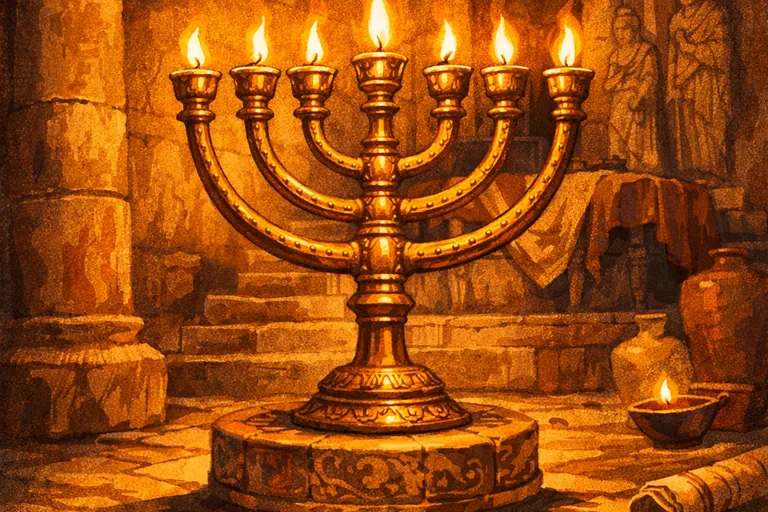
When the Maccabees went to rededicate the Temple, they found only enough consecrated olive oil to keep the Temple's menorah (the original seven-branched lamp) burning for a single day. Preparing new oil required eight days. According to the Talmud, the small quantity of oil miraculously lasted the full eight days. That miracle of the oil is why Hanukkah lasts eight nights and why oil, in the form of fried foods, is central to the celebration.
The holiday is also spelled Chanukah. Both transliterations are acceptable. The initial Hebrew letter, chet (ח), produces a guttural sound with no exact English equivalent. "Ch" is closer to the pronunciation; "H" is simpler. Neither is wrong.
When Is Hanukkah and When Does It End?
Hanukkah begins on the 25th of Kislev in the Hebrew calendar and lasts eight days, ending on the 2nd or 3rd of Tevet (depending on the length of the month of Kislev in that particular year). Because the Hebrew calendar is lunisolar, Hanukkah's Gregorian dates shift annually. It can start as early as late November or as late as late December.
In 2025, Hanukkah runs from the evening of Sunday, December 14 through Monday, December 22. The first candle is lit at sundown on December 14. The last day of Hanukkah 2025 is December 22.
This timing means Hanukkah sometimes overlaps with Christmas and sometimes doesn't. In years when Hanukkah falls early, it can be completely finished before December 25. In other years, the final night of Hanukkah coincides with Christmas Eve or Christmas Day. The overlap is coincidental. The two holidays have no historical connection.
Hanukkah Traditions and How the Holiday Is Celebrated
Lighting the hanukkiah
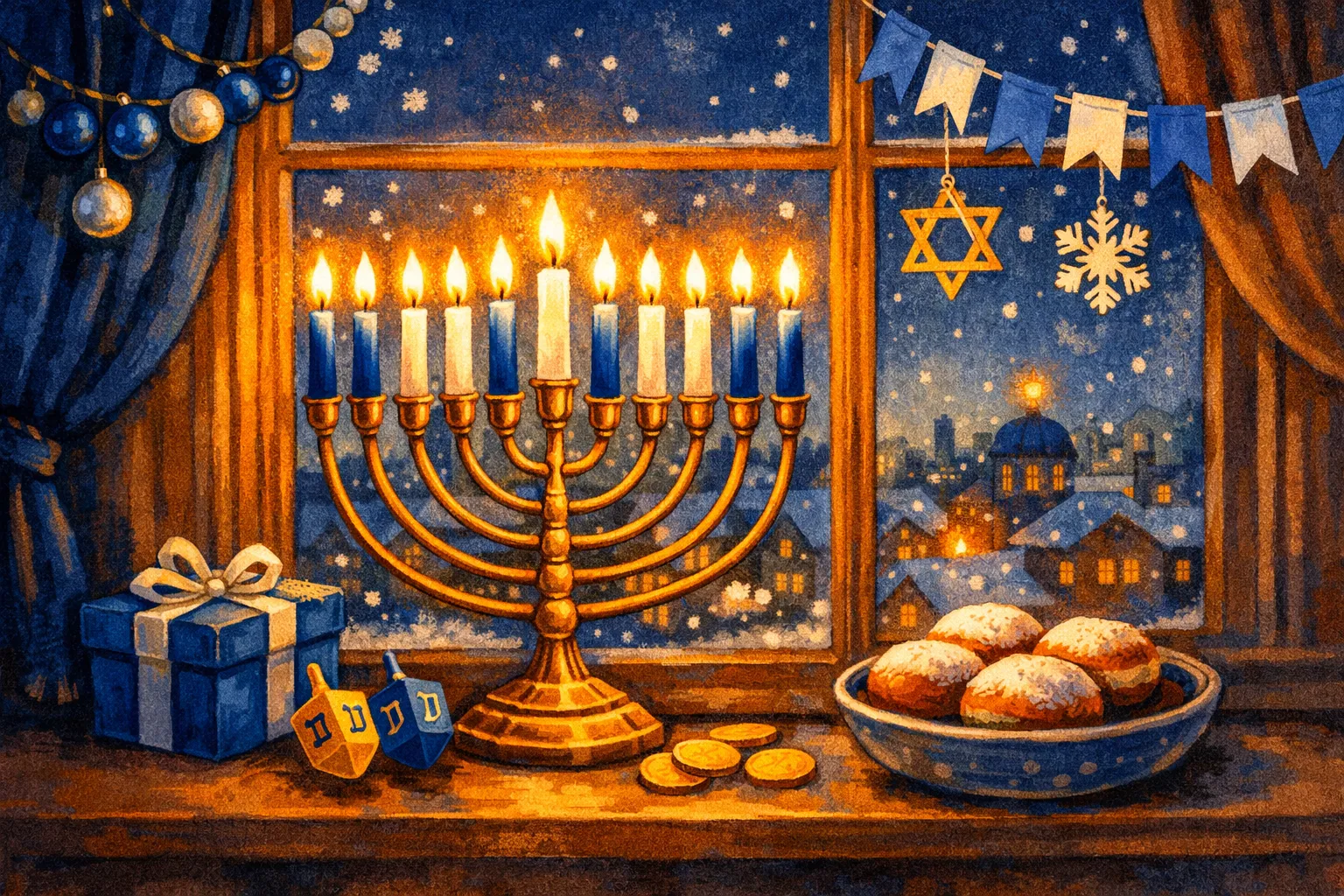
The central ritual of Hanukkah is lighting the hanukkiah, a special nine-branched menorah. (The term "menorah" technically refers to the original seven-branched Temple lamp, but in common usage, people call the Hanukkah candelabrum a menorah too.) Eight branches represent the eight nights. The ninth branch, called the shamash ("helper" or "servant"), is used to light the others.
On the first night, one candle is lit. On the second, two. By the eighth night, all eight candles plus the shamash are burning. Candles are placed right to left but lit left to right, so the newest candle is always lit first. The hanukkiah is traditionally placed in a window or doorway to publicize the miracle, a concept in Jewish law called pirsumei nisa.
Blessings are recited each night before lighting. On the first night, three blessings are said. On subsequent nights, two. After lighting, families often sing Ma'oz Tzur ("Rock of Ages"), a 13th-century hymn recounting God's deliverance of the Jewish people through history.
Foods fried in oil
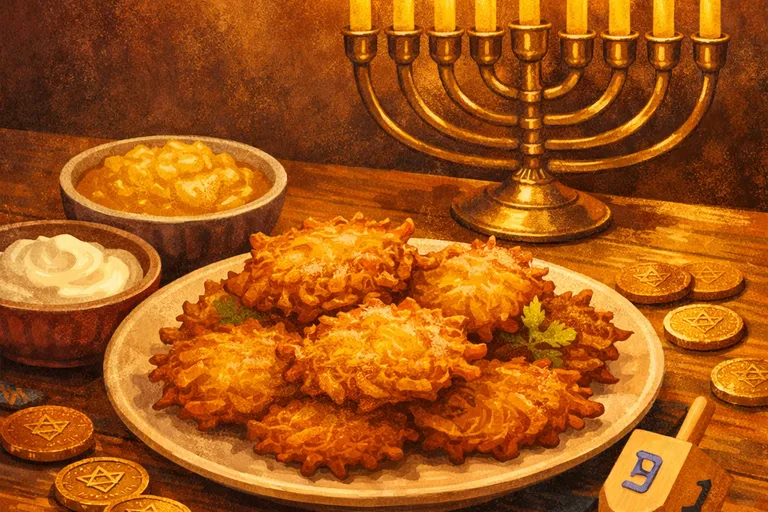
Because the holiday commemorates a miracle involving oil, traditional Hanukkah foods are fried. The two most iconic are latkes (potato pancakes) and sufganiyot (jelly-filled doughnuts). Latkes dominate in Ashkenazi (Eastern European Jewish) households, typically served with applesauce or sour cream. Sufganiyot are the centerpiece in Israel, where bakeries produce millions of them each Hanukkah season. Israeli sufganiyot have evolved far beyond basic jelly filling; modern versions feature dulce de leche, halva cream, and crème brulee.
Dreidel
The dreidel is a four-sided spinning top bearing Hebrew letters: Nun (נ), Gimel (ג), He (ה), and Shin (ש). These stand for Nes Gadol Haya Sham, meaning "A great miracle happened there." In Israel, the Shin is replaced with Pe (פ), changing the phrase to Nes Gadol Haya Po, "A great miracle happened here."
The dreidel game is played with gelt (coins, traditionally chocolate) or other small tokens. Each letter determines the outcome of a spin: Nun means nothing happens, Gimel means you take the whole pot, He means you take half, and Shin means you put one in. It's a gambling game dressed up as a children's activity, and it has kept kids occupied during Hanukkah evenings for generations.
Gelt
Hanukkah gelt, the tradition of giving coins, predates the modern gift-giving custom by centuries. The practice has roots in 17th- and 18th-century Eastern Europe, where families gave coins to children during Hanukkah. Some historians connect the tradition to the Maccabees minting their own coins after gaining independence. Chocolate gelt, the foil-wrapped coins found in mesh bags, became widespread in the early 20th century and remains a staple of Hanukkah celebrations.
What Are the Colors of Hanukkah?
Blue and white are the colors most associated with Hanukkah. They also happen to be the colors of the Israeli flag, which was adopted in 1948. But the association between Hanukkah and blue predates the modern state of Israel.
The connection likely traces to tekhelet, a blue dye mentioned repeatedly in the Torah. Tekhelet was used in the ritual fringes (tzitzit) of Jewish prayer shawls and in the curtains of the Tabernacle. The dye was produced from a specific Mediterranean sea snail and was considered sacred. Blue became associated with Jewish spirituality, divinity, and the heavens.
Silver is a common addition to the blue-and-white palette, reflecting the metallic shimmer of the hanukkiah itself. In practice, Hanukkah decorations tend toward blue, white, and silver, which provides a clear visual distinction from the red-and-green palette of Christmas. That color contrast has likely reinforced the association, especially in the United States, where both holidays share retail space in December.
How Did Hanukkah Presents Become a Tradition?
Gift-giving on Hanukkah is largely a 20th-century American development, and its growth tracks directly alongside Christmas's commercial expansion. Traditional Hanukkah observance centered on candle-lighting, prayer, food, and gelt. Presents were not part of the equation for most of the holiday's history.
The shift happened as Jewish families in the United States navigated the reality of living in a Christmas-saturated culture. Jewish children saw their neighbors receiving Christmas gifts. Jewish parents, understandably, wanted their own holiday to feel equally special. By the mid-20th century, gift-giving on each of the eight nights had become common in American Jewish households. Some families give one gift per night. Others concentrate gifts on a single night. Some give a mix of small gifts throughout the week with one larger gift.
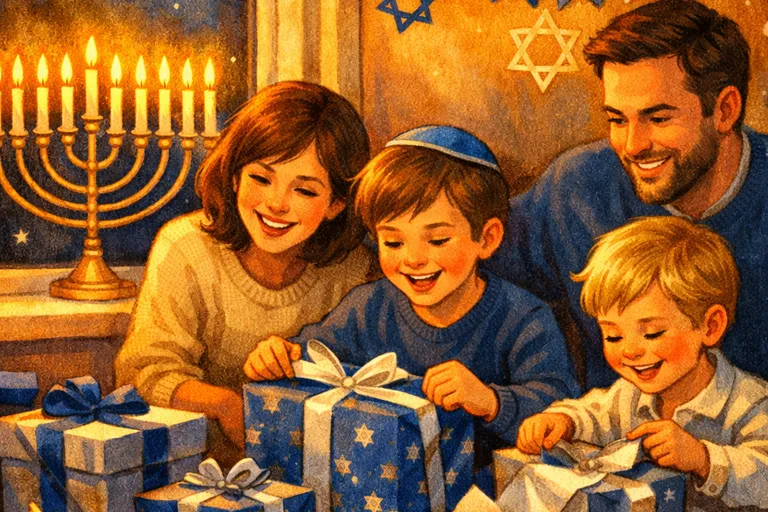
This evolution has been a source of genuine debate within the Jewish community. Some rabbis and cultural commentators have argued that turning Hanukkah into a gift-oriented holiday distorts its meaning, reducing a story about religious resistance and divine intervention to a December shopping occasion. Others take a more pragmatic view: holidays evolve, and giving gifts to children is hardly a betrayal of Maccabean values.
The debate aside, American retailers took notice. The National Retail Federation now tracks Hanukkah spending alongside Christmas spending. A 2023 survey found that Americans celebrating Hanukkah planned to spend an average of around $100 on gifts per household, compared to nearly $900 for Christmas households. The gap reflects the different roles the two holidays play, but it also reflects the fact that Hanukkah gift-giving, while widespread, remains more modest in scale.
In Israel, Hanukkah gift-giving is less prominent. The holiday is a school vacation, and public celebrations focus on community menorah lightings, doughnut consumption, and cultural events. Gelt remains more central than wrapped presents. The American gift-exchange model hasn't transplanted fully, partly because Israeli culture doesn't have Christmas as a competing reference point.
Frequently Asked Questions
What is the correct spelling: Hanukkah or Chanukah?
Both are correct. They are different transliterations of the same Hebrew word (חֲנֻכָּה). "Chanukah" is closer to the original Hebrew pronunciation, while "Hanukkah" is the more common English spelling. Major publications and dictionaries accept both.
Is Hanukkah a major Jewish holiday?
No. In terms of religious significance, Hanukkah is considered a minor holiday in Judaism. Yom Kippur, Rosh Hashanah, Passover, Sukkot, and Shavuot all rank higher. Hanukkah's cultural prominence, especially in the United States, comes largely from its December timing near Christmas rather than from its theological importance.
When is Hanukkah in 2025?
Hanukkah 2025 begins at sundown on Sunday, December 14 and ends on the evening of Monday, December 22. The dates change each year because Hanukkah follows the Hebrew lunisolar calendar, always starting on 25 Kislev.
Why do Hanukkah dates change every year?
Hanukkah follows the Hebrew calendar, which is lunisolar (based on both the moon and the sun). Months begin with the new moon, making the calendar about 11 days shorter than the Gregorian calendar each year. A leap month is added periodically to keep seasons aligned, which causes Jewish holidays to shift within a range of Gregorian dates.
What foods are traditional for Hanukkah?
Foods fried in oil are traditional because the holiday celebrates a miracle involving oil. The two most common are latkes (potato pancakes), popular in Ashkenazi households, and sufganiyot (jelly-filled doughnuts), which dominate in Israel. Other oil-fried foods vary by community, including fritters, fried cheese, and bimuelos (fried dough balls).
Do all Jewish families give Hanukkah presents?
Gift-giving varies widely. The tradition is strongest in the United States, where it developed in the 20th century partly in response to the cultural prominence of Christmas gift-giving. In Israel and many other countries, Hanukkah celebrations focus more on candle-lighting, food, and gelt (coins) than on wrapped presents. Some families give a gift each of the eight nights; others give one or two gifts total.