
Durbin... In her most dramatic glory.
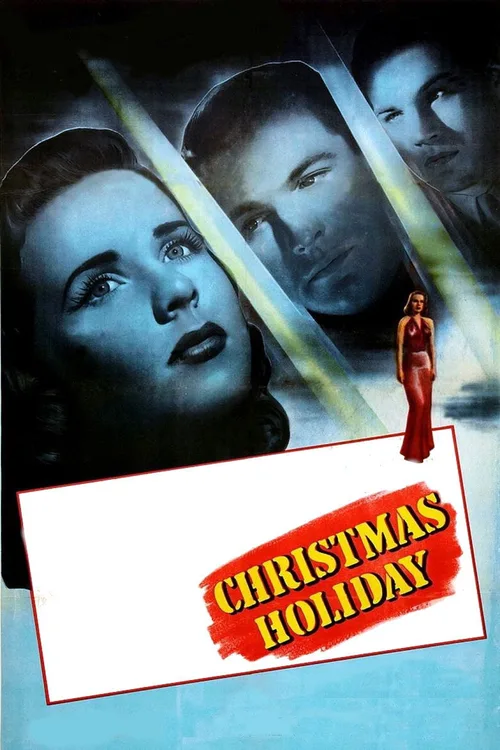
Christmas Holiday (1944)
A young femme fatale realizes that the man she married is an incorrigible wastrel.
 rating 7/10 User rating 34 votes 64%
 ❄ Christmas Connection
The film is explicitly set during the Christmas holiday season, with carolers, midnight mass, and a Christmas Eve dinner scene providing the backdrop for its dark story. The festive setting functions as deliberate irony: Siodmak and screenwriter Herman J. Mankiewicz use the warmth of the holidays to throw the ugliness of the central relationship into starker relief. Christmas here is not decoration but contrast.
Our Review
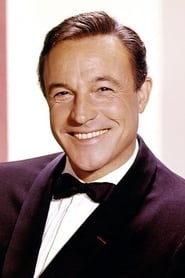
The title "Christmas Holiday" promises something it has no intention of delivering. Released in 1944 by Universal Pictures, this film noir directed by Robert Siodmak has a Christmas setting, a Christmas Eve dinner, a midnight mass scene, and almost nothing else to connect it to the genre the title implies. What it delivers instead is a story about a woman slowly destroyed by her love for a man who turns out to be a murderer. Gene Kelly plays the murderer.
What Christmas Holiday Is Actually About
A young Army lieutenant named Charlie Mason, stranded in New Orleans on Christmas Eve after his fiancee sends a Dear John letter, ends up at a seedy club where he meets Abigail, a woman who performs there under the name Jackie Lamont. Over the course of Christmas Eve and Christmas Day, she tells him her story.
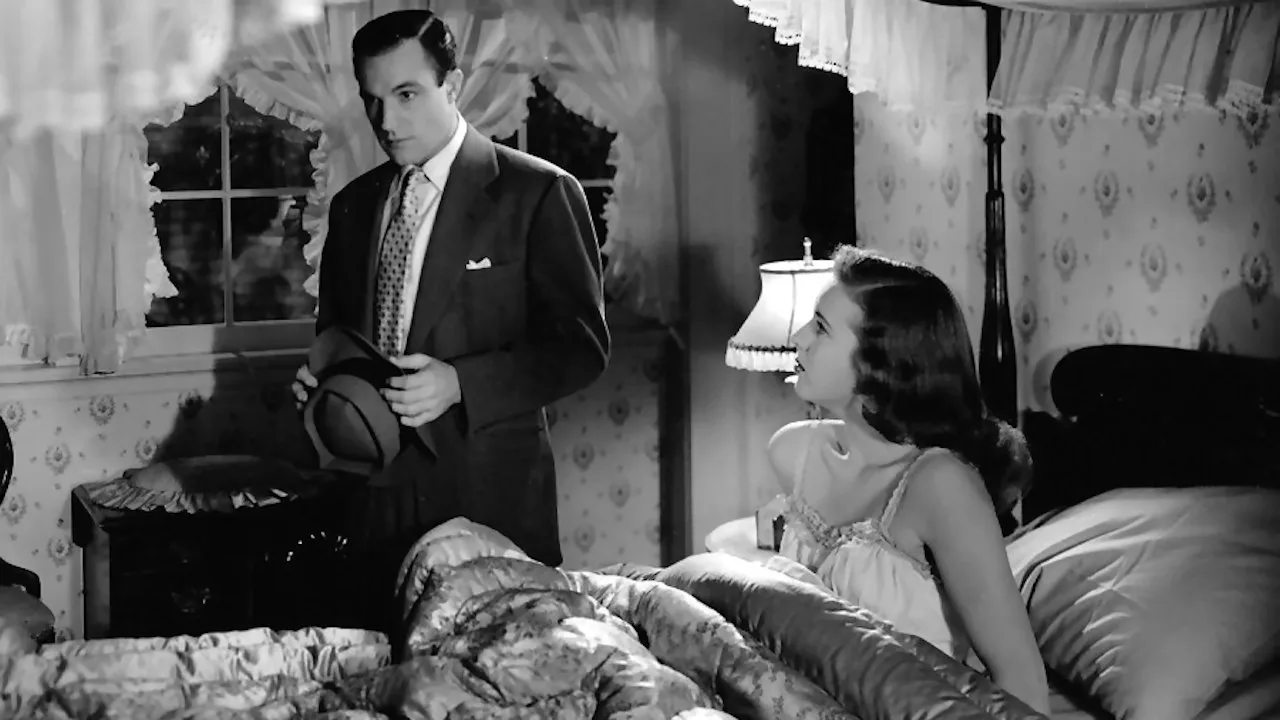
Abigail married Robert Manette, played by Kelly, a charming and deeply troubled man from a New Orleans family with money but bad habits. Robert gambled away what he had, borrowed from the wrong people, and eventually shot a bookmaker in what he called self-defense. Abigail, who loved him completely, testifies on his behalf at trial, but he is convicted and sentenced to prison. While he serves his sentence, she works at the club to survive. The film is essentially her account of how she got from a naive young woman in love to someone working in a dive on Christmas Eve.
Siodmak shoots New Orleans the way he shot every city in his noir work: wet streets, shadows in corners, rooms where the light sources feel slightly wrong. He had fled Nazi Germany in 1933 and spent years working his way through France before arriving in Hollywood. His sense of unease was not affectation.
Gene Kelly Against Type
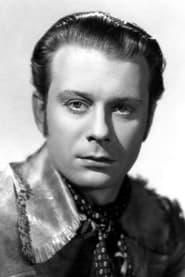
In 1944, Gene Kelly was already known for "For Me and My Gal" (1942) opposite Judy Garland and "Du Barry Was a Lady" (1943). He was becoming synonymous with physical grace and likable energy. Robert Manette is neither graceful nor likable. He is vain, volatile, weak, and ultimately dangerous.
Kelly takes the role seriously. There is a scene where Robert, charming a room full of people at a family dinner, turns to look at Abigail with something that reads as possessiveness rather than love, and Kelly holds the look just long enough for it to curdle. The film does not show him as a monster who was always obviously monstrous. He is shown as someone who could plausibly attract a smart woman, which makes the story land.
Kelly reportedly found the role uncomfortable and was not eager to play a killer. The performance works precisely because of that discomfort. He never settles into the role with the ease of an actor who enjoys playing villains.
Deanna Durbin's Pivot
Durbin was Universal's biggest star through the late 1930s and early 1940s, built almost entirely on a wholesome image: operatic soprano voice, innocent persona, the girl-next-door who could sing. By 1944 she was trying to expand beyond that image, and "Christmas Holiday" was the most aggressive attempt.
The studio was nervous. Durbin's fanbase was built on a specific kind of audience expectation, and "Christmas Holiday" violates nearly all of it. She plays a woman who works in a taxi-dance hall, who married badly, who testifies for a guilty man, who ends up singing "Spring Will Be a Little Late This Year" in a dive club on Christmas Eve while her husband's mother tries to get her away from her son.
The song "Spring Will Be a Little Late This Year" was written specifically for this film by Frank Loesser. Its placement is one of the more pointed uses of a song in a 1940s Hollywood picture: a woman singing about hope deferred to an audience that isn't really listening.
W. Somerset Maugham's Source Novel
The film is based on Maugham's 1939 novel of the same name. Maugham's original is set in Paris, and the central relationship in the novel is different in structure: Maugham's narrator is a young English writer, not a stranded soldier, and the woman's account has a different texture in the novel. Herman J. Mankiewicz moved the story to New Orleans for the adaptation, which gives it the Southern Gothic flavor Siodmak knew how to use.
Maugham reportedly disliked what Hollywood did with his novel, though this was not an unusual position for Maugham to take about film adaptations of his work.
Is This a Christmas Movie
By strict definition, yes. It is set at Christmas. It contains Christmas imagery, Christmas music, and Christmas Eve scenes. By the spirit of the genre as most people understand it, no. There is no warmth, no family reunion, no gift that fixes a relationship, no redemption tied to the season.
The Christmas setting functions as pressure. The holiday's expectations of joy and togetherness make the reality of Abigail's situation harder to ignore. She is alone in a strange city on Christmas Eve because the man she loved turned out to be someone who would shoot another person over a gambling debt. The carols in the background are not ironic decoration in a cheap sense. They're a genuine counterweight.
Siodmak made the film the same year he made "Phantom Lady," another noir with a woman at the center of a crime story. His 1944 was productive in a specific and dark way.
Fun Facts
Gene Kelly was borrowed from MGM specifically for this film. Universal wanted his rising star power but the role required him to play against the persona MGM was carefully constructing for him. Kelly completed the film and returned to MGM for "Anchors Aweigh" (1945).
Deanna Durbin received $250,000 for her work on "Christmas Holiday," making her one of the highest-paid performers in Hollywood in 1944. The salary reflected her box office value even as the studio was uncertain about her dramatic pivot.
Frank Loesser wrote "Spring Will Be a Little Late This Year" for Durbin's character to sing in the film. Loesser would go on to write the music and lyrics for "Guys and Dolls" (1950) and "How to Succeed in Business Without Really Trying" (1961).
W. Somerset Maugham's source novel was published in 1939 and set in Paris. Screenwriter Herman J. Mankiewicz relocated the story to New Orleans for the adaptation, giving it a Southern Gothic atmosphere suited to Siodmak's visual style.
Robert Siodmak directed four noir films in 1944 and 1945 in rapid succession: "Phantom Lady" (1944), "Christmas Holiday" (1944), "The Suspect" (1944), and "The Spiral Staircase" (1945). This run established him as one of Hollywood's preeminent directors of the genre.
The film was a commercial success despite mixed critical reception, which Universal took as confirmation that Durbin's audience would follow her into darker material. Durbin did not fully make the transition and retired from acting in 1948 at age 27, settling in France for the rest of her life.
Deanna Durbin's singing voice in the film drew from her opera training. Her rendition of "Spring Will Be a Little Late This Year" is performed in the style of a lounge singer, which required her to deliberately underplay the voice she had spent years developing.
Cast