

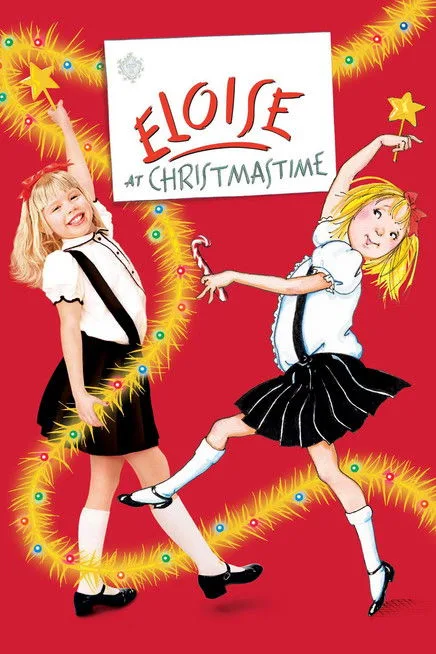
Eloise at Christmastime (2003)
Eloise is a precocious but lovable six-year-old girl who lives in New York's Plaza Hotel. The owner's daughter is getting married, but Eloise discovers that the fiance has devious plans to defraud kind Rachel! When her true love is revealed to be none other than Eloise's best friend Bill who works in the kitchen, Eloise goes on a mission to bring about a Christmas miracle and get the starcrossed lovers back together.. will things work out in time for a happy holiday ending?
 rating 7/10 User rating 72 votes 64%
 ❄ Christmas Connection
The entire film is set at the Plaza Hotel during the Christmas season, with the holiday as the engine of the plot: a wedding scheduled for Christmas Eve, a meddlesome six-year-old trying to stop it, and the hotel itself draped in decorations from top to bottom. Christmas is not a backdrop here, it is the deadline.
Where to Watch


Our Review
Eloise at Christmastime aired on ABC on November 22, 2003, which put it in direct competition with the Thanksgiving holiday weekend and every other family special the networks throw at viewers in late November. It held its own. The movie pulled a Nielsen household rating of 8.9, which for a made-for-TV film is a real number. The reason is not complicated: Julie Andrews, a Plaza Hotel set dressed within an inch of its life, and a ten-year-old actress from Minneapolis who plays a six-year-old with the confidence of a minor deity.
What Eloise at Christmastime Is Actually About
The plot runs on a classic setup. Rachel Peabody, daughter of the hotel manager, returns from college with her fiance, Brooks Oliver III, who is every bit as oily as that name suggests. Eloise, who lives in the penthouse and treats the Plaza as her personal fiefdom, figures out quickly that Brooks doesn't love Rachel. He is marrying her for access to her family's money. The real love interest is Bill, a room service waiter played by Gavin Creel, who had left the original Broadway cast of Thoroughly Modern Millie just months earlier to film this movie. Eloise decides to fix everything. The hotel's event planner, Prunella Stickler, played by Christine Baranski with sharp comic precision, does not appreciate the interference.
The wedding is scheduled for Christmas Eve. That gives the movie its ticking clock and its most decorative assets. Every corridor of the Plaza set is packed with garland, ornaments, and enough Christmas trees to supply a small neighborhood.
The Performances That Make It Work
Julie Andrews plays Nanny, Eloise's long-suffering and quietly devoted caretaker, and she approaches the role with the same professionalism she brings to everything. She is not slumming here. Andrews grounds the movie whenever Sofia Vassilieva's performance tips from charming into exhausting, which happens a few times, because Eloise is written to be exhausting. That is the character.
Vassilieva, who was 10 years old during filming despite playing a six-year-old, described the production as a "54-day vacation." She plays Eloise as someone who has never once been told her ideas are bad, which is exactly right. The character originated in Kay Thompson's 1955 book, and Thompson herself was the kind of person who lived rent-free at the actual Plaza Hotel for seven years until she was evicted in 1973. The books carry that energy. So does Vassilieva's performance.
Baranski gets the best lines and the sharpest reaction shots. Jeffrey Tambor plays the hotel manager, Mr. Salamone, with the weary air of a man who has accepted that his workplace will never be calm. Creel, despite being cast as the romantic lead, has less to do than anyone with his stage credits deserves. He mostly looks earnest near room service carts.
Kevin Lima Knew What Kind of Movie This Was
Director Kevin Lima had made A Goofy Movie in 1995, co-directed Tarzan in 1999, and directed 102 Dalmatians in 2000 before taking on both Eloise TV films. He is an animator turned live-action director, and it shows in the way he stages the movie: broad physical comedy, exaggerated reactions, characters who exist in slightly heightened versions of real spaces. The Plaza sets, built mostly in Toronto, are not trying to be realistic. They are trying to be Plaza-shaped, which is a different goal.
Lima won the Directors Guild of America award for Outstanding Directorial Achievement in Children's Programs for this film. The score, composed by Bruce Broughton, won Broughton the Emmy for Outstanding Music Composition for a Miniseries, Movie or a Special in 2004. Broughton has eight Emmy wins total. The production collected serious craft recognition for what looks, on the surface, like a holiday confection.
The Plaza as the Real Co-Star
The Plaza Hotel opened in 1907, and by the time Kay Thompson's book came out in 1955, it had already been a cultural landmark for half a century. Thompson chose it specifically because it was the kind of place where a child running entirely unsupervised through corridors would be absurd in the most plausible possible way. The 2003 film leans into this. Eloise does not run through a generic luxury hotel. She runs through the luxury hotel, or a very convincing stage-built version of it.
Exterior shots used the actual Plaza at 750 Fifth Avenue. ABC promoted the premiere with a high tea event at the hotel on November 15, 2003, attended by Andrews and Vassilieva. The hotel had its own reasons to participate. The Eloise character had, by 2003, been part of Plaza Hotel marketing for decades. The brand relationship between a fictional six-year-old and a Manhattan hotel has always been mutually beneficial.
Is This a Good Movie?
It is a good version of exactly what it is. The screenplay, credited to Elizabeth Chandler and based on Thompson's characters, does not try to do anything the format can't support. The romance is thin but functional. The villain is clear. The child meddles, causes chaos, and is ultimately vindicated. Andrews brings warmth without sentimentality. Baranski brings wickedness without cruelty.
What the film lacks is any real edge. The original Eloise books had a slightly anarchic quality: a child operating without adult supervision, treating a famous hotel as her personal toy, never facing real consequences. The TV movie softens this. Eloise here is meddlesome but ultimately in service of a very conventional love story. Thompson's Eloise wouldn't have cared that much about who Rachel marries. She'd have been more interested in seeing what happens if you order 47 room service meals in one afternoon.
But as Christmas TV movies go, this is solidly above average. The cast is too good, the production too well-crafted, and Baranski's comic timing too reliable for it to be otherwise.
Fun Facts
Sofia Vassilieva was 10 years old during filming in 2003, despite playing a six-year-old Eloise. She described the 54-day shoot as feeling like a vacation.
Director Kevin Lima won the Directors Guild of America award for Outstanding Directorial Achievement in Children's Programs for this film, the same year he directed the companion film Eloise at the Plaza.
Composer Bruce Broughton, who scored the film, won the 2004 Emmy Award for Outstanding Music Composition for a Miniseries, Movie or a Special. It was his eighth Emmy win.
Gavin Creel, who plays the love interest Bill, had left the original Broadway cast of Thoroughly Modern Millie on April 27, 2003, specifically to film both Eloise TV movies. He had been Tony-nominated for the role.
Kay Thompson, who created the Eloise character in her 1955 book, actually lived at the real Plaza Hotel for seven years, establishing squatter's rights and paying no rent until she was evicted in 1973.
The film was shot back-to-back with Eloise at the Plaza in Toronto, with the Plaza Hotel in New York City used only for exterior shots and a promotional event on November 15, 2003.
The film's premiere on ABC on November 22, 2003, achieved a Nielsen household rating of 8.9, strong viewership for a made-for-television holiday special.
Kevin Lima started his career as a character animator at Disney, working on The Great Mouse Detective (1986), Oliver and Company (1988), and as a character designer on The Little Mermaid (1989) before moving into directing.
Cast