
Love means never having to say you’re sorry.
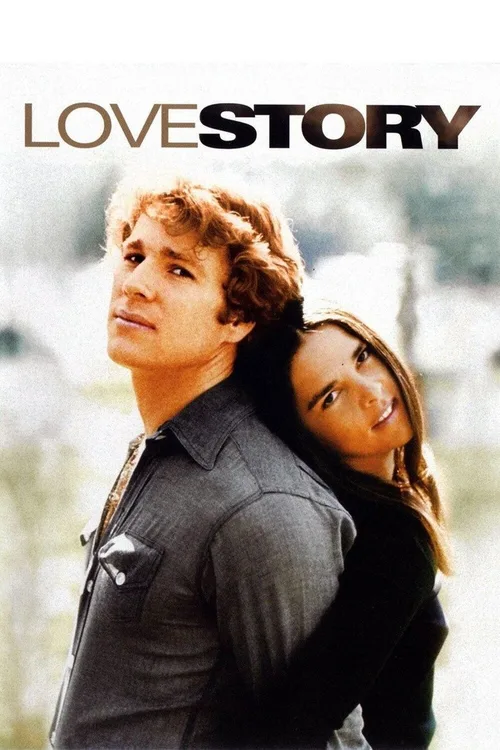
Love Story (1970)
Harvard Law student Oliver Barrett IV and music student Jennifer Cavilleri share a chemistry they cannot deny - and a love they cannot ignore. Despite their opposite backgrounds, the young couple put their hearts on the line for each other. When they marry, Oliver's wealthy father threatens to disown him. Jenny tries to reconcile the Barrett men, but to no avail.
 rating 7/10 User rating 726 votes 68%
 ❄ Christmas Connection
The film's most emotionally resonant scenes unfold during the Christmas season, including a pivotal moment when Oliver searches for Jenny in the snow on Christmas Eve. The holiday setting is not decoration but structural, marking the point where the love story turns toward loss and the couple's last Christmas together carries the full weight of what is coming.
Where to Watch


Our Review
Love Story came out in December 1970 and became the highest-grossing film of that year, ahead of Airport and M*A*S*H. It cost $2.2 million to make and earned over $106 million worldwide. Erich Segal wrote the novel and the screenplay simultaneously, and the book was published to coincide with the film's release. The whole enterprise had the calculated feel of a product launch. None of that should have produced something that still makes people cry.
And yet it does.
What Love Story Actually Is
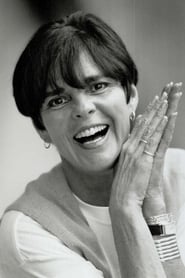
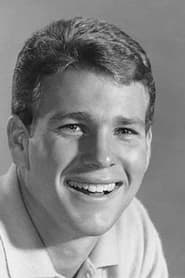
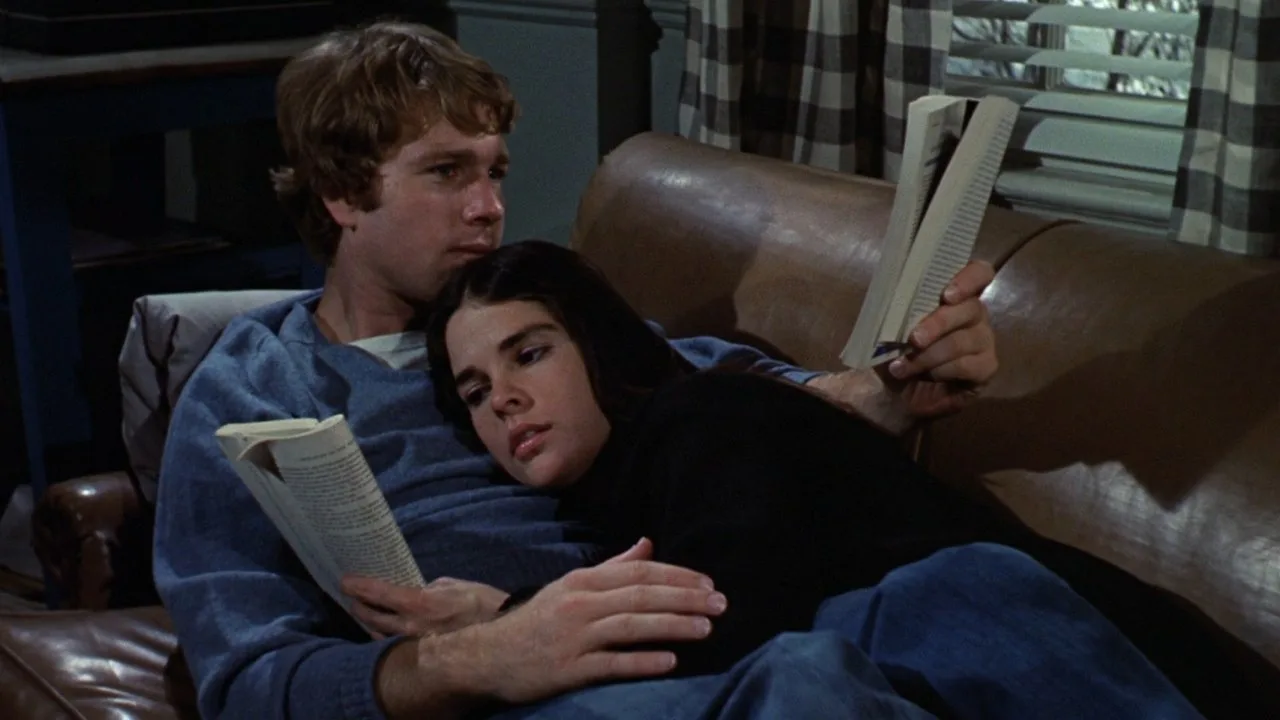
Oliver Barrett IV (Ryan O'Neal) is a Harvard hockey player from old Boston money. Jenny Cavilleri (Ali MacGraw) is a Radcliffe music student from working-class Cranston, Rhode Island, the daughter of a baker. They meet in the library. She insults him. He comes back. The setup is a classic romantic comedy opening that the film spends its entire runtime dismantling.
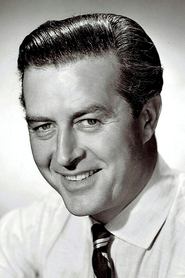
Oliver's father, Barrett III (Ray Milland), disapproves of the match on class grounds and cuts Oliver off financially. The two marry anyway. Oliver gets into Harvard Law on his own merits while Jenny works to support them. They are poor and happy in the particular way that young people in love believe poverty is temporary and happiness is structural. Then Jenny gets sick.
The film never names her illness. You know how it ends from the first three minutes, when Oliver narrates from a moment after her death. This is a movie that tells you the ending before the beginning and somehow makes you hope you heard wrong.
The Line Everyone Knows
"Love means never having to say you're sorry." It's one of the most quoted lines in film history and, taken in isolation, one of the least defensible pieces of relationship advice ever put on screen. Oliver's father says it to him near the end, repeating what Jenny had said earlier. In context it makes a kind of grief-logic sense: forgiveness between people who love each other can go without saying. Out of context it became a cultural shorthand that inspired decades of parody, most memorably Ryan O'Neal himself delivering it to Barbra Streisand in What's Up, Doc? (1972), to which she replies, "That's the dumbest thing I ever heard."
The line originated in Segal's novel. He claimed he wrote it sincerely. Make of that what you will.
Christmas in Love Story
The holiday setting arrives in the film's third act. Oliver and Jenny spend what turns out to be her final Christmas season together, and the film uses winter not as atmosphere but as punctuation. Snow in Boston, the cold light of New England December, Oliver running through the city on Christmas Eve looking for Jenny after a fight. When he finds her outside, sitting in the snow, the scene is one of the film's quieter devastations.
This is not a Christmas movie in the way that It's a Wonderful Life or White Christmas are Christmas movies. The holiday is not the point. But the season gives the film's emotional climax a specific weight that wouldn't exist in, say, April. Loss during Christmas has a particular texture. The film understands that.
What O'Neal and MacGraw Actually Do
The performances are more interesting than the film's reputation suggests. Ali MacGraw received an Academy Award nomination for Best Actress, and Ryan O'Neal was nominated for Best Actor. The critical consensus at the time was that the nominations were generous. Watch the film again and the consensus is harder to maintain.
MacGraw plays Jenny with a particular kind of unsentimental directness. Jenny doesn't perform her own illness. She's sharp and funny until she isn't, and MacGraw doesn't signal the transition with actorly preparation. O'Neal's job is harder in some ways: he has to be simultaneously a recognizable type (the WASP golden boy) and a specific person, and the film needs you to care about him enough that his grief lands. He manages it.
The supporting cast is more conventional. Ray Milland's Barrett III is a function, not a character. John Marley as Jenny's father, Phil Cavilleri, does better work than the script requires.
Arthur Hiller's Choices
Director Arthur Hiller made a deliberate decision to keep the camera close to the actors and stay out of the way. There are no elaborate set pieces. Francis Lai's score, which won the Academy Award and is one of the most recognizable in film history, does considerable emotional heavy lifting. Hiller knew it and let it.
The film was shot in Cambridge, Massachusetts and New York, using real Harvard locations including the Widener Library and the university hockey rink. The location photography gives the film a texture that studio shooting wouldn't have provided. These are real places, which makes the people in them feel more real.
Seven Academy Award nominations in total, including Best Picture. Hiller was not nominated for Best Director, which he thought was an oversight. He was probably right.
Why It Still Works
The film is manipulative. It's structured to produce a specific emotional response and it achieves that response with professional efficiency. Segal's source material is slender, the kind of novella that exists primarily to be adapted. None of this disqualifies the result.
What Love Story does is make you care about two specific people in a specific situation. The class conflict between Oliver and Jenny is more substantively developed than similar films of the period. The comedy in the early scenes is genuinely funny. And the romance, before the tragedy arrives, has a credible weight because both actors convince you that these two people have found something they didn't expect to find.
The ending works because everything before it has worked. That's a harder thing to pull off than it looks.
Fun Facts
Erich Segal wrote the original screenplay before turning it into a novel. The book was published in February 1970, months before the film opened in December, and reached number one on the New York Times bestseller list.
Ryan O'Neal was not the first choice for Oliver Barrett IV. Producer Robert Evans originally wanted Beau Bridges, Jon Voight, or Michael Douglas for the role before casting O'Neal.
Francis Lai composed the film's iconic main theme after watching the rough cut without sound, then scored the visuals. The theme won the Academy Award for Best Original Score at the 1971 ceremony.
The film was shot largely on location at Harvard University. Harvard gave the production access to real campus locations, including the Widener Library and Dillon Field House, which were used for the hockey scenes.
Ali MacGraw and Ryan O'Neal began a real-life romantic relationship during filming. MacGraw was married to producer Robert Evans at the time; she and Evans divorced in 1972.
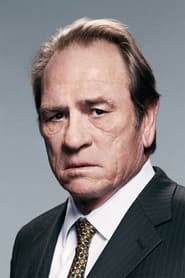
Erich Segal based the character of Oliver Barrett IV partly on two of his Harvard students: Tommy Lee Jones and Al Gore, who were roommates. Jones has confirmed this; Gore has been more ambiguous about it.
The film earned $106 million at the worldwide box office against a production budget of $2.2 million, making it one of the most profitable films of 1970. Paramount Pictures, which had been struggling financially, used the profits to fund the production of The Godfather two years later.
Ray Milland, who plays Oliver's disapproving father, had won the Academy Award for Best Actor in 1946 for The Lost Weekend. He considered his role in Love Story one of the less demanding jobs of his career.
Cast