

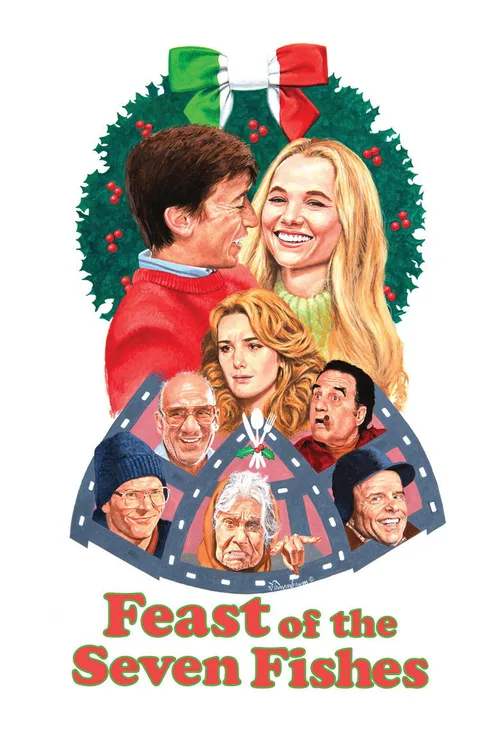
Feast of the Seven Fishes (2019)
A slice of life story that follows a large Italian family on Christmas Eve as they prepare for the traditional Feast of the Seven Fishes, reminisce about the past and seek love in the future.
 rating 7/10 User rating 59 votes 66%
 ❄ Christmas Connection
The entire film takes place on a single Christmas Eve and revolves around a multigenerational Italian-American family's annual feast of the seven fishes. Christmas Eve is not backdrop here; it is the engine. Every conflict, confession, and romance in the film is forced to the surface by the pressure of that one night together.
Where to Watch


Our Review
There is a specific kind of Christmas movie that only gets made when someone is paying for it with personal obsession rather than studio money. "Feast of the Seven Fishes" (released 2019, festival run 2018) is that kind of movie. Writer-director Robert Tinnell based it on his own Eisner Award-nominated 2005 graphic novel, shot it in Rivesville and Fairmont, West Virginia, and filmed significant portions of it inside his actual grandparents' house. You feel that level of personal investment in every frame, for better and occasionally for worse.
The premise is deceptively simple. It's Christmas Eve, 1983. Tony Oliverio, a sweet working-class Italian-American kid from a rust-belt town on the Monongahela River, brings Beth, a wealthy Protestant girl from a different world entirely, to meet his sprawling, loud, seafood-obsessed family. Chaos, warmth, romance, and several competing recipes ensue.
What the Feast of the Seven Fishes Gets Right
The strongest element of this film is its commitment to specificity. Tinnell isn't making a generic "big family at Christmas" movie. He's making a movie about a particular tradition: La Vigilia, the Italian Catholic Christmas Eve feast rooted in centuries of religious fasting. Before Christmas, the Church prohibited meat on vigil days, so southern Italian families ate fish instead, and over generations that constraint became a ritual they would have kept even if the prohibition disappeared. The number seven is contested theology: some say the seven sacraments, others say the seven deadly sins, others shrug and say their grandmother counted seven and that settled it.
The film respects that cultural texture. It doesn't explain the tradition to the audience like a documentary. It drops you into a kitchen where it has already been happening for decades, and lets you figure it out alongside Beth.
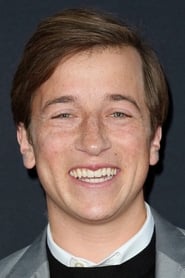
Skyler Gisondo plays Tony with genuine likability, which is harder to pull off than it sounds. The role requires him to be earnest without being a pushover, devoted to his family without being pathetic about it. Madison Iseman as Beth holds her own opposite a cast of much older, more established actors. Joe Pantoliano shows up as Uncle Carmine and does exactly what Joe Pantoliano does, which is to say he is funny and slightly threatening and you can never quite tell which one he's leaning toward at any given moment.
The 1983 Setting Does Real Work
Tinnell sets the film in 1983 for autobiographical reasons, but the period choice earns its keep cinematically. The rust belt was mid-collapse. The steel mills were shutting down. The Italian-American immigrant communities that had built their lives around that industry were watching that stability drain away, and the Christmas Eve feast was one of the cultural anchors they held onto harder precisely because other things were slipping.
The film doesn't lecture about any of this. It's background radiation. But it explains why the feast matters so much, why the older generation in the film takes the ritual so seriously, and why Tony's conflict between his inherited world and something new feels like a genuine stakes situation rather than a standard romantic comedy obstacle.
Cast and the Question of Joe Pantoliano
The supporting cast fills in the Oliverio family with enough personality that you can keep track of everyone without a scorecard, which is a real directorial achievement. Paul Ben-Victor and Lynn Cohen anchor the older generation. The family dynamics feel borrowed from real memory rather than invented from screenwriting formula.
Pantoliano's Uncle Carmine is the film's comic relief pressure valve. When the drama gets too heavy, Carmine walks in with something absurd and the room decompresses. It's a structural function as much as a character one, and Pantoliano executes it with the timing of someone who has been doing this for thirty years because he has been doing this for thirty years.
Where It Struggles
The romance between Tony and Beth runs on the thinner side of the script. The obstacles between them feel more asserted than earned, and the film resolves them with a speed that suggests Tinnell's real interest was always the family meal rather than the love story. That's not a fatal problem, but it means the film's emotional peaks come from the ensemble rather than the central couple.
The low budget is visible in some scenes, particularly in exterior shots and transitions. For a film this personal, shot in real locations with real family history, the constraint ends up reinforcing the authenticity more than it undermines it. A slicker production would have made a different, worse movie.
The film won the Audience Choice Award at the 2019 Heartland International Film Festival, which is a useful signal. This is a crowd-pleaser with soul, not an awards contender with ambition. It knows what it is.
Is It a Christmas Movie?
The most Christmas movie possible. The entire story takes place on Christmas Eve. Remove Christmas and there is no movie. The tradition of La Vigilia is older than America, carried from southern Italy by immigrants who wanted to keep something from home, and this film is a direct portrait of that tradition surviving into the early 1980s in a dying industrial town. For Christmas Eve specifically, it's hard to think of a film that takes the night itself more seriously as a subject.
Fun Facts
Robert Tinnell filmed major portions of "Feast of the Seven Fishes" inside his actual grandparents' house in Rivesville, West Virginia, making it one of the more literally autobiographical Christmas films in recent memory.
The film is based on Tinnell's 2005 graphic novel of the same name, which received an Eisner Award nomination. The Eisner Awards are comics' equivalent of the Oscars.
The real-world Feast of the Seven Fishes is a southern Italian and Italian-American Christmas Eve tradition rooted in the Catholic Church's ban on eating meat on vigil days. The number seven is theologically disputed: leading theories include the seven sacraments, the seven hills of Rome, and the seven deadly sins.
Joe Pantoliano, who plays Uncle Carmine, is himself of Italian-American heritage, born in Hoboken, New Jersey, to Italian immigrant parents. He has spoken publicly about the role the Italian-American family table played in his upbringing.
The film is set in 1983 on the Monongahela River in West Virginia, during the collapse of the American steel industry. Marion County, where Fairmont and Rivesville sit, lost thousands of steel-related jobs in the early 1980s.
Madison Iseman, who plays Beth, had previously appeared in "Jumanji: Welcome to the Jungle" (2017) before taking this smaller indie role. Skyler Gisondo, who plays Tony, had already built an extensive comedy resume on shows like "The Righteous Gemstones."
La Vigilia as a tradition is most strongly associated with families from southern Italy and Sicily. In Italy itself, the feast varies widely by region: some families serve thirteen fishes (one for each apostle plus Jesus), some serve seven, and some simply serve whatever seafood is available without counting.
Cast