
Without an enemy there can be no war.
Joyeux Noel (2005)
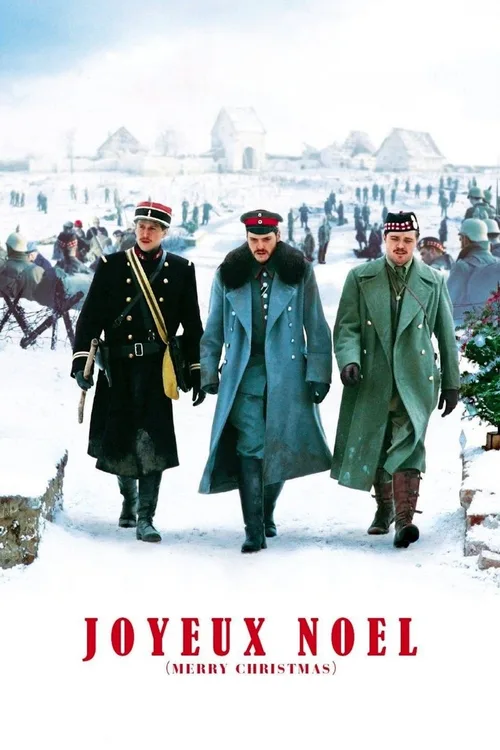
France, 1914, during World War I. On Christmas Eve, an extraordinary event takes place in the bloody no man's land that the French and the Scots dispute with the Germans…
 rating 8/10 User rating 910 votes 74%
 ❄ Christmas Connection
The entire film revolves around the real Christmas truce of 1914, when soldiers from France, Scotland, and Germany laid down their weapons on Christmas Eve to celebrate together. Christmas is not just the backdrop but the moral engine of the story.
Where to Watch


Our Review
On Christmas Eve 1914, roughly five months into a war that would kill 20 million people, soldiers along the Western Front did something their commanding officers never authorized. They stopped fighting. They sang carols across the trenches, shared cigarettes, and in some sectors played football in no man's land. Christian Carion's Joyeux Noel (2005) turns this well-documented event into a war film that is, paradoxically, most powerful in its quietest moments.
The film was nominated for the Academy Award for Best Foreign Language Film, and it deserved more attention than it received in English-speaking markets. It's one of those rare Christmas movies where the holiday isn't decoration. It's the point.
Three Armies, Three Languages, One Night
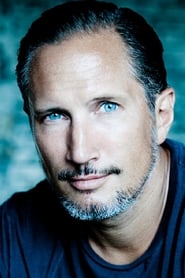
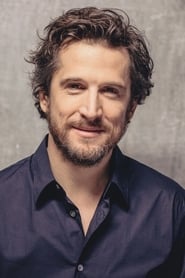
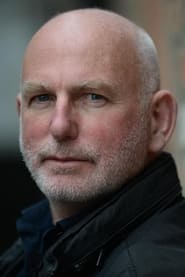
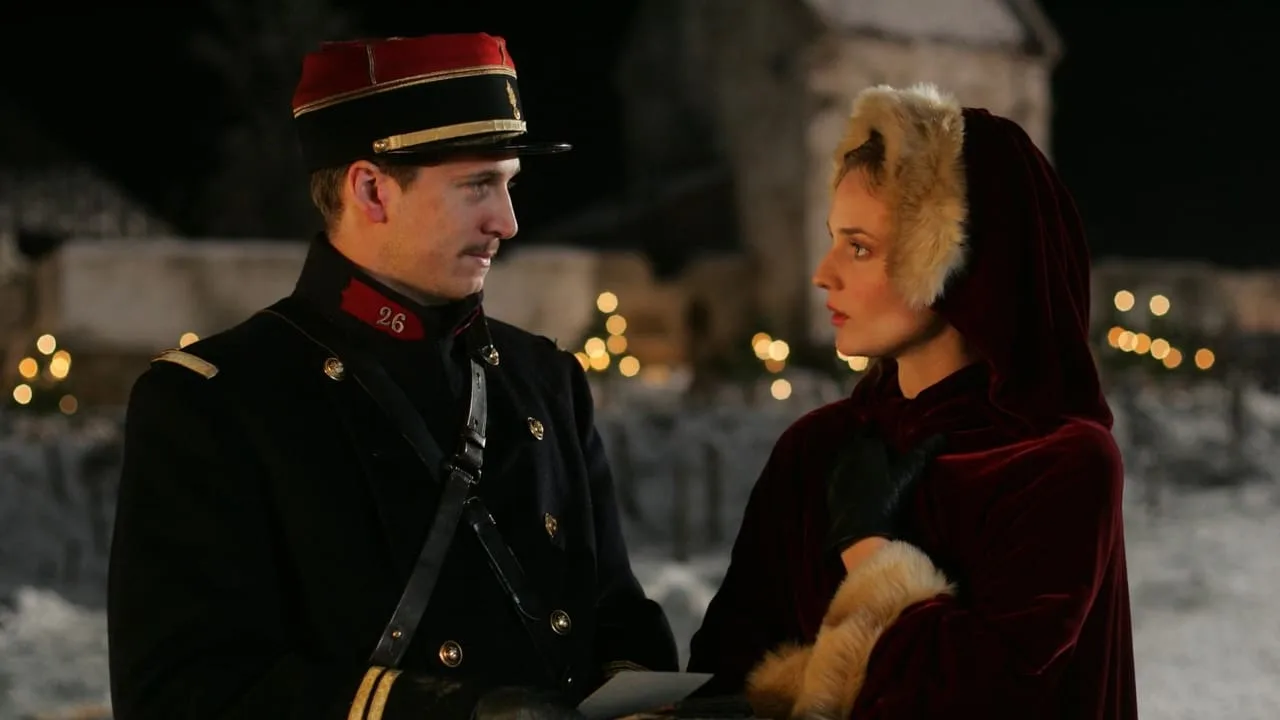
Carion structures his film around three parallel storylines converging on a single stretch of the front in northern France. On the French side, Lieutenant Audebert (Guillaume Canet) writes letters to his pregnant wife while trying to keep his men alive. The Scottish regiment is led by the pragmatic Palmer (Gary Lewis), whose soldiers include a young minister named Jonathan (Steven Robertson). And in the German trenches, tenor Nikolaus Sprink (Benno Fuermann) receives a visit from his lover Anna (Diane Kruger), a Danish soprano who has arranged through the German high command to perform for the troops on Christmas Eve.
It's Anna's singing that sets the truce in motion. When Sprink carries a lit Christmas tree into no man's land and begins to sing "Stille Nacht," the Scots respond with bagpipes. The French follow. Within minutes, men who were shooting at each other are shaking hands.
Carion, who also wrote the screenplay, based his script on extensive research into the actual truces of 1914. He drew from soldiers' letters, regimental histories, and existing accounts to build composite characters grounded in documented behavior. The film is fiction, but the events it depicts are not invented.
The Cast Earns Its Multilingual Ambition
The film is performed in French, German, English, and Latin, with each group speaking its own language. This is not a gimmick. It's the film's central formal decision, and it works because the cast commits fully.
Diane Kruger, in one of her earlier roles before Troy made her internationally known, brings real vocal presence to Anna. She was already fluent in French and German, which gives her scenes an ease that a dubbed performance could never match. Benno Fuermann's Sprink is a classical singer asked to become a soldier, and Fuermann plays the contradiction without sentimentality.
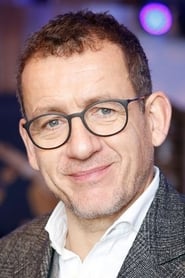
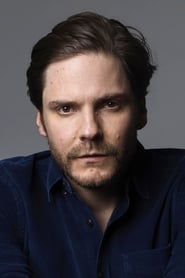
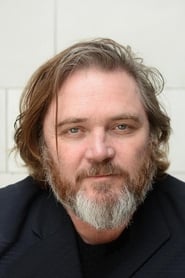
The real surprise is Dany Boon as Ponchel, a French soldier desperate to recover his cat from behind German lines. Boon, who would go on to direct the massive French hit Bienvenue chez les Ch'tis, provides moments of genuine warmth without tipping into comic relief. Daniel Bruehl, meanwhile, brings restraint to Horstmayer, a German officer who begins to question his own chain of command.
Where the Film Cuts Deepest
The strongest sequence in Joyeux Noel is the midnight Mass scene. A French military chaplain celebrates Christmas Mass in no man's land, with soldiers from all three armies attending. The camera stays on their faces. Nobody speaks. The scene works because Carion resists the urge to underline it.
What follows is harder to watch. When command learns about the fraternization, all three groups are punished. The Scottish regiment is split up and sent to the most dangerous sectors. The German soldiers are transferred to the Eastern Front. The French chaplain is reassigned and replaced by a bishop (Ian Richardson, in his final screen appearance) who delivers a sermon comparing the Germans to the Antichrist.
Richardson's scene is the film's sharpest piece of writing. The bishop quotes scripture to justify killing, and the camera holds on the faces of soldiers who just shared bread with the men they're now ordered to hate again. There's no rebuttal speech. There doesn't need to be.
A Christmas Film That Does Not Look Away
Most Christmas movies offer comfort. Joyeux Noel offers something more uncomfortable and arguably more valuable: the image of Christmas as a challenge. The truce didn't last because institutions, military and religious alike, couldn't tolerate it. The film makes this clear without preaching.
At $22 million, the production was ambitious for a European co-production. The budget shows on screen. The trench sets are convincingly grimy, the no man's land sequences are lit with flares and candlelight, and Philippe Rombi's score knows when to be present and when to be absent.
Carion's film earned strong reviews in France and across Europe but was largely overlooked in the U.S. despite its Oscar nomination. It has since built a loyal following among viewers who seek out Christmas films with historical weight. If you've seen every version of A Christmas Carol and need something that treats the holiday as more than a setting, this is the film.
Fun Facts
Christian Carion grew up in a farmhouse in northern France that still had World War I trenches running through the fields. He said the landscape itself inspired the film.
The Christmas truce of 1914 occurred along roughly two-thirds of the British-held sector of the Western Front. Some truces lasted only Christmas Eve; others continued into the New Year.
Diane Kruger was born in Germany and grew up in France, making her one of the few cast members who didn't need language coaching for her bilingual scenes.
Ian Richardson's performance as the bishop was one of his final film roles. The veteran British actor, known for House of Cards (1990), died in 2007.
The football match depicted in the film is based on multiple documented accounts, though historians debate the scale and locations of these games. The most cited match involved soldiers of the Royal Welsh Fusiliers and Saxon troops near Ypres.
The film was a co-production among France, Germany, the United Kingdom, Belgium, and Romania, mirroring the multinational nature of its story.
Dany Boon, who plays Ponchel, went on to direct Bienvenue chez les Ch'tis (2008), which became the highest-grossing French-language film of all time at the domestic box office.
Cast