

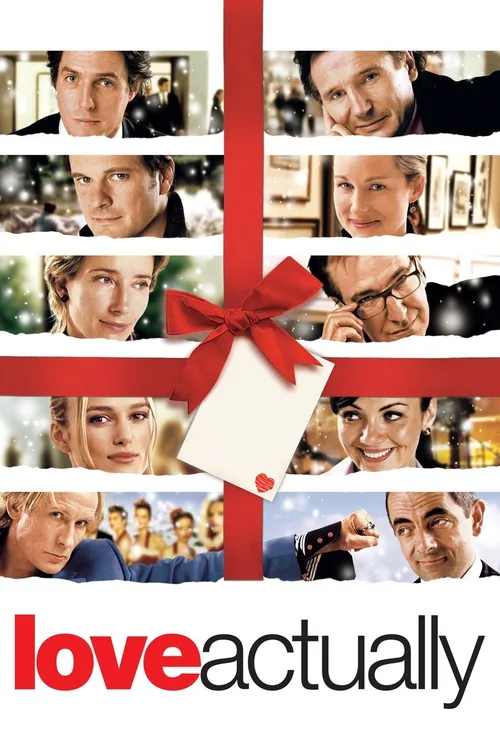
Love actually is all around.
Love Actually (2003)
Eight very different couples deal with their love lives in various loosely interrelated tales all set during a frantic month before Christmas in London.
 rating 8/10 User rating 7,279 votes 71%
 ❄ Christmas Connection
Love Actually is set entirely during the five weeks leading up to Christmas in London. Every storyline revolves around the holiday season as a catalyst for romantic declarations, family reunions, and emotional reckonings. Christmas here is not backdrop; it is the engine driving every plot thread to its conclusion.
Where to Watch


Our Review
Love Actually opens with footage of real people embracing at Heathrow Airport arrivals, and Hugh Grant's voiceover tells you that love is everywhere. It is a thesis statement delivered with total sincerity, and depending on your tolerance for that sort of thing, you'll either lean in or start looking for the exits. Released in November 2003, Richard Curtis's directorial debut grossed over $246 million worldwide and became one of the most debated Christmas movies in the English-speaking world. Not debated over whether it's a Christmas movie. That part is obvious. Debated over whether it's actually good.
The Richard Curtis Formula, Supersized
Curtis wrote Four Weddings and a Funeral, Notting Hill, and Bridget Jones's Diary before deciding that one love story per film was not enough. Love Actually weaves together ten separate storylines across five weeks of the London Christmas season, connecting them through coincidence, family ties, and workplace proximity. The cast reads like a roll call of British acting royalty plus a few Americans thrown in for box office insurance: Hugh Grant, Emma Thompson, Alan Rickman, Colin Firth, Liam Neeson, Keira Knightley, Bill Nighy, Rowan Atkinson, Laura Linney, and Martin Freeman.
The structure is the movie's greatest strength and its most obvious weakness. Some plots get 20 minutes of screen time. Others get barely five. The result is that you're watching ten short films shuffled together, and your opinion of Love Actually depends almost entirely on which ones you care about.
The Storylines That Work
Emma Thompson finding out about her husband's infidelity is the movie's emotional core. Her scene alone in the bedroom, listening to Joni Mitchell's "Both Sides Now" while quietly falling apart, is the best piece of acting in any Christmas movie ever made. Curtis himself has said he considers it the most important storyline, and Thompson brings a specificity to grief that the film's lighter plots can't match.
Bill Nighy as aging rock star Billy Mack is pure joy. His campaign to get "Christmas Is All Around" (a deliberately terrible rewrite of The Troggs' "Love Is All Around") to the Christmas number one is the movie's funniest subplot. Nighy improvised much of his dialogue, and the storyline lands its emotional punch precisely because it sneaks up on you. You think it's a joke, and then it turns out to be about the most important relationship in his life: his friendship with his manager Joe.
Colin Firth falling in love with his Portuguese housekeeper despite not sharing a common language is silly and charming in equal measure. The climactic scene where he proposes in broken Portuguese to a cheering restaurant is one of the great crowd-pleasing moments in romantic comedy.
The Love Actually Cast and the Storylines That Don't
The cue card scene. Yes, that one. Andrew Lincoln standing on Keira Knightley's doorstep, confessing his love for his best friend's wife via handwritten signs, has become the movie's most iconic moment. It has been parodied, memed, and referenced thousands of times. It is also, if you think about it for more than ten seconds, deeply uncomfortable. He's been secretly filming her at her own wedding. She's married to his closest friend. The movie frames this as romantic rather than concerning, and it has aged poorly.
The Colin-goes-to-America subplot, where a mediocre Englishman flies to Wisconsin and immediately attracts a house full of supermodels, is a fantasy so absurd it barely qualifies as a storyline. Laura Linney's plot about choosing between romance and caring for her mentally ill brother feels like it wandered in from a much better, much sadder film and never got a proper ending.
Is Love Actually a Christmas Movie?
This is not a close call. Love Actually is Christmas down to its bones. The plot begins five weeks before Christmas and ends on Christmas Eve. Characters buy presents at stores decorated for the holidays. A school nativity play drives an entire storyline. The Prime Minister dances through 10 Downing Street to "Jump" while Christmas decorations hang in every room. Billy Mack's whole arc is about the Christmas number one chart. The film's climax takes place on Christmas Eve, and its epilogue returns to Heathrow Airport, completing the circle.
If you're keeping score: Christmas trees, Christmas shopping, carol concerts, nativity plays, Christmas parties, Christmas Eve proposals, and Rowan Atkinson wrapping a gift with the slow deliberation of a man defusing a bomb. This movie doesn't just take place at Christmas. It could not exist without it.
Christmas Songs in Love Actually
The soundtrack did as much cultural work as the film itself. "All I Want for Christmas Is You" by Mariah Carey appears during the opening titles and helped cement the song's status as the modern Christmas standard. Carey's 1994 track had already been a hit, but Love Actually introduced it to a new generation of audiences who now associate it with airport reunions.
"Christmas Is All Around," performed by Bill Nighy in character as Billy Mack, was released as an actual single and reached number one on the UK chart. The original song it parodies, "Love Is All Around" by Wet Wet Wet, had been the UK's best-selling single of 1994. The joke was not lost on British audiences.
The film also features "Both Sides Now" by Joni Mitchell, "God Only Knows" by The Beach Boys, and "All You Need Is Love" by The Beatles. Curtis chose songs that had emotional weight independent of the film, which is why the soundtrack works even when the plotting doesn't.
The Verdict
Love Actually is a mess, and it knows it. Some storylines are brilliant. Some are cringe-worthy. Some have aged well; others have aged like milk left on a radiator. But the ones that hit, hit hard. Emma Thompson's bedroom scene alone justifies the film's existence. Bill Nighy's Billy Mack is one of the great comic creations in British cinema. And the Heathrow Airport bookends still work because they're built on real footage of real people who genuinely love each other.
Twenty years on, the film's reputation has settled into something honest: a flawed, overstuffed, sometimes brilliant holiday movie that people watch every December because the best parts are so good they forgive the worst parts. That's not a bad deal for 136 minutes on Christmas Eve.
Fun Facts
Hugh Grant's dancing scene in 10 Downing Street was not in the original script. Curtis added it late in production, and Grant has said in multiple interviews that he "dreaded" filming it and considered it the most embarrassing day of his career.
Emma Thompson has confirmed that her crying scene after discovering the gold necklace was informed by her own real-life experience of being cheated on by Kenneth Branagh. She has called it the easiest scene she ever had to play.
Bill Nighy improvised the line "I feel it in my fingers, I feel it in my toes" delivered as a deadpan spoken-word reading during a radio interview. Curtis kept it in because nothing in the script was funnier.
The film was shot in just 62 days across 63 different London locations, making it one of the most logistically demanding British productions of its era.
Rowan Atkinson's gift-wrapping scene was originally written as a longer subplot where his character was a Christmas angel. Curtis cut the supernatural element but kept the scene because it was too funny to lose.
Keira Knightley was only 17 during filming and had to get special permission from the local council to work on scenes that ran past 7 p.m.
"Christmas Is All Around" was released as a real single in the UK and debuted at number one, displacing the Black Eyed Peas from the top spot in December 2003.
Cast