
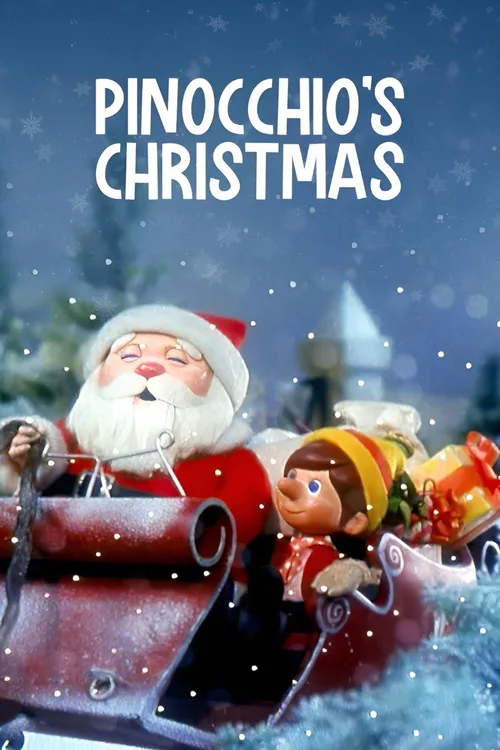
Playful pranks can lead a puppet astray!
Pinocchio's Christmas (1980)
As Geppetto prepares for Christmas, Pinocchio joins a puppet show to earn money for a present. There he meets and elopes with the beautiful girl puppet, Julietta, leaving Geppetto alone and worried.
 rating 6/10 User rating 25 votes 66%
 ❄ Christmas Connection
The entire special is built around Christmas Eve, with Pinocchio desperately trying to buy Geppetto a present before the holiday arrives. The story resolves with a Christmas morning reunion and the gift of a simple, honest love between father and son. Snow, carolers, and a toy fair full of holiday wares fill out the seasonal backdrop.
Where to Watch


Our Review
Pinocchio's Christmas arrived in November 1980, a decade past the golden era of Rankin/Bass holiday specials. By then the studio had already given the world Rudolph, Frosty, and Santa Claus Is Comin' to Town. Returning to Carlo Collodi's wooden puppet for a Christmas special was either a natural fit or a late-era cash grab, depending on your tolerance for stop-motion nostalgia. The answer turns out to be somewhere in the middle, which is more honest than most holiday programming will admit about itself.
What Pinocchio's Christmas Is Actually About
The plot strips Collodi's sprawling novel down to a single day's worth of trouble. Pinocchio sells his school spelling book to buy Geppetto a Christmas present, gets swindled by a fox named Alexander, and spends the rest of the special trying to recover both his money and his dignity. A traveling showman named Stromboli briefly enters the picture, as does a fairy who operates as the special's moral compass.
It's a compact story, which suits the 47-minute runtime. Rankin/Bass never had much patience for plot complexity in their specials, and here they don't pretend otherwise. The fox scheme, the puppet show, the snowbound chase: each sequence gets its time and moves on. No scene overstays its welcome, which is more discipline than some feature-length Christmas films manage.
What the special is really about, underneath the holiday trimmings, is the oldest lesson in Pinocchio's repertoire: easy money is a trap, and the people who promise you shortcuts are the ones who profit from your gullibility. That moral lands harder in a Christmas context than it does in Collodi's original summer setting. Everyone at a Christmas toy fair is trying to sell you something.
The Animagic Technique in 1980
Rankin/Bass called their stop-motion process "Animagic," a brand name for puppet animation produced largely in Japan by a company called Topcraft. By 1980, Topcraft had been executing this work for nearly two decades, and the craftsmanship shows in the puppet construction even if the animation itself is the slightly stiff variety that defines the studio's aesthetic.
Pinocchio as a puppet character has an inherent advantage in stop-motion: he's supposed to look artificial. His wooden joints and painted features translate naturally into the Animagic style in a way that, say, a realistic human character never quite does. The special leans into this. Pinocchio moves with a slightly jerky, marionette quality that feels intentional rather than technically limited.
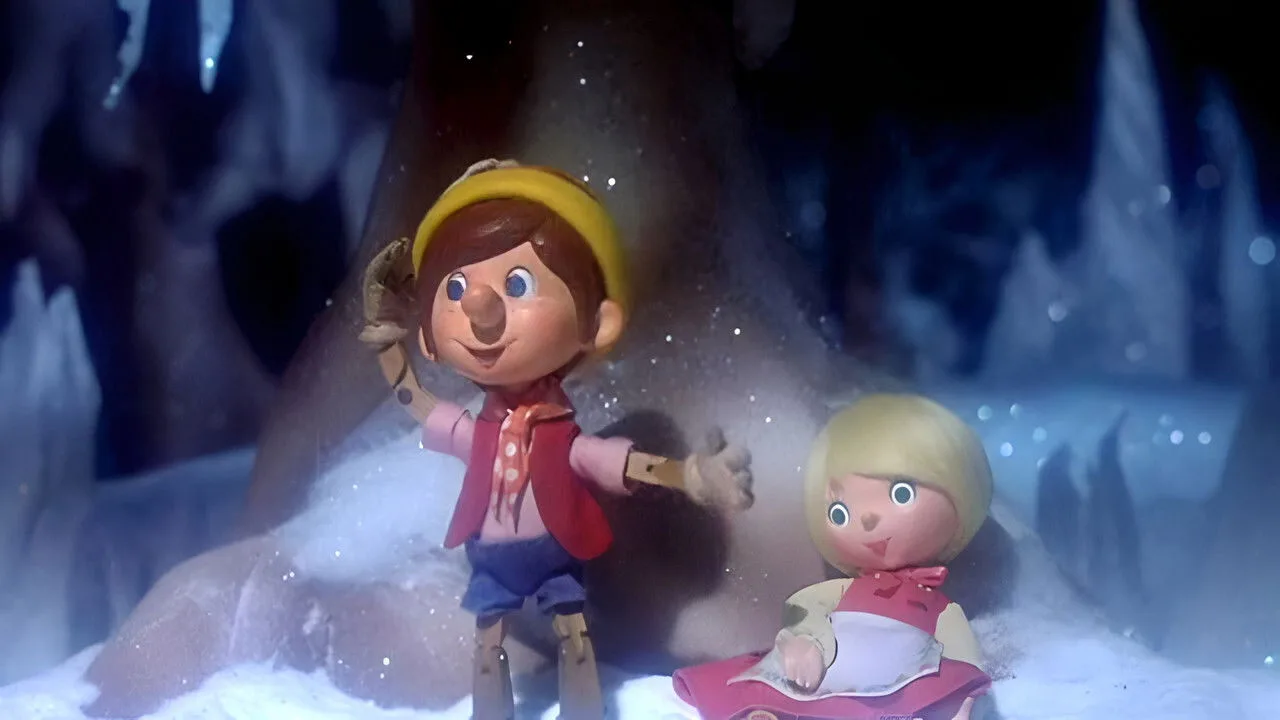
The toy fair sequence is the visual highlight. Dozens of small puppet figures populate a snow-dusted market, and the background detail rewards attention. Rankin/Bass specials were always better at world-building in small moments than in their main dramatic beats, and this holds here.
The Voice Cast and Songs
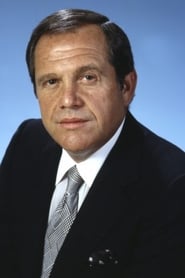
Todd Field voiced Pinocchio. This is the same Todd Field who later directed In the Bedroom (2001) and Tar (2022), two of the more serious American films of their respective decades. He was a teenager when he recorded the role, and his performance has the slightly over-enunciated quality common to animated specials of the era. Alan King, the veteran comedian known for his sharp observational humor, voiced the villain Alexander the fox. King was miscast in exactly the right way: he sounds like a man who finds his own scheming vaguely embarrassing, which gives Alexander an unintentional comedic layer.
The songs are original compositions rather than traditional carols, which was standard Rankin/Bass practice. None of them became classics. The studio's musical track record in the early 1980s never matched the songs from their 1960s peak, when "Holly Jolly Christmas" and "Silver and Gold" were written for Rudolph. The songs here are functional: they move the story forward and give Pinocchio something to do during transitional scenes, but you won't remember them by the time the credits roll.
Where It Sits in the Rankin/Bass Catalog
Ranking Rankin/Bass specials is a cottage industry among animation historians, and Pinocchio's Christmas generally lands in the second tier. It lacks the cultural footprint of Rudolph the Red-Nosed Reindeer (1964) or the bizarre ambition of The Life and Adventures of Santa Claus (1985). It's closer in spirit and quality to something like Jack Frost (1979), another late-era special that has its fans but never crossed into genuine holiday tradition.
That's not a dismissal. Second-tier Rankin/Bass is still a specific and irreplaceable thing. No other studio made holiday specials that looked and felt like this, and no one has seriously tried to replicate the format since. The Animagic aesthetic is so specific to its era that watching any of these specials now functions as a kind of time travel. Pinocchio's Christmas transports you to a particular version of late-1970s American childhood television, complete with its unironic storytelling and its confidence that children could follow a morality tale without having it spelled out in the final scene.
Geppetto's workshop at the end, with its hand-carved toys and single candle in the window, is the image the special earns. Everything else was prologue.
Fun Facts
Rankin/Bass produced Pinocchio's Christmas for ABC, which aired it on November 27, 1980. It was one of the studio's final batch of holiday specials before their output slowed significantly in the mid-1980s.
The stop-motion puppet work was executed by Topcraft, a Tokyo-based animation studio that Rankin/Bass used extensively from the 1960s onward. Topcraft later evolved into Studio Ghibli after Nausicaa of the Valley of the Wind (1984).
Todd Field, who voiced Pinocchio, went on to become an acclaimed film director. His 2022 film Tar won Cate Blanchett an Academy Award for Best Actress and was nominated for six Oscars total.
Alan King, who played the scheming fox Alexander, was one of the most prominent American stand-up comedians of the 1950s and 1960s, known for routines about suburban life and airline travel. He appeared in more than 30 films and TV specials across his career.
Carlo Collodi's original novel, The Adventures of Pinocchio, was published in Italy between 1881 and 1883 as a serial in a children's newspaper. Collodi initially killed Pinocchio at the end of the first installment, but reader response convinced him to continue the story.
The Rankin/Bass "Animagic" brand name was coined in the 1960s to distinguish their puppet animation work from traditional cel animation. The studio used the term as a marketing label rather than a technical description of any specific process.
Pinocchio's Christmas is one of at least four distinct Christmas specials based on the Pinocchio character, a number that reflects how thoroughly the wooden puppet has been absorbed into the broader folklore of European children's storytelling.
Cast