
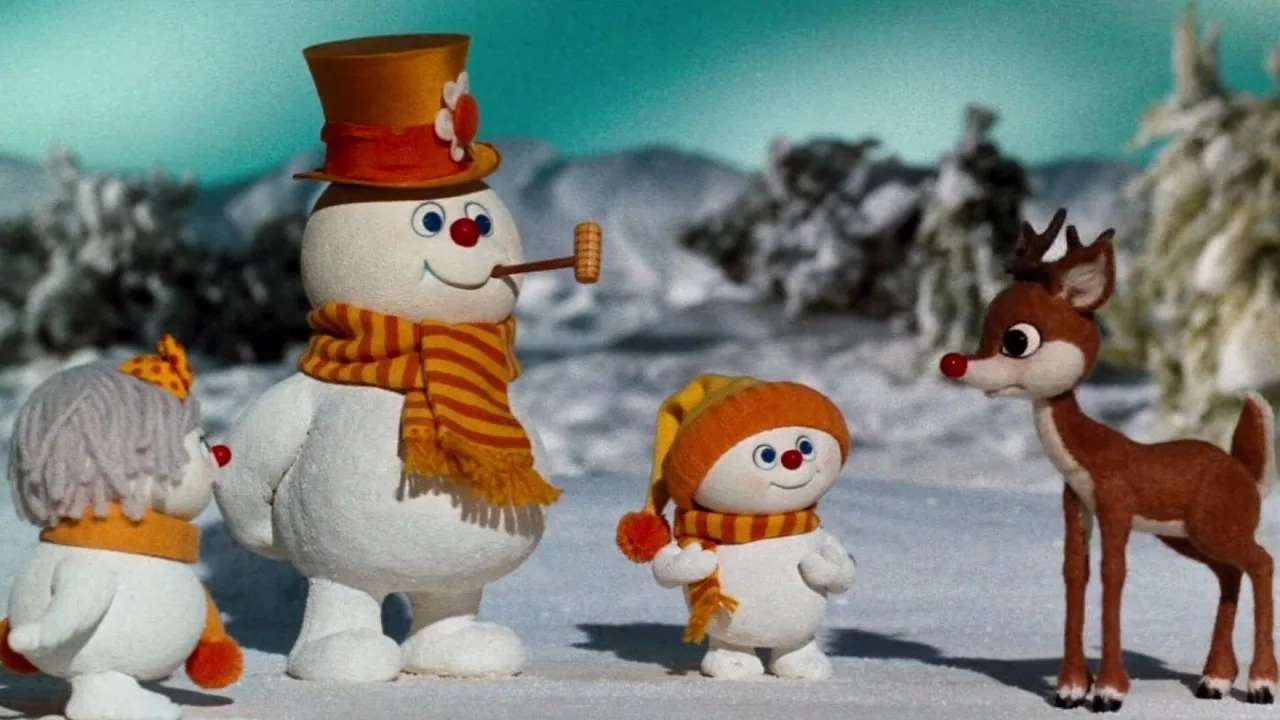
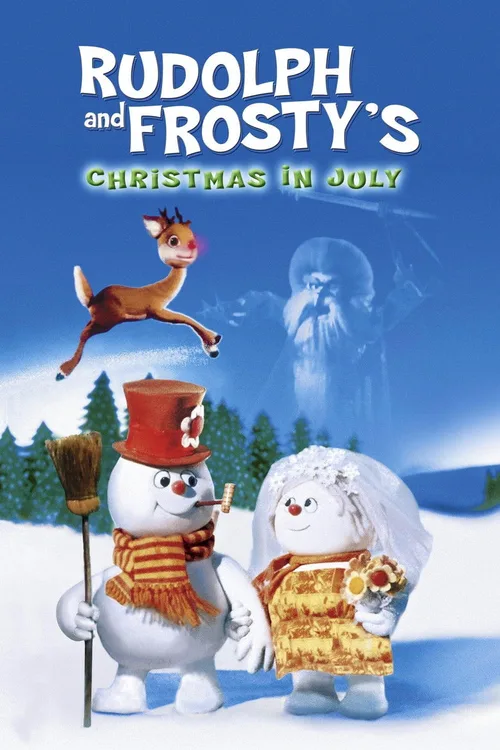
A magical, musical fun-filled fantasy!
Rudolph and Frosty's Christmas in July (1979)
Winterbolt is trying to make the North Pole his evil wonderland, and it is up to Frosty the Snowman, Rudolph the Red-Nosed Reindeer and others to stop him.
 rating 6/10 User rating 75 votes 64%
 ❄ Christmas Connection
The film is literally a Christmas special fighting to stay relevant in July, with Rudolph's magical nose tied directly to Santa's power and Frosty's survival dependent on winter cold. The entire plot hinges on preserving Christmas magic against a villain who wants to permanently snuff it out. Without Christmas mythology at its core, there is no story.
Where to Watch


Our Review
At 97 minutes, Rudolph and Frosty's Christmas in July is the longest special Rankin/Bass ever produced, and the studio used every one of those minutes trying to knit together a mythology that nobody had asked for but, in retrospect, absolutely should exist. Released in 1979, it is a stop-motion crossover event featuring Rudolph the Red-Nosed Reindeer, Frosty the Snowman, a carnival, Ethel Merman, and a vengeful ice sorcerer named Winterbolt who holds a surprisingly complicated grudge against Santa Claus. It is, by any reasonable measure, too much. It is also kind of great.
The premise operates with the internal logic of a child explaining a dream. Winterbolt once ruled the Northern darkness before Santa's goodness drove him back. Now he schemes to reclaim the world by extinguishing Rudolph's magical nose, which is, apparently, powered by a spell from a good wizard named Lightening. Winterbolt tricks Rudolph and Frosty into appearing at a Fourth of July beach carnival, where Frosty's family will melt if they stray too far from a magical ice cream wagon. Things proceed from there in the manner of a story where every new plot problem is solved by introducing two more.
The Rankin/Bass Cinematic Universe, Such As It Was
Rankin/Bass had spent over a decade producing separate specials for Rudolph and Frosty. Rudolph the Red-Nosed Reindeer aired in 1964. Frosty the Snowman followed in 1969. By 1979 the studio had accumulated enough characters, actors, and mythology to attempt something ambitious: a unified canon. Christmas in July was designed as the connective tissue, explaining how all these beloved specials fit together in one world.
The film brings back Billie Mae Richards as the voice of Rudolph, a role she had held since the original 1964 special. Jackie Vernon returned as Frosty. Paul Frees, the voice actor who narrated or voiced characters across nearly every Rankin/Bass production, appears here too. These weren't just casting decisions. They were load-bearing continuity choices meant to signal that this was the same universe, finally unified.
What Rankin/Bass was attempting in 1979 is essentially what Marvel made into an industry in the 2010s. The difference is that Marvel had individual films to build audience investment before the crossover. Rankin/Bass had 22-minute television specials.
Winterbolt Is a Better Villain Than He Has Any Right to Be
The film's genuine achievement is its antagonist. Winterbolt, voiced by Paul Frees, is not the standard-issue cartoon bad guy who wants something vague like "power." He has a specific, coherent grievance. He ruled the Arctic before Santa arrived, his darkness was displaced by Christmas cheer, and he wants it back. That's a real villain motivation with actual stakes attached to it.
He is also genuinely manipulative rather than simply menacing. He doesn't attack Rudolph directly. He deceives him, exploiting Rudolph's good nature and his desire to help Frosty. The nose extinguishing plot works because Winterbolt understands that Rudolph's kindness is the lever to pull. For a children's special from 1979, that's sophisticated characterization.
Red Buttons plays the carnival barker Sam Spangles, and Ethel Merman plays the circus star Lilly Loraine. Merman, a Broadway legend whose voice could fill a theater without a microphone, gets a big showstopper number that exists somewhat adjacent to the plot but lands hard regardless. She was 71 years old when she recorded it. The performance does not suggest a woman coasting on her reputation.
The Summer Setting Is Both the Point and the Problem
The July setting is conceptually clever and structurally awkward in equal measure. A Christmas story set in summer forces the audience to hold two tonal registers simultaneously: the warmth of a beach carnival and the existential threat to Christmas magic. Frosty's family melting under the July sun is played for genuine peril. Rudolph worrying about his nose going dark is treated as serious. Meanwhile there are seals and carousel rides and a fireworks finale.
The 97-minute runtime is where the film struggles most. Rankin/Bass pacing worked for 22 minutes because it had to. Every scene carried weight by necessity. At nearly four times that length, the film accumulates subplots at a rate that tests even sympathetic viewers. The ice cream wagon alone generates about three separate crises.
Children who encountered this on television in 1979 and 1980 tended to find it completely absorbing. Adults watching it now will notice the seams. Both reactions are correct.
What to Make of It Now
The stop-motion animation, produced by Rankin/Bass's Japanese partner Mushi Production, holds up better than the pacing. The character models are consistent with the 1964 Rudolph special, and the July setting gave the animators an excuse to build environments that weren't the usual snow and ice. The beach carnival sets have a warmth and color that distinguishes this special visually from everything else in the Rankin/Bass catalog.
The film was broadcast on ABC and then moved to CBS, where it aired irregularly through the 1980s before disappearing from network television. It became a VHS rarity and then a streaming find, the kind of special that people with strong childhood memories of it describe to friends who have never seen it and are greeted with skepticism. The skepticism is understandable. The childhood memories are also justified.
Winterbolt's final scene, where he is defeated not by force but by his own magic staff turning against him, is genuinely eerie. It was written for children and would work in a grimmer context without changing a line.
Fun Facts
At 97 minutes, Rudolph and Frosty's Christmas in July is the longest production Rankin/Bass ever made, more than four times the length of a typical 22-minute Rankin/Bass Christmas special.
Billie Mae Richards voiced Rudolph for the last time in this 1979 special. She had originated the role in the 1964 classic and returned for several sequels, but Christmas in July was her final performance as the character.
Ethel Merman, cast as circus star Lilly Loraine, was 71 years old during production. She had become famous on Broadway in the 1930s and 1940s, and her vocal power remained strong enough to carry the film's biggest musical number.
The villain Winterbolt was given a full backstory explaining that he once ruled the Northern darkness before Santa Claus arrived, making him one of the few Rankin/Bass antagonists with a coherent origin tied to the studio's broader mythology.
Paul Frees, who voiced Winterbolt and served as narrator, appeared in more Rankin/Bass productions than any other actor. He voiced characters in nearly every special the studio produced from the 1960s through the 1980s, including roles in Rudolph the Red-Nosed Reindeer (1964), Santa Claus Is Comin' to Town (1970), and The Year Without a Santa Claus (1974).
The stop-motion puppet animation was produced by Mushi Production in Japan, the same studio that handled the original 1964 Rudolph special under the name Videocraft International. By 1979 this partnership had produced over a dozen specials spanning 15 years.
The film premiered on ABC on November 25, 1979, before the Thanksgiving holiday, then moved to CBS for later broadcasts. It was eventually released on home video, which is how most viewers under 40 have seen it, as network airings became increasingly rare through the 1980s.
Red Buttons, who played the carnival barker Sam Spangles, had won the Academy Award for Best Supporting Actor in 1957 for Sayonara. His casting alongside Broadway legend Ethel Merman gave the special an unusually heavyweight adult cast by the standards of animated television in 1979.
Cast