

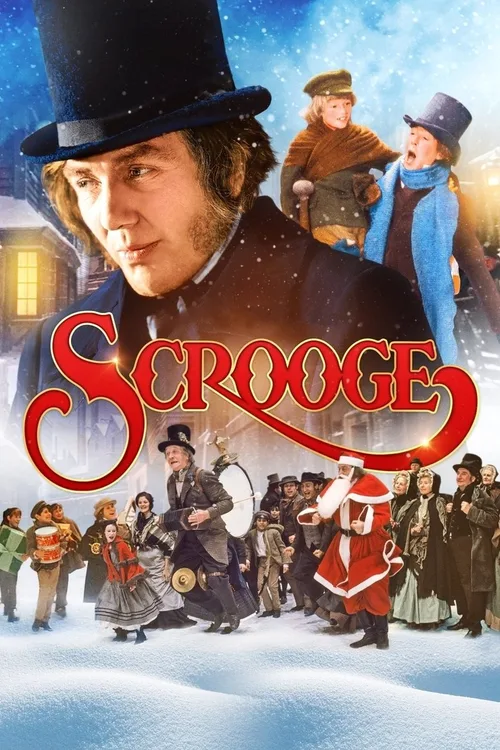
Scrooge (1970)
A musical retelling of Charles Dickens' classic ghost story about the miser Ebenezer Scrooge and the three spirits of Christmas who visit him on Christmas Eve.
 rating 7/10 User rating 75%
 ❄ Christmas Connection
Scrooge is a full musical adaptation of Charles Dickens' "A Christmas Carol," set entirely on Christmas Eve and Christmas Day in Victorian London. The three ghosts of Christmas drive the entire plot, and every musical number revolves around Christmas themes, from "I Hate Christmas" to the jubilant "I Like Life" on Christmas morning.
Our Review
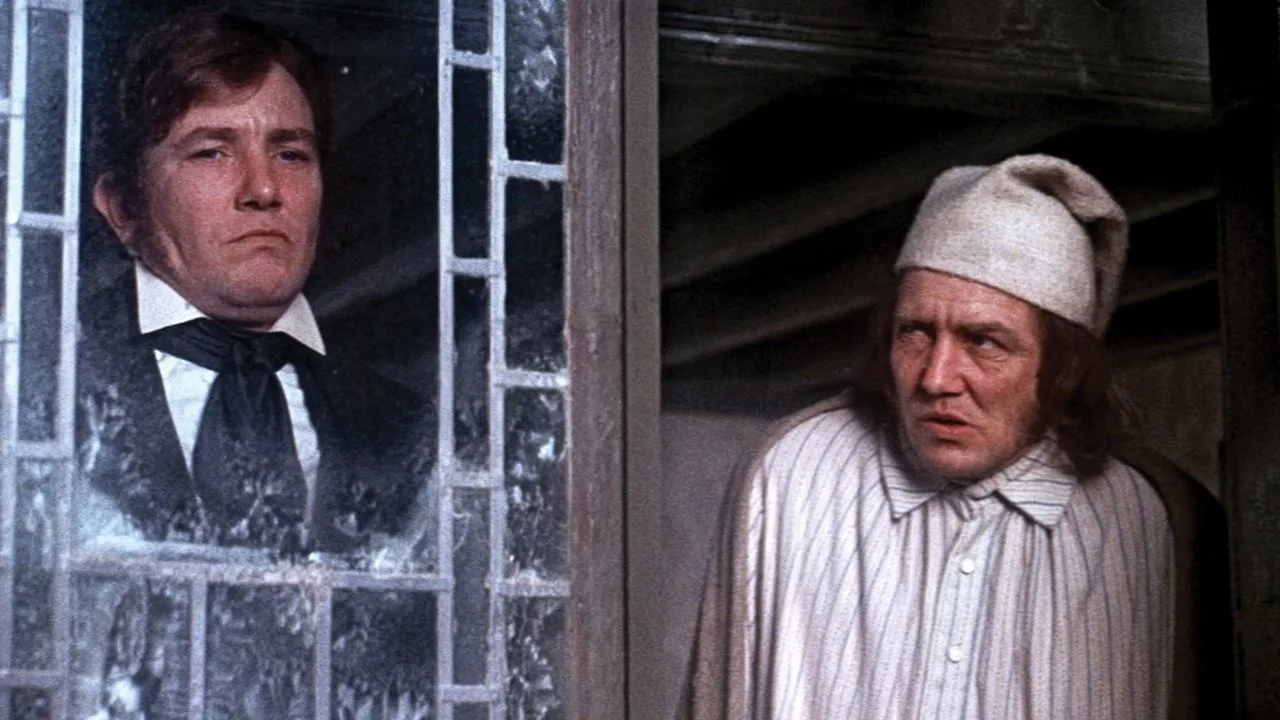
Albert Finney was 34 years old when he put on prosthetic aging makeup, hunched his shoulders, and became one of the most convincing Ebenezer Scrooges ever filmed. The 1970 musical "Scrooge" asked audiences to accept a young man as a bitter octogenarian, and against all odds, it worked. Finney's physical transformation is so complete that first-time viewers are routinely shocked to learn this is the same actor who played the swaggering title character in "Tom Jones" seven years earlier.
Albert Finney's Scrooge and the 1970 Cast
Director Ronald Neame built this adaptation around Finney's performance, and it was a gamble. Finney had no training as a musical performer. He did his own singing, and while his voice doesn't have the polish of a West End star, it has something more useful: character. His "I Hate Christmas" is a masterclass in comic bitterness, each note bitten off with genuine venom. When he sings "I'll Begin Again" after his transformation, the shift in vocal quality alone tells you everything about the character's change.
The supporting cast is stacked with British talent. Alec Guinness plays Marley's Ghost with the weary authority of a man who has spent eternity regretting his life choices. Kenneth More turns the Ghost of Christmas Present into a booming, warmhearted giant who seems to genuinely enjoy showing Scrooge how miserable he is. Edith Evans, at age 82, plays the Ghost of Christmas Past with an ethereal calm that makes her scenes feel genuinely otherworldly. David Collings brings a quiet decency to Bob Cratchit that avoids the usual hand-wringing.
Guinness reportedly accepted the role specifically because of the "Thank You Very Much" sequence, where he gets to watch his own funeral procession turn into a street party. It's the film's most visually ambitious scene, and Guinness plays Marley's reaction to it with a deadpan that's funnier than anything in the script.
The Songs of Scrooge: Hits and Misses
Leslie Bricusse wrote the screenplay, the lyrics, and the music. He'd won an Oscar for "Talk to the Animals" from "Doctor Dolittle" three years earlier, and the producers were betting that he could do for Dickens what Lionel Bart had done for Oliver Twist with "Oliver!" The results are mixed.
"Thank You Very Much" is the standout. It's a massive production number where the people of London celebrate what they think is Scrooge's death, dancing through the streets with his coffin in a sequence that's both darkly funny and visually spectacular. The song became a genuine hit in 1970 and remains the one number most people remember from the film. It works because it's built on irony: the happiest song in the movie is about a man's death.
"I Like Life" is nearly as good. The Ghost of Christmas Present drags Scrooge through the streets of London on Christmas morning, and the entire city seems to erupt into song. Kenneth More sells it with infectious energy. The choreography by Paddy Stone fills every corner of the frame with dancers, and the sequence has the controlled chaos of a great stage musical transferred successfully to film.
The weaker numbers tend to be the sentimental ones. "Christmas Children" tries too hard to tug at the heartstrings, and "Happiness," while pleasant enough, sounds like it belongs in a different movie. Bricusse's score works best when it's sharp, funny, or grand. When it reaches for tenderness, it sometimes loses its grip.
Victorian London on a Sound Stage
The production design by Terry Marsh deserves its own paragraph. Marsh and his team built a massive Victorian London on the Shepperton Studios backlot, and the craftsmanship is extraordinary. The streets have texture: mud, cobblestones, frost on window panes, and the kind of grime that suggests decades of coal smoke. Cinematographer Oswald Morris, who would later shoot "Fiddler on the Roof," lit the sets with a cold, blue-gray palette that warms noticeably as Scrooge's heart does. It's a visual trick, but an effective one.
The film also includes a sequence in Hell that has startled more than a few children over the decades. After Scrooge sees his own death in the Ghost of Christmas Yet to Come's visions, he descends into a fiery underworld where he's presented with his own massive chain, mirroring Marley's. It's genuinely unsettling, closer to horror than family entertainment. Neame clearly wanted to raise the stakes beyond what most Dickens adaptations attempt.
Where This Scrooge Stands Among Dickens Adaptations
The 1970 Scrooge occupies a specific niche. It doesn't have the emotional precision of the 1984 George C. Scott version or the inventiveness of the Muppets' take. What it has is scale, energy, and Albert Finney giving a performance so physically committed that he reportedly needed three hours in the makeup chair each morning and collapsed from exhaustion multiple times during the shoot.
The musical format forces the film to be broader than a straight dramatic adaptation. That's both its strength and its limitation. The big production numbers are genuinely thrilling, but they eat screen time that could have been spent on the quieter emotional beats. Bob Cratchit's family gets less attention than in most versions. The Ghost of Christmas Past sequence feels rushed compared to what follows.
But when Finney stands at his window on Christmas morning, throws it open, and realizes he's alive, the moment lands with real force. His face, under all that latex, conveys something approaching genuine revelation. It's a performance that earned him a Golden Globe nomination and a permanent place in the rotation of Christmas Eve television programming in Britain, where the film has been a holiday tradition for over fifty years. The last image the film gives you is Tiny Tim on Finney's shoulders, walking through snow that was actually fire-retardant foam sprayed over the Shepperton backlot at six in the morning.
Fun Facts
Albert Finney was only 34 when he played the elderly Scrooge. His aging makeup took over three hours to apply each day, and the prosthetics were so convincing that crew members reportedly didn't recognize him off-camera without them.
Alec Guinness agreed to play Marley's Ghost partly because the role required only a few days of shooting. He later described the experience as "agreeably brief and handsomely paid."
"Thank You Very Much" was nominated for the Academy Award for Best Original Song at the 1971 ceremony. It lost to "For All We Know" from the film "Lovers and Other Strangers."
The film's Hell sequence was considered so frightening for children that some television broadcasts in the UK edited it out during daytime holiday airings.
Richard Harris was originally offered the role of Scrooge but turned it down, reportedly because he didn't want to spend hours in old-age makeup. Rex Harrison was also considered before Finney was cast.
Leslie Bricusse wrote the entire score in approximately eight weeks. He later recycled and revised some unused material from the project for other musicals.
The film was a significant box office success in the UK but performed poorly in the United States on its initial release. American audiences were less familiar with the Dickens adaptation tradition than British viewers, who had grown up with annual Christmas Carol broadcasts.