
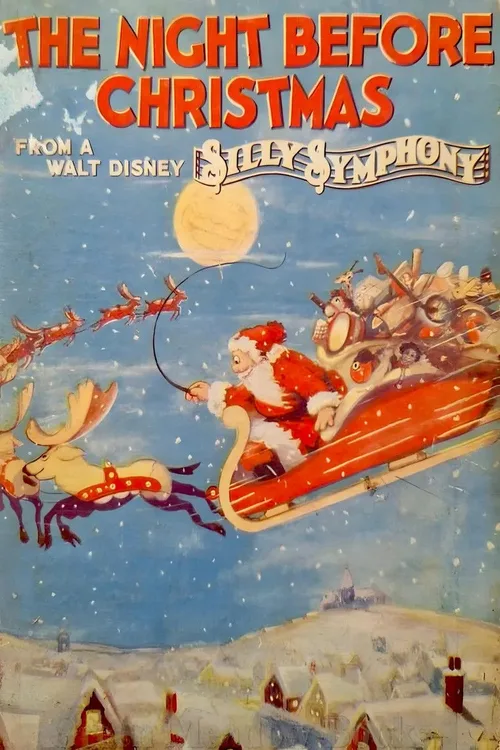
The Night Before Christmas (1941)
It's snowy and cold outside, and warm inside where Jerry squeezes past a mousetrap to cavort under a present-laden Christmas tree. Mistaking the sleeping Tom for a plush toy, Jerry wakes him and a mad chase ensues.
 rating 7/10 User rating 91 votes 74%
 ❄ Christmas Connection
The short takes place entirely on Christmas Eve and Christmas Day, with decorations, a Christmas tree, stockings, and snow framing every scene. Christmas is not window dressing here. It structures the whole story, giving both Tom and Jerry a reason to coexist briefly before the chasing resumes.
Our Review
The Night Before Christmas came out in December 1941, about three weeks after Pearl Harbor. MGM had no way of knowing what kind of Christmas that year would be for American audiences, but they shipped an eight-minute Tom and Jerry short anyway, and it did what Tom and Jerry always did: it got laughs by having a cat hurt himself repeatedly while a small mouse made him look like an idiot.
This was only the fourth Tom and Jerry short ever made. William Hanna and Joseph Barbera had introduced the pair in 1940's Puss Gets the Boot, and they were still finding the formula. By 1941, they had it. The Night Before Christmas is almost a proof-of-concept for everything the series would become over the next decade.
What Actually Happens in Eight Minutes
Jerry wakes up inside a toy train display under a Christmas tree. He's having a wonderful Christmas Eve, sampling a toy train set, pressing his nose against the warmth of a light bulb, and generally enjoying the holiday while the humans sleep. Then Tom wakes up.
What follows is the usual programme. Tom chases Jerry. Jerry outsmarts Tom. Tom suffers for it. The Christmas setting gives Hanna and Barbera a specific toolkit to work with: ornaments shatter, ribbon gets weaponized, a toy train becomes a vehicle for mouse escape. The gag structure is tighter than in the earlier shorts. Each set piece uses the holiday environment rather than just happening to occur near one.
There's one moment that's genuinely odd. Tom catches Jerry and, in an uncharacteristic burst of Christmas sentiment, decides not to hurt him. He puts Jerry down, gives him a little pat, and gestures around at the decorations as if to say "it's Christmas, let's call a truce." Jerry looks suspicious. Tom gestures again, more sincerely. Jerry relaxes. Then Tom, apparently incapable of restraint for more than about four seconds, immediately tries to grab him again.
It's a better joke than it sounds. The truce attempt feels genuine for exactly as long as a cat could plausibly sustain goodwill toward a mouse, which is not long.
The Oscar Nomination and What It Meant
The Academy nominated The Night Before Christmas for Best Animated Short Film at the 1943 ceremony, covering films from 1942. The nomination placed it alongside work from Disney's considerably larger operation. Tom and Jerry would go on to win seven Academy Awards for Best Animated Short between 1943 and 1953, a record for the series that still stands. This particular short didn't win, but it was early evidence that Hanna and Barbera were producing work that the industry took seriously.
MGM's cartoon unit in the 1940s is often overlooked in histories that focus on Disney and Warner Bros. It was smaller, but Hanna and Barbera were methodical in ways that paid off. They developed a specific timing system for their gags, counting frames obsessively to land the moment of impact at exactly the right beat. That precision is visible in The Night Before Christmas. The short doesn't overstay anything.
Tom and Jerry and the Christmas Short Tradition
Theatrical animated shorts had been using Christmas as material since the 1930s, but most of them leaned sentimental. Disney's holiday output in particular tends toward warmth and resolution. Tom and Jerry took the opposite approach: Christmas is a setting, not a moral. Nobody learns anything. Tom does not achieve peace with Jerry. The mouse goes back to sleep and the cat is presumably still somewhere in the house, furious.
This made The Night Before Christmas unusual for its time and explains why it still works. The short doesn't ask the audience to feel good about Christmas specifically. It asks them to enjoy watching a cat fail, which is a more durable request.
The animation quality is high for a non-Disney studio production of 1941. The background art on the Christmas tree and living room scenes is detailed and warm without being fussy. The cel work on Tom's expressions, particularly his brief attempt at Christmas goodwill, is more nuanced than the studio's earliest shorts. Hanna and Barbera were getting better quickly.
At eight minutes, The Night Before Christmas is closer to a sketch than a short film. It establishes setting, introduces conflict, runs through four or five well-constructed gags, and stops. No sentiment. No resolution. Just a cat sleeping under a tree with a dented head while a mouse enjoys his toy train undisturbed. As a summary of what Tom and Jerry cartoons actually are, it's hard to beat.
Fun Facts
The Night Before Christmas was only the fourth Tom and Jerry theatrical short ever produced. The duo had debuted less than two years earlier in Puss Gets the Boot (1940), which was itself originally titled Jasper and Jinx before the characters were renamed.
The short was released on December 6, 1941, one day before the attack on Pearl Harbor. It was already in theaters when the United States entered World War II.
The Academy Award nomination came at the 15th Academy Awards ceremony in 1943, covering films released in 1942. The winner that year was Disney's Der Fuehrer's Face, a Donald Duck propaganda short.
William Hanna and Joseph Barbera won the Academy Award for Best Animated Short Film seven times between 1943 and 1953, all for Tom and Jerry cartoons. No other short film series has matched that record.
The MGM cartoon studio where Hanna and Barbera worked was headed by producer Fred Quimby, whose name appeared on every Tom and Jerry title card despite having little creative involvement. Hanna and Barbera reportedly accepted their first Oscar believing Quimby had been the one invited to the stage.
The Christmas tree living room set used in this short was reused and redrawn in later Tom and Jerry holiday cartoons. MGM, like most animation studios of the era, recycled background assets across productions to control costs.
Tom and Jerry cartoons of the 1940s were produced on a budget of roughly $50,000 per short, compared to Disney's theatrical shorts which could run two to three times higher. The tighter budget pushed Hanna and Barbera toward tighter gag timing as a substitute for elaborate visual spectacle.
Cast