
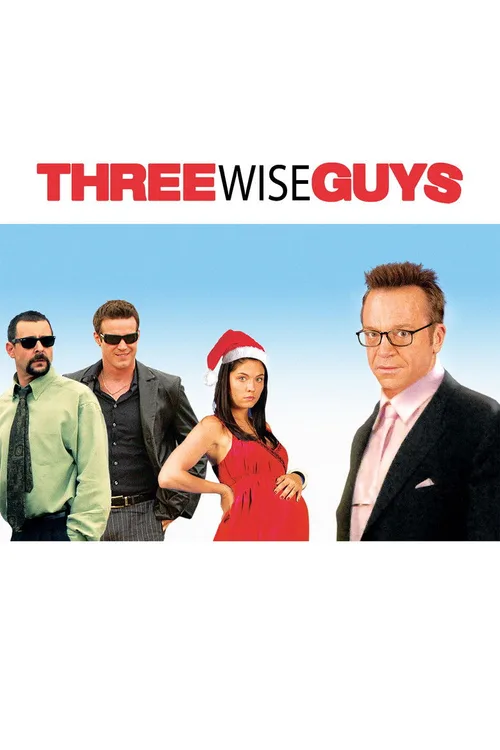
She's No virgin...and They're No Wise Men.
Three Wise Guys (2005)
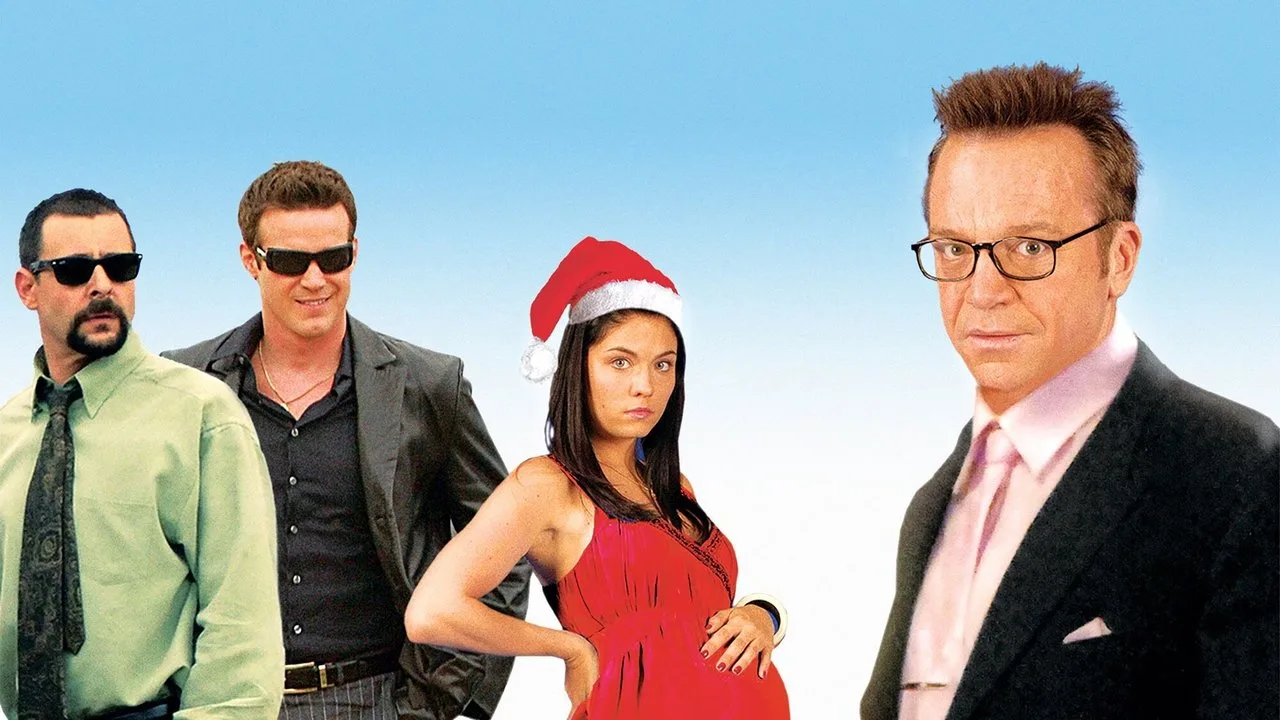
On Christmas Eve, three hired killers give chase after unwittingly aiding the pregnant girlfriend of one of their targets.
 rating 5/10 User rating 8 votes 39%
 ❄ Christmas Connection
The entire film takes place on Christmas Eve and reimagines the Nativity story with Las Vegas mobsters standing in for the biblical Magi. The pregnant woman named Mary, the Nevada desert setting as a modern Bethlehem, and the cosmic shift in the criminals' intentions make the Christmas allegory impossible to miss.
Where to Watch


Our Review
There is something almost perversely appealing about a Christmas movie that begins with three contract killers getting their holiday assignment. Three Wise Guys, the 2005 USA Network TV film directed by Robert Iscove, arrives pre-loaded with a concept so obvious it should be embarrassing: Nativity story, mob setting, Christmas Eve deadline. And yet the movie leans into its own absurdity with enough confidence to make the 87 minutes pass without pain. That is genuinely more than you can say for most December cable fare from that decade.
The Setup: Runyon Goes to Vegas
The premise comes straight from Damon Runyon. Runyon published his original short story "The Three Wise Guys" in 1933, setting a tale of underworld characters stumbling into something bigger than themselves against the backdrop of Christmas. The 2005 film modernizes that setup, moving the action from Depression-era New York to Las Vegas and the Nevada desert, but keeping the essential moral architecture intact: bad men, Christmas Eve, a pregnant woman named Mary.
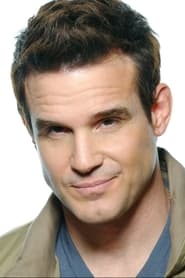
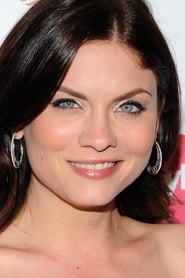
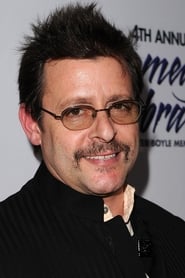
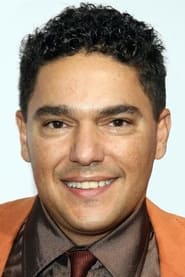
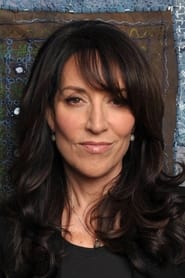
Tom Arnold plays Murray Crown, the nefarious casino owner who dispatches three of his men on what amounts to a murder errand. Eddie McClintock, Judd Nelson, and Nick Turturro play the trio sent to do the job. They find Mary, played by Jodi Lyn O'Keefe, and things go sideways in exactly the direction the viewer expects from the opening minutes. Katey Sagal rounds out the main cast as Murray's sharp-tongued wife Shirley.
The film was shot in Albuquerque, New Mexico, standing in for Las Vegas and the desert beyond. Director Robert Iscove, a Canadian-born choreographer turned filmmaker who made his feature debut with She's All That in 1999, brings a workmanlike visual approach. There is nothing here that announces itself as artistic ambition. That is probably the correct choice.
Does the Allegory Hold Up?
The Nativity parallels are played broadly enough that no one is going to miss them, but gently enough that the movie never feels like a sermon. Mary is pregnant, stranded, and in need of help. The three wise guys are not literally following a star, but the desert night sky does a lot of symbolic heavy lifting. Their moral transformation over the course of one Christmas Eve follows the same arc you find in Runyon's best work: men defined by loyalty to one hierarchy discovering, briefly, a different set of obligations.
The film does not pretend the allegory is subtle. It is not subtle. But Runyon's genius was always in the gap between what his characters said and what they meant, and the screenplay by Lloyd Gold captures enough of that spirit to give the film a functional center.
"It's a reworking of the Nativity done sorta mob style" is how the film's own promotional materials described it, and that summary is both accurate and complete.
What the movie lacks is genuine surprise. Every beat lands exactly where you expect it to. The criminals soften. Murray gets his comeuppance. The desert yields something unexpectedly tender. The pleasure, such as it is, comes not from suspense but from watching a small cast of capable television actors execute familiar material without embarrassing themselves.
The Cast: Cable-Era Competence
Tom Arnold as the villain is the film's largest swing and its most inconsistent result. Arnold has genuine comic instincts, but the role requires him to play menace and absurdity simultaneously, and the script does not always help him find the balance. Katey Sagal, fresh from her years on Married... with Children, does considerably more with considerably less screen time. She makes Shirley Crown feel like a person with opinions, which puts her ahead of most of the other characters by a wide margin.
Judd Nelson, who spent the 1980s as a Brat Pack fixture after The Breakfast Club, looks comfortable in a role that asks him to be world-weary and occasionally decent. The real revelation is Nick Turturro, whose Vincent provides the film's sharpest comic timing. Eddie McClintock holds the center of the three wise guys themselves, playing the role with enough earnestness to keep the emotional pivot credible.
Jodi Lyn O'Keefe as Mary has the most difficult job: she must be simultaneously resourceful, vulnerable, and symbolic. She manages two of those three consistently, which is about as well as the material allows.
The Verdict
This is a mid-tier holiday TV movie from the mid-2000s, and it knows it. The budget is visible, the ambitions are modest, and the running time is mercifully short. What saves it from pure disposability is the Runyon source material. A story about criminals encountering grace on Christmas Eve is not a bad story. It is, in fact, one of the oldest stories in the tradition. Runyon told it well in 1933, and the 2005 film tells it adequately in his shadow.
If you are looking for a Christmas movie that takes risks or offers something genuinely unexpected, this is not that film. But if you want 87 minutes of inoffensive mob-and-manger allegory with a functional cast and zero pretension, Three Wise Guys will not disappoint you, mostly because it never sets up expectations high enough to disappoint.
It aired December 8, 2005, at 9 p.m. on USA Network, and was promptly forgotten by most people who watched it. That is the honest biography of a certain kind of holiday television.
Fun Facts
The 2005 film is based on Damon Runyon's 1933 short story "The Three Wise Guys," which Runyon set on Christmas Eve, 1932, among the speakeasies and racetrack characters of Depression-era New York.
Director Robert Iscove began his career as a choreographer and won a Primetime Emmy Award for Outstanding Choreography for the Ann-Margret special in 1976, decades before he moved into directing films and TV movies.
Despite being set in Las Vegas and the Nevada desert, the film was shot entirely in Albuquerque, New Mexico.
Katey Sagal, who plays casino owner's wife Shirley Crown, had recently finished her long run as Peg Bundy on Married... with Children, which ended in 1997 after 11 seasons and 259 episodes.
Judd Nelson, who plays George, became famous in 1985 as John Bender in John Hughes' The Breakfast Club, a film which has itself become an unlikely Christmas season staple on cable television.
The film was produced by Lions Gate Television, which at the time was building a catalog of low-budget holiday TV movies as part of a broader cable licensing strategy in the early 2000s.
Damon Runyon's characters were so distinctive that "Runyonesque" became a recognized adjective in American English, describing stories set in the world of gamblers, hustlers, and small-time criminals who speak in a particular mix of slang and formal diction.
Robert Iscove's previous Christmas-adjacent work included directing the 1997 TV production of Cinderella for ABC, starring Brandy and Whitney Houston, which earned him an Emmy nomination for Outstanding Directing for a Variety or Musical Program.
Cast