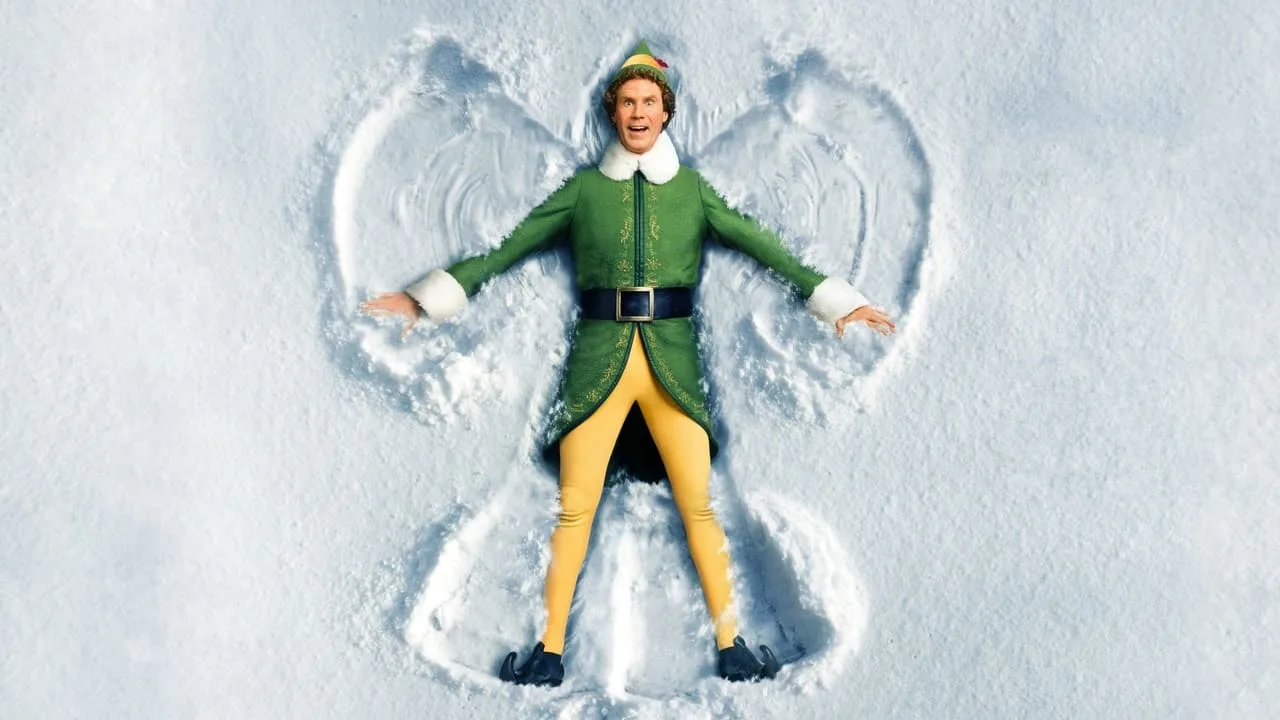
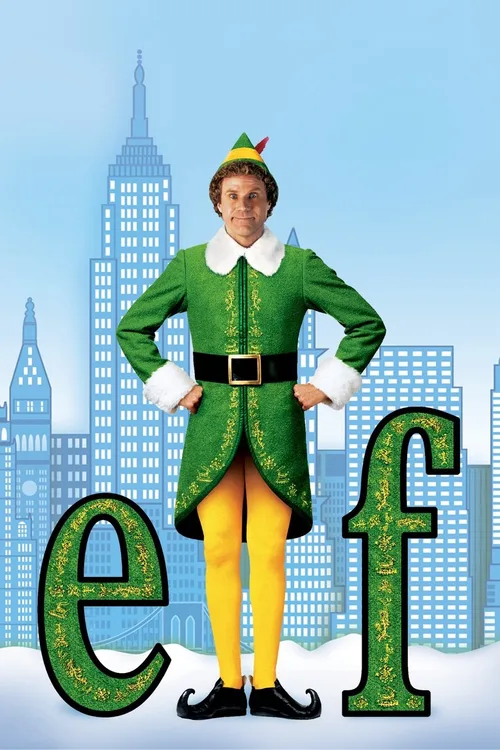
Discover your inner elf.
Elf (2003)
When young Buddy falls into Santa's gift sack on Christmas Eve, he's transported back to the North Pole and raised as a toy-making elf by Santa's helpers. But as he grows into adulthood, he can't shake the nagging feeling that he doesn't belong. Buddy vows to visit Manhattan and find his real dad, a workaholic.
 rating 9/10 User rating 4,469 votes 67%
 ❄ Christmas Connection
Elf is a Christmas movie from first frame to last. The entire plot revolves around Santa's workshop, the North Pole, Christmas spirit, and the magic of believing. Its climax literally depends on collective Christmas spirit to power Santa's sleigh.
Where to Watch


Our Review
Elf should not have worked. A PG-rated Christmas comedy starring a Saturday Night Live alumnus, directed by the guy who made Swingers, about a grown man in yellow tights who thinks he's an elf. On paper, it reads like a straight-to-DVD disaster. Instead, Jon Favreau's 2003 film grossed $220 million worldwide and became the first new Christmas classic in a generation.
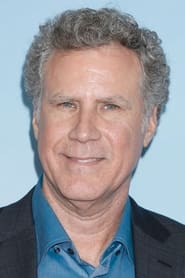
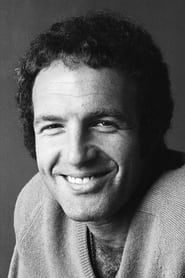
Will Ferrell plays Buddy, a human who was accidentally transported to the North Pole as a baby and raised by Santa's elves. When he discovers he's not actually an elf (the fact that he's 6'3" and can't build toys fast enough being the main clues), he travels to New York City to find his biological father, Walter Hobbs, played by James Caan. What follows is a fish-out-of-water comedy that works because Ferrell plays it with complete sincerity.
The Commitment That Makes It
Ferrell's performance is the film's engine. He doesn't wink at the audience, doesn't play Buddy as a man-child for cheap laughs, and doesn't break character for ironic distance. Buddy genuinely believes in Santa, genuinely loves Christmas, and genuinely doesn't understand why strangers don't want to be hugged. The comedy comes from the collision between his earnestness and New York City's cynicism.
Consider the department store scene where Buddy confronts a mall Santa. "You sit on a throne of lies," he says, and Ferrell delivers it with the righteous fury of someone defending a real person's reputation. It's funny because he means it. A lesser performer would have played the scene as broad comedy. Ferrell plays it as a moral stand, and the gap between his sincerity and the absurdity of the situation generates the laughs.
Favreau's Rankin/Bass Gamble
Jon Favreau made a deliberate choice to shoot the North Pole sequences in a style that evokes the 1960s Rankin/Bass stop-motion specials like Rudolph the Red-Nosed Reindeer. The forced perspective sets, the practical snow, and the deliberately artificial look of Santa's workshop aren't limitations. They're homages. Favreau understood that the audience's nostalgic connection to those specials would create instant warmth.
The New York City sequences, by contrast, are shot with handheld energy and natural light. The contrast between the storybook North Pole and the gritty reality of midtown Manhattan amplifies Buddy's displacement. When Buddy walks through the Lincoln Tunnel on foot, surrounded by commuter traffic, the visual gap between where he came from and where he is tells the story without dialogue.
James Caan and the Straight Man Problem
James Caan's Walter Hobbs is the most thankless role in the film, and Caan plays it perfectly. He's not a villain. He's a distracted publishing executive who never knew he had a son and is now confronted with a 33-year-old who eats spaghetti with maple syrup. Caan's gravel-voiced irritation grounds every scene he shares with Ferrell.
The father-son dynamic gives Elf its emotional spine. Buddy doesn't just want to live in New York. He wants a dad. Caan's gradual thaw, from hostile dismissal to reluctant tolerance to genuine affection, follows a predictable arc, but it works because both actors sell every beat. When Walter quits his job to read Buddy's story to a crowd in Central Park, it lands because Caan has spent the whole film being believably resistant.
The Modern Classic Argument
Twenty years on, Elf has earned its place alongside the films it references. It airs constantly on cable during December, its quotes circulate on social media annually ("The best way to spread Christmas cheer is singing loud for all to hear"), and Buddy's cotton-ball snowflake decorations have been replicated in offices worldwide.
Ferrell has repeatedly turned down a sequel, reportedly walking away from a $29 million offer. That refusal may be the smartest creative decision attached to the film. Elf works as a single, self-contained story about a person who is too kind for the world he lives in and changes it anyway. A sequel would dilute that. Some Christmas traditions are better left exactly as they are.
Fun Facts
Will Ferrell reportedly turned down $29 million to make a sequel. He has said he didn't want to do it unless the script was strong enough, and it never was.
Jim Carrey was originally offered the role of Buddy before the project shifted to New Line Cinema and Ferrell was cast.
The cotton-headed ninny muggins insult was improvised by Ferrell on set. Favreau kept it because the cast's surprised laughter was genuine.
Buddy's four main food groups (candy, candy canes, candy corns, and syrup) were actually consumed by Ferrell on set. He reportedly felt ill for days during the breakfast spaghetti scenes.
The North Pole scenes were filmed using forced perspective, a technique where oversized props make actors appear smaller. No CGI was used to shrink Ferrell in the elf workshop scenes.
Peter Billingsley, who played Ralphie in A Christmas Story, has a cameo as Ming Ming the elf in the North Pole workshop scenes.
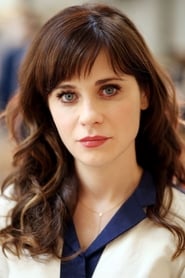
Zooey Deschanel's shower singing scene uses her real voice. She later recorded "Baby, It's Cold Outside" with Leon Redbone for the film's soundtrack.
The film was shot primarily in Vancouver and New York City. Central Park and the Rockefeller Center locations were filmed on location, while the North Pole was built on a Vancouver soundstage.
Cast