

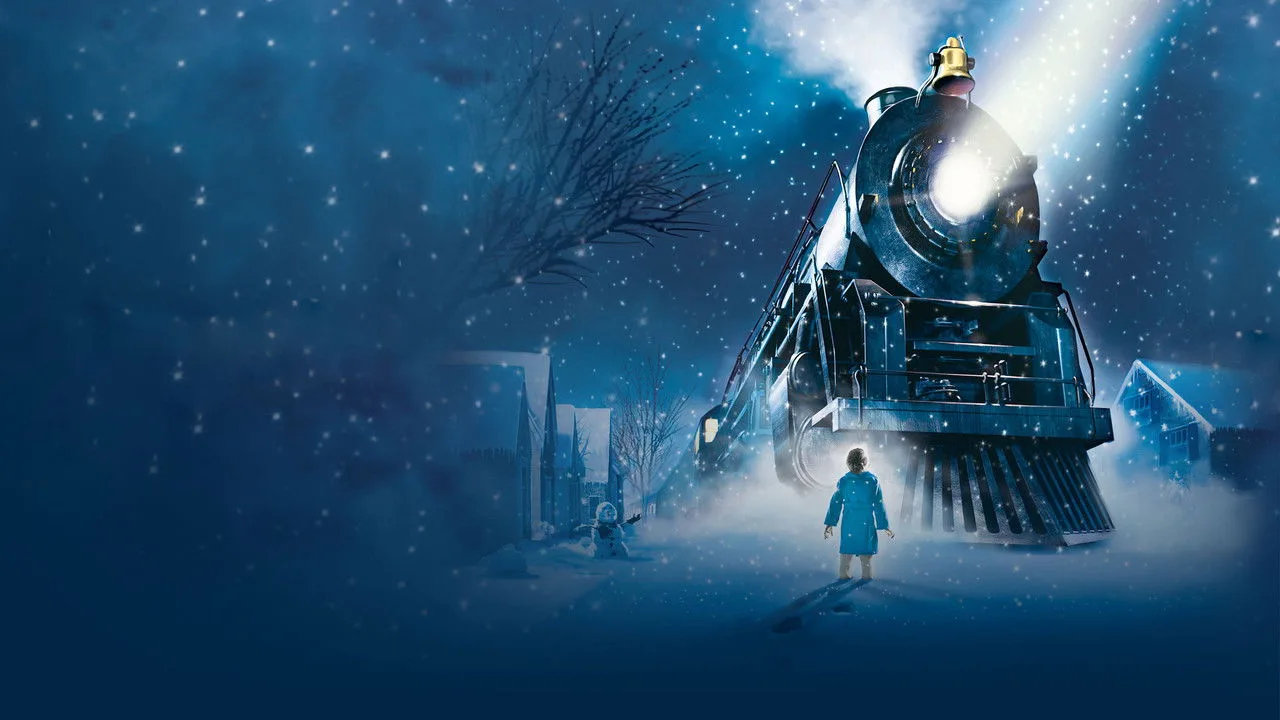
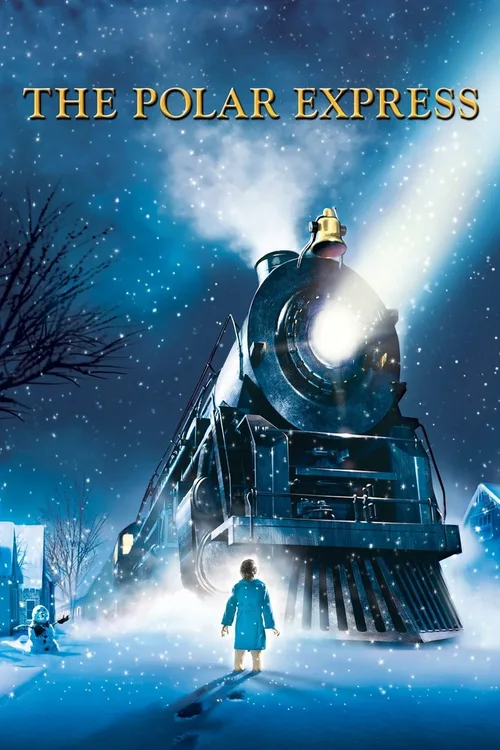
A journey like you’ve never imagined.
The Polar Express (2004)
When a doubting young boy takes an extraordinary train ride to the North Pole, he embarks on a journey of self-discovery that shows him that the wonder of life never fades for those who believe.
 rating 7/10 User rating 6,791 votes 67%
 ❄ Christmas Connection
The Polar Express is entirely about Christmas. A boy boards a magical train to the North Pole on Christmas Eve, meets Santa Claus, and learns to believe in the magic of Christmas. There is no more thoroughly Christmas movie in existence.
Where to Watch


Our Review
Chris Van Allsburg's The Polar Express is 32 pages long. The 1985 picture book tells a simple story: a boy boards a mysterious train on Christmas Eve, rides to the North Pole, receives the first gift of Christmas from Santa himself (a silver bell from his sleigh), and discovers that only those who believe can hear it ring. The book won the Caldecott Medal and sold millions. In 2004, Robert Zemeckis turned it into a $165 million motion-capture animated film starring Tom Hanks in six different roles.
The result is one of the most technically ambitious and visually polarizing Christmas films ever made. It's also one of the most sincere.
The Uncanny Valley Problem
The Polar Express pioneered performance-capture animation at a scale nobody had attempted before. Tom Hanks wore a motion-capture suit and performed as the Boy, the Conductor, the Boy's Father, the Hobo, Santa Claus, and the Narrator. The technology captured his movements and facial expressions with hundreds of sensors, then translated them onto digital characters.
The results were technically stunning and deeply unsettling to many viewers. The characters' eyes have a glassy, unfocused quality that sits squarely in the uncanny valley, close enough to human to trigger recognition but far enough to trigger discomfort. Critics at the time described the characters as "dead-eyed" and "zombie-like." The film became a case study in animation textbooks about the gap between technical capability and emotional connection.
Two decades later, the animation reads differently. Audiences raised on CGI find it less jarring, and the dreamlike quality of the visuals, which was a flaw in 2004, now plays as a deliberate stylistic choice that matches the story's surreal tone. A midnight train ride to the North Pole probably should look slightly unreal.
Zemeckis and the Spectacle
Robert Zemeckis has always been a filmmaker obsessed with technology. He pioneered digital compositing in Forrest Gump, built an entire virtual world for Beowulf, and pushed motion capture further with A Christmas Carol. The Polar Express sits at the beginning of that obsession, and his ambition shows in every frame.
The train sequences are the film's strongest asset. The roller-coaster ride across a frozen lake, the steep mountain descent, and the arrival at the impossibly vast North Pole city are genuinely thrilling set pieces. Zemeckis stages them with the kineticism of an action director, and in IMAX 3D (the film was one of the first to use the format for a narrative feature), they remain spectacular.
The Story Underneath
Strip away the animation debate and The Polar Express is telling a disarmingly simple story about doubt. The unnamed Boy is at the age where he's starting to question Santa's existence. His parents' gifts have logical explanations. The evidence doesn't add up. The entire film is about the night he decides whether belief is something worth holding onto even when logic argues otherwise.
That theme resonates because it's universal. Every child reaches the moment where Christmas magic starts to feel implausible. The film treats that moment with genuine gravity rather than dismissing it. When the Boy finally says "I believe" and hears the silver bell ring, it works not because the film has proven Santa exists, but because it has made the act of choosing to believe feel meaningful.
The IMAX Christmas Tradition
The Polar Express has been re-released in IMAX theaters every holiday season since its original run. These annual screenings have generated over $50 million in additional revenue and turned the film into a theatrical tradition in a way that few other Christmas movies can claim. Families who first saw it in 2004 now bring their own children, and the IMAX presentation, with its enveloping sound and massive screen, makes the train sequences feel genuinely immersive.
Van Allsburg's original story ends with the narrator, now grown, noting that his friends can no longer hear the bell. "At one time, most of my friends could hear the bell. But as years passed, it fell silent for all of them." That sentence contains more emotional weight than most Christmas films manage in two hours. Zemeckis' film doesn't quite reach that level of understatement, but it comes closer than its critics have given it credit for.
Fun Facts
Tom Hanks performs six distinct roles in the film: the Boy, the Conductor, the Boy's Father, the Hobo, Santa Claus, and the adult Narrator. Each was captured separately using motion-capture technology.
The film was one of the first narrative features presented in IMAX 3D. It has been re-released in IMAX theaters every holiday season, collectively earning over $50 million in re-release revenue.
Chris Van Allsburg's original picture book is only 32 pages long with minimal text. Screenwriters had to invent most of the film's plot, including the entire North Pole sequence and the secondary characters.
The production used 150 motion-capture cameras simultaneously to record performances. The technology was so new that Zemeckis called it an "experiment" during press tours.
The real-world Pere Marquette 1225 steam locomotive served as the visual and audio model for the Polar Express train. Its whistle and steam sounds were recorded specifically for the film.
Steve Tyler of Aerosmith performed the song "Rockin' on Top of the World" for a scene set at the North Pole. The original book has no music, but Zemeckis wanted the North Pole arrival to feel like a rock concert.
Despite mixed reviews on release, The Polar Express has grossed over $315 million worldwide and has become one of the highest-grossing Christmas films of all time when including annual re-releases.
Cast