
Buster & Chauncey's Silent Night (1998)
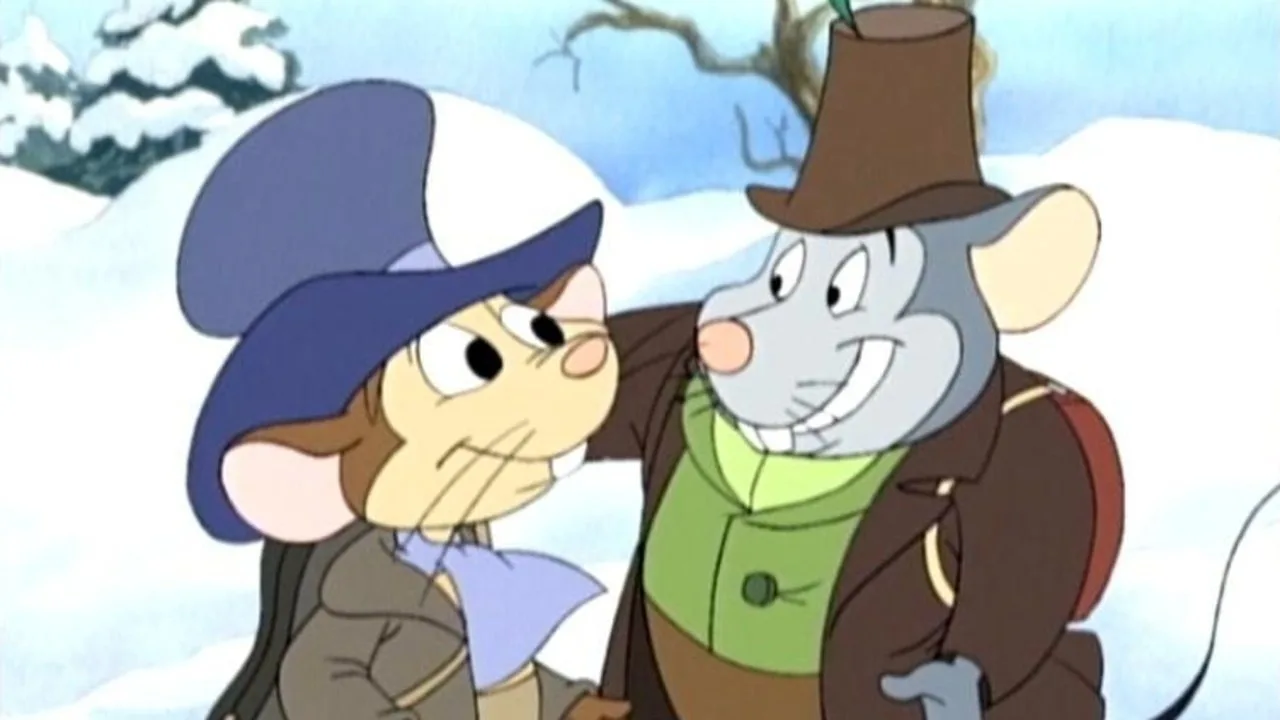
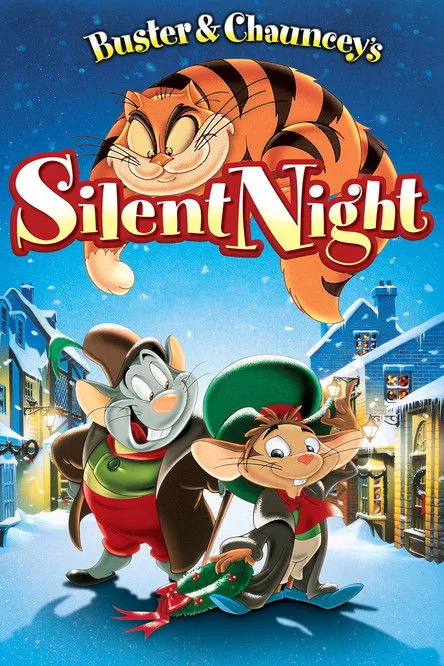
Buster and Chauncey - the world's greatest Mouse-icians - have arrived in Oberndorf for their shot at the big time: performing for the queen at the annual Christmas Pageant! But on Christmas Eve, Burghermeister Huffenmeir finds all the preparations for the festivities destroyed and the treasure of Oberndorf missing. When he accuses Buster and Chauncey's friend Christina - an orphan in search of her long lost family - it seems certain that Christmas will be ruined. Now it's up to the Moustroes of Mistletoe to help Christina reveal the real culprits, return the treasure and show the town of Oberndorf the true meaning of Christmas.
 rating 6/10 User rating 10 votes 56%
 ❄ Christmas Connection
The film dramatizes the true historical events of Christmas Eve 1818 in Oberndorf, Austria, when Father Joseph Mohr and Franz Xaver Gruber composed "Silent Night" after the church organ broke down. The carol itself is the backbone of the story. Christmas Eve, a village church, a broken instrument, and two mice watching history happen -- it doesn't get more Christmassy than this.
Our Review
Not many animated Christmas specials can claim to be based on verifiable historical events. Buster and Chauncey's Silent Night, a 1998 direct-to-video production from CINAR Animation, can. The premise sounds like a stretch on paper -- two mice witness the creation of "Silent Night" -- but the underlying story is real. On Christmas Eve 1818, in the village of Oberndorf bei Salzburg in Austria, Father Joseph Mohr and organist Franz Xaver Gruber really did compose the carol in a single day after the church organ broke down.
That the film chose to dramatize this moment at all is the most interesting creative decision it makes.
The Historical Story Behind the Carol
The origin of "Silent Night" is genuinely strange history. Mohr had written the poem two years earlier, in 1816, but it sat unused. When the organ at St. Nicholas Church in Oberndorf stopped working on December 24, 1818, Mohr brought the poem to Gruber and asked him to set it to music for guitar -- the only instrument available. Gruber composed the melody the same day. The carol premiered that evening at Midnight Mass, performed by its two creators.
The song spread slowly. A traveling organ repairman named Karl Mauracher reportedly took a copy when he came to fix the organ, and folk singing families like the Strasser siblings carried it further across Austria and Germany. It wasn't until the late 19th century that "Silent Night" became the global phenomenon it is today.
The film compresses this history into an accessible story for young viewers, with Buster and Chauncey serving as eyewitness narrators rather than main drivers of the plot. This is a reasonable choice. The real drama belongs to Mohr and Gruber, not to a pair of cartoon mice.
Phil Hartman's Final Performance
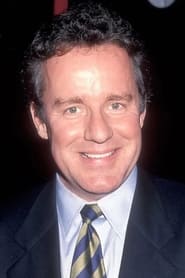
The film's most significant footnote is its cast. Phil Hartman, the beloved Saturday Night Live veteran and voice of Troy McClure on The Simpsons, voiced one of the lead mice. He was killed in May 1998, and the film was released later that year. Buster and Chauncey's Silent Night became, unintentionally, a memorial piece -- one of the last recordings of his voice that audiences would hear.
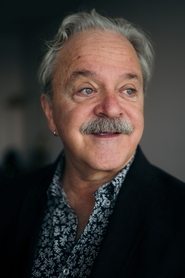
Hartman's natural warmth suits the material. This is not a role that demands his satirical edge, and the film wisely doesn't try to use him that way. Jim Cummings, one of the most prolific voice actors in animation history, rounds out the central cast. Between the two of them, there's more voice acting talent here than most direct-to-video productions could reasonably expect.
What CINAR Animation Got Right
CINAR was a Montreal-based studio that produced a large volume of educational children's animation through the 1990s. Their work rarely attracted critical attention, but they had a consistent commitment to content with some historical or educational substance. This film fits that pattern. It doesn't dumb the history down to the point of distortion.
Mohr is portrayed as a young, idealistic priest with genuine faith rather than a cardboard figure. Gruber is practical and talented. The village of Oberndorf looks cold, wooden, and appropriately 19th century. The animation quality is modest -- this is clearly not a theatrical production -- but it's clean and competent for its era and budget.
The film runs under an hour, which is exactly the right length. It tells its story, performs the carol properly, and gets out of the way.
The Mouse Problem
The mice are the film's one structural weakness. Buster and Chauncey are charming enough, but they exist in a narrative no-man's-land. They're not the protagonists -- Mohr and Gruber are. They don't change the outcome of events. They're witnesses. The film wants them to provide an entry point for young viewers, but children watching animated movies are perfectly capable of following a story about humans without needing rodent surrogates to hold their hand.
The device isn't offensive. It's just unnecessary. The true story of "Silent Night" is compelling enough on its own.
Who Actually Watches This in 2026
The audience for this film today is specific. Parents looking for a short, quiet, historically grounded Christmas special for young children will find it useful. Hartman completists have genuine reason to seek it out. Anyone curious about the actual history of "Silent Night" will get a reasonably accurate introduction.
It won't generate the nostalgic heat of the Rankin/Bass specials or A Charlie Brown Christmas. It was never going to. But within its modest ambitions, it delivers. The carol itself, performed in context at the end of the film, lands with more weight than it would in a setting-free performance precisely because you've watched the circumstances of its creation play out.
Gruber composed that melody on Christmas Eve, 1818, in under a day, for two voices and a guitar. It's now been translated into over 300 languages. That's not a bad return on a broken organ.
Fun Facts
The original "Stille Nacht" was performed on December 24, 1818, at the Church of St. Nicholas in Oberndorf bei Salzburg, Austria. The premiere was accompanied only by guitar because the church's pipe organ was not functioning.
Phil Hartman, who voiced one of the lead mice, was murdered on May 28, 1998, making this one of his final completed voice acting roles before the film's release later that year.
Jim Cummings, who co-stars in the film, has voiced over 400 characters across television and film, including Winnie the Pooh, Tigger, and Pete in Disney productions.
Father Joseph Mohr wrote the original German poem "Stille Nacht" in 1816, two years before it was set to music. He carried the poem with him to Oberndorf when he was assigned there as assistant priest.
CINAR Animation, the Montreal studio that produced the film, was later engulfed in a major financial fraud scandal in 2000, when its founders were found to have diverted millions of dollars from the company. The studio was restructured and eventually became Cookie Jar Entertainment.
"Silent Night" was designated an Intangible Cultural Heritage by UNESCO in 2011, specifically the tradition of performing it in the Salzburg region of Austria where it originated.
The carol organ repairman Karl Mauracher, credited with spreading "Stille Nacht" beyond Oberndorf, worked in the Zillertal (Ziller Valley) region of Austria. The Strasser siblings, who popularized it at the Leipzig Christmas Fair around 1832, were glove traders who performed folk music on the side.
Cast