

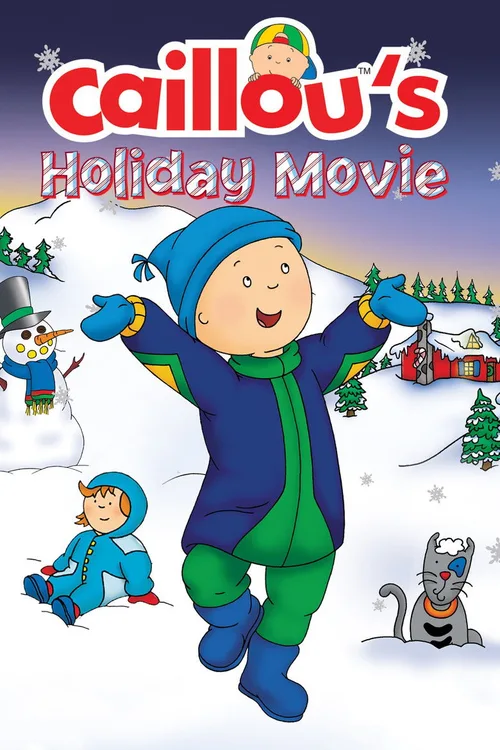
Caillou's Holiday Movie (2003)
Caillou learns about winter holiday traditions from around the world. He and his entire family celebrate Christmas, sharing, giving and caring.
 rating 5/10 User rating 7 votes 66%
 ❄ Christmas Connection
Caillou's Holiday Movie is built entirely around Christmas and the December holiday season. The entire plot revolves around Caillou counting down the days to Christmas using an advent calendar, learning yuletide traditions from around the world, and embracing the spirit of giving by donating his old toys to children in need. Hanukkah also gets a genuine subplot, making this one of the few children's holiday films to treat both December traditions with equal warmth.
Where to Watch


Our Review
There are Christmas movies made for children, and then there are Christmas movies made specifically for four-year-olds who will watch the same 70-minute block of content seventeen times before December 25th arrives. Caillou's Holiday Movie, released direct-to-video in the United States on October 7, 2003, falls firmly into the second category. It does not apologize for this. It should not. But if you are a parent strapping in for repeated viewings on the living room couch, you deserve to know exactly what you are getting into.
What Caillou's Holiday Movie Actually Is
This is not a feature film in the traditional sense. It is a 72-minute collection of loosely connected holiday vignettes stitched together by a central premise: Caillou's father gives him an advent calendar, and each window reveals a Christmas tradition from a different country around the world. Germany and the origin of the Christmas tree. England and the first Christmas cards, sent by schoolchildren in the Victorian era. France and Hungary, where stockings and shoes play a central role in holiday gift delivery.
The structure is episodic because the source material is episodic. Caillou the TV series ran individual 10-minute segments. Stretching that format to 72 minutes is a genuine creative challenge, and the film does not always rise to it. Some scenes exist for no reason other than to fill time. The tobogganing sequence is pleasant. The skiing lesson is harmless. Neither advances anything.
Where the film finds its footing is in the Hanukkah subplot. Caillou's friend Leo invites him to light the menorah and play dreidel, and the film treats this with the same matter-of-fact warmth it brings to everything else. There is no big lesson moment. No orchestral swell. Just two kids playing a game together. That restraint is actually good filmmaking, even if nobody making this production was thinking of it in those terms.
The Cast and a Shadow Behind the Credits
Caillou is voiced by Annie Bovaird, who stepped into the role under circumstances no one would have chosen. The previous voice actress, Jaclyn Linetsky, died on September 8, 2003, in a highway accident near Brossard, Quebec, at age 17. She had been traveling to a filming location for a separate TV production. Bovaird took over the title role, and this holiday film was among her first major credits in that capacity.
The rest of the voice cast includes Jennifer Seguin as Mom and Pat Fry as Dad. Seguin also performs one of the film's original songs, "Where Christmas Is Not the Same," with lyrics by Peter Svatek, who also wrote the screenplay. The other notable musical contribution comes from Marilou Bourdon, a French-Canadian singer from Longueuil, Quebec, who was 13 years old when she recorded "Everyday" for the closing credits. The album version of that song became something of a minor lost media curiosity among fans years later.
Caillou's Bald Head and Why It Matters to Nobody
The single question adults ask most about this franchise has nothing to do with Christmas. Caillou is bald, and adults find this unsettling. The actual explanation is straightforward: when the character was first illustrated in 1989 by Helene Desputeaux, he was drawn as a nine-month-old infant. When the show aged him up to four years old for television, giving him hair made him unrecognizable to the young audience already familiar with the character, so the animators left his head bare. Chouette Publishing later leaned into it, framing the baldness as a lesson in accepting difference.
Children watching this film do not think about any of this. They are watching Caillou put on mittens.
The Toy Donation Scene Is the Best Part
Buried in the second half, there is a sequence where Caillou learns that children in other parts of the world do not have toys. He decides to give away some of his own. He chooses specific toys. He handles them. He puts them in a box.
It is a small scene, and it does not overstay its welcome. The film does not cut to grateful recipients or manufacture an emotional payoff. Caillou just does a decent thing and moves on. For a children's movie pitched at the preschool demographic, that kind of quiet moral simplicity is harder to execute than it looks. Most productions in this space cannot resist the sentimental close-up.
An Honest Assessment
The critical consensus on this film, such as it exists, landed around "inoffensive but bland." That is fair. The film is not boring to its target audience. The colors are bright. The pacing matches how a four-year-old processes information. The traditions-around-the-world framing is a genuinely good educational hook, the kind of thing parents will appreciate even when the plot stalls.
What it is not is a film anyone over the age of six will find rewarding on its own terms. The jokes are not for adults. The songs are functional rather than memorable. The production company, CINAR (which later became Cookie Jar Entertainment), operated on budgets and timelines that prioritized output over craft. Director Nick Rijgersberg delivered exactly what was asked of him.
If you are looking for a Christmas film that will occupy a toddler for 72 minutes without putting anything disturbing or cynical in front of them, this does the job. If you are looking for the next great children's holiday classic, keep looking.
Fun Facts
The film was released in the United States on October 7, 2003, through Warner Home Video, and in Canada on October 28, 2003, through Sony Wonder. Two major distributors handled the same film in the same month across two countries.
Annie Bovaird took over the voice of Caillou after Jaclyn Linetsky, the previous voice actress, died in a car accident on September 8, 2003, on Highway 10 near Brossard, Quebec. Linetsky was 17 years old. Bovaird was the same age when she assumed the role.
The "Everyday" closing credits song was performed by Marilou Bourdon, a pop singer from Longueuil, Quebec, who was born on September 20, 1990, making her approximately 13 years old at the time of recording. The full album version of the song later became a minor lost media search among fans of the franchise.
The film's advent calendar framing introduces historically accurate Christmas trivia: it correctly attributes the tradition of the decorated Christmas tree to 16th-century Germany and credits Victorian English schoolchildren with sending the first commercial Christmas cards.
Caillou's bald head, one of the most discussed features of the character, originated from the original 1989 illustrated books by Helene Desputeaux, where Caillou was depicted as a nine-month-old infant. When the character was aged to four for television, animators kept him bald because adding hair made him unrecognizable to the existing young audience.
The screenplay was written by Peter Svatek, who also contributed lyrics for the original song "Where Christmas Is Not the Same." The music was composed by Jeffrey Zahn, who scored multiple Caillou productions during this period.
CINAR, the Montreal-based production company behind the film, rebranded to Cookie Jar Entertainment in 2004, the year after this film's release, following a financial scandal involving false Canadian content claims. The Caillou franchise continued under the new company name.
Cast