
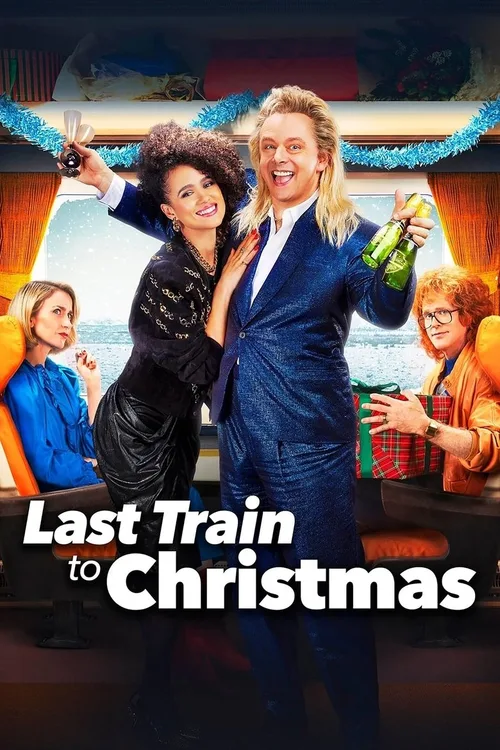
Last Train to Christmas (2021)
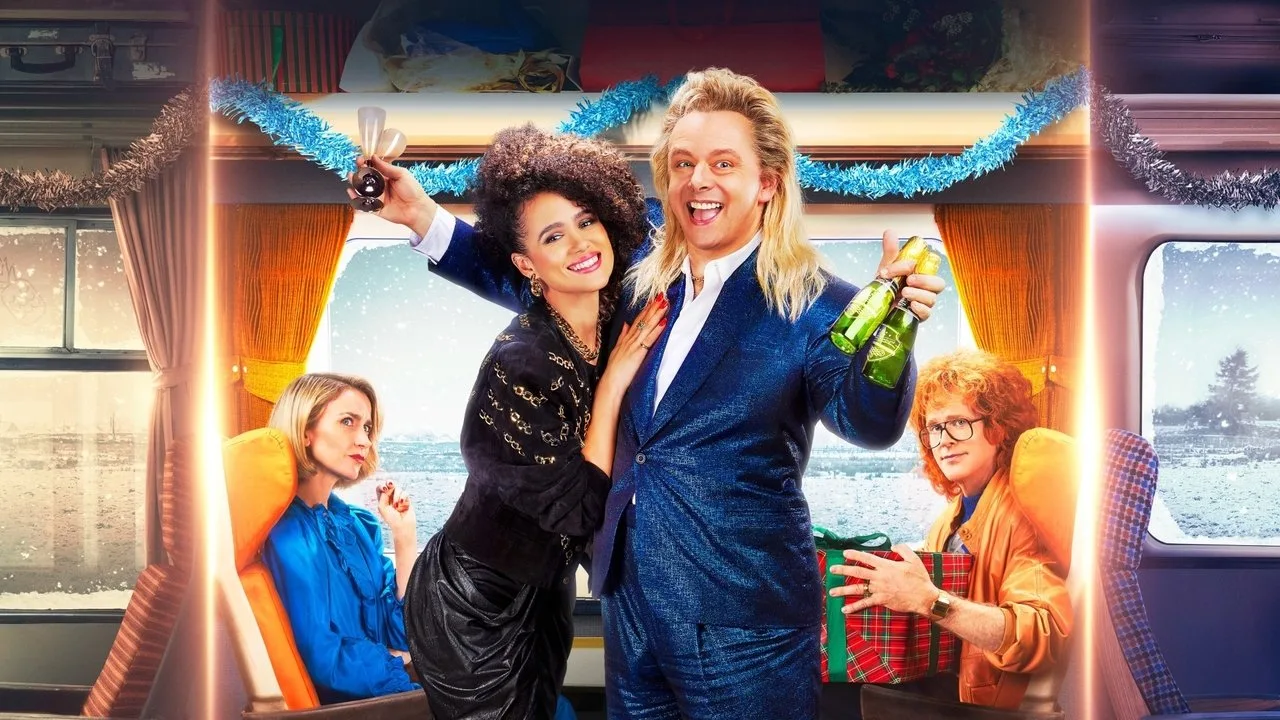
When successful 80s nightclub manager Tony Towers boards a magical train at Christmas, he discovers that each carriage harbours a different stage of his life and the actions he takes in one carriage directly affect his life in the next. Can Tony change his life – and the lives of the people he loves – for the better, or will he just make things worse?
 rating 7/10 User rating 55 votes 54%
 ❄ Christmas Connection
The entire film is set on Christmas Eve 1985, with the train journey framing a Scrooge-like reckoning with past choices and their consequences. Christmas is not just backdrop but structural engine — the season of reckoning gives the time-travel premise its emotional weight. It belongs firmly in the A Christmas Carol tradition of festive self-examination.
Our Review
The British have a long tradition of finding miserable men redeemed at Christmas, and Last Train to Christmas (2021) is a worthy late entry into that canon. Written and directed by Julian Kemp, the film follows Tony Towers, a self-made nightclub king on Christmas Eve 1985, aboard a train from London to Nottingham. When Tony walks into the next carriage, he is no longer in 1985. He is in 1995. Walk forward again: 2005. Walk back: 1985. The train is a time machine, each carriage a decade, and Tony has about ninety minutes to figure out whether his life was actually worth building.
Michael Sheen is on screen for nearly the entire runtime, and he carries it. That is the full stop at the end of the casting question.
What Kind of Christmas Movie Is This?
It is tempting to call Last Train to Christmas a riff on A Christmas Carol, and the film does not resist that reading. Tony's journey through different versions of his own timeline maps neatly onto Scrooge's three-ghost tour: the man he was, the man he is, the man he might become. But where Dickens used supernatural visitors, Kemp uses a train and a hard-edged fantasy logic. Whenever Tony moves forward through the carriages, ten years pass. Whenever he moves back, ten years reverse. It has the clean geometry of a puzzle box.
The 1980s setting is more than nostalgia dressing. Tony's nightclub empire is a creature of Thatcherite optimism, built on ambition and transactional thinking. The Christmas Eve framing means his reckoning arrives at exactly the right moment — the one night of the year when even the most driven people stop and ask whether they are happy.
Cary Elwes plays Tony's younger brother Roger, and Nathalie Emmanuel plays Sue, Tony's girlfriend at the story's starting point. Both are good. Neither is given quite enough to do in a film that is, unavoidably, the Michael Sheen show.
The Train as Time Machine: Does It Work?
The conceit holds up better than it has any right to. Kemp shoots the train carriages with enough visual distinction between eras that the audience rarely loses its bearings, even as Tony scrambles from decade to decade. The 1985 compartment has the padded vinyl and cigarette-stained air of a British Rail second-class carriage. By 2005 it has been refurbished into something blander and more corporate, which is its own quiet joke.
Where the film loses its footing is in the second half, when the rules of the time-travel mechanism start to bend under the weight of dramatic necessity. Tony's choices in one era ripple into others in ways that feel emotionally satisfying but logically patchy. The film asks you to feel the consequences before fully explaining the mechanics, which is a gamble that mostly pays off but occasionally fumbles.
The production leaned hard into practical authenticity for the train sequences. The shoot used actual 1980s and 1990s British Rail carriages sourced for the production, moved to a static off-rail location in Swansea, Wales, which gave the cast a genuinely cramped and period-accurate environment to work in.
Michael Sheen's Performance
Sheen plays Tony at six or seven different points in his life, which means he is doing the work of de-aging and re-aging through posture, voice, and expression rather than visual effects. He plays the young Tony with a rawness that the older Tony has buried so deep he has forgotten it exists. The transition moments, when Tony realizes which version of his life he has stumbled into, are the film's best scenes.
Sheen's previous Christmas work includes playing Charles Dickens himself in the 2019 BBC adaptation of A Christmas Carol, which gives his presence here an extra layer of seasonal irony. The man who played the author of the original template is now stuck inside a remix of it.
What the Film Gets Right
The emotional core is legitimate. Tony's choices are not portrayed as simply good or bad, and the film resists making his nightclub wealth the villain of the piece. He made sacrifices that cost real people real things, but he also built something real. The ambiguity gives the story more weight than the premise initially suggests.
The British Rail setting also matters more than its novelty suggests. The train as a space of transition has deep roots in British culture and literature. You travel between worlds on a train. You meet strangers you'll never see again. You leave behind whoever you were at the station. Using it as the physical mechanism for a life-reckoning story is, quietly, a very elegant choice.
At a 6.1 on IMDb, the film is somewhat undersold. It is not flawless, and the third act does more explaining than it should. But it earns its Christmas credentials honestly, which is harder than it looks.
Fun Facts
The film was written and directed by Julian Kemp, who previously directed the 2009 British comedy Boogie Woogie. Last Train to Christmas was his first feature-length Christmas film.
Michael Sheen had played Charles Dickens in the BBC's acclaimed 2019 adaptation of A Christmas Carol, making his starring role in this Dickens-adjacent Christmas parable a notable piece of seasonal typecasting.
The train carriages used in production were actual British Rail vehicles from the 1980s and 1990s, moved to a static off-rail filming location in Swansea, Wales, rather than being filmed on a moving train.
Cary Elwes, best known internationally as Westley in The Princess Bride (1987), plays Tony's younger brother Roger. It was an unusual casting of an American actor in a role that does not require a British accent, since Elwes was born in London and is naturally British.
The film was released on 18 December 2021 exclusively on Sky Cinema and Now in the UK, part of Sky's strategy of commissioning original Christmas films to compete with streaming platform holiday slates from Netflix and Amazon.
The story's time-travel logic moves in increments of exactly ten years per carriage, meaning Tony has access to approximately five distinct eras of his own life depending on how many carriages the train has. The film uses this constraint to force choices rather than endless revision.
Nathalie Emmanuel, who plays Sue, is best known for Game of Thrones (as Missandei) and the Fast and Furious franchise, making Last Train to Christmas one of her relatively rare leading roles in a standalone British film.
Cast