
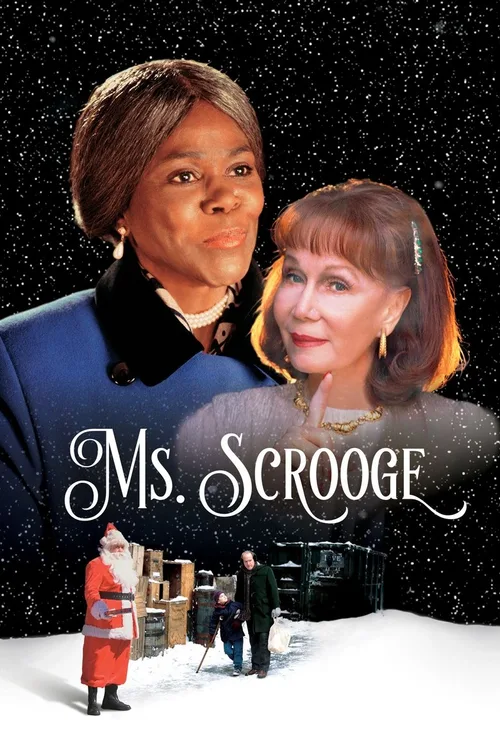
Let's just say she didn't make Santa's 'nice' list.
Ms. Scrooge (1997)
Television movie updating Charles Dickens' story, "A Christmas Carol." Businesswoman Ebenita Scrooge treats her employees and customers poorly. She has no time for Christmas or the holiday spirit. On Christmas Eve, she is visited by the ghost of her dead partner Maude Marley and then by other spirits who remind her of her happy past and chronicle the bitterness and greed that have taken over her life. At last, she is shown her own death and funeral. No one is there to mourn her. This revelation shocks her into opening her heart and her checkbook.
 rating 7/10 User rating 11 votes 56%
 ❄ Christmas Connection
Ms. Scrooge is a direct adaptation of Charles Dickens' A Christmas Carol, set during the Christmas season with all three supernatural visitations intact. The entire plot turns on Ebenita Scrooge's redemption through the ghosts of Christmas Past, Present, and Yet to Come. Without Christmas, there is no movie.
Our Review
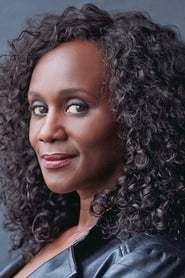
The premise sounds like a pitch meeting dare: take A Christmas Carol, make Scrooge a Black woman, set it in a modern American city, and cast one of the most respected dramatic actresses in the country. What could go wrong? In the case of Ms. Scrooge, the 1997 TV movie directed by John Korty, the answer is surprisingly little. Cicely Tyson plays Ebenita Scrooge, a wealthy moneylender operating in a contemporary urban setting, and she plays the role with the kind of controlled ferocity that makes you forget you've seen this story a hundred times.
Why Cicely Tyson Makes This Work
Tyson was 63 when Ms. Scrooge aired, and she brought to the role something most Scrooge performances don't have: genuine weight. Her Ebenita isn't a cartoon miser cackling at the poor. She's a woman who built something from nothing, who calcified around her own discipline, and who has confused ruthlessness with strength for so long she can no longer tell the difference.
That's a more interesting character than Dickens usually gets credit for, and Tyson finds it. The scene where the Ghost of Christmas Past takes her back to her younger self carries real grief. You're not watching an actress hit marks. You're watching a woman reckon with the specific decisions that made her who she is.
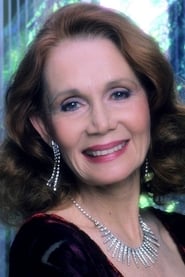
Katherine Helmond plays the Ghost of Christmas Past with a dry wit that keeps the supernatural sequences from going saccharine. Helmond, best known as Mona from Who's the Boss?, was a smart casting choice. She plays the ghost as a knowing, slightly impatient guide rather than a weeping sentimentalist.
The Race and Gender Swap Is the Point, Not a Gimmick
A common failure mode for this kind of adaptation is treating the central change as decoration. The character is now a woman, or now Black, but nothing about the story actually shifts to reflect that. Ms. Scrooge avoids this, at least partially.
Ebenita's backstory is shaped by the specific obstacles a Black woman in America would face in building wealth. The film doesn't belabor it, but the context is there. Her miserliness isn't just Dickensian greed transplanted onto a new body. It's connected to a particular kind of survival logic that the original Scrooge never had to contend with.
The 1990s produced several high-profile A Christmas Carol reimaginings that played with the source material's assumptions. Bill Murray's Scrooged (1988) had arrived just before this wave, and adaptations like this one and the 1992 Muppet version kept the story alive across demographics. The gender-swapped retelling wasn't a new idea by 1997, but Tyson's presence gave it a specific gravity that most TV movies don't achieve.
What the TV Movie Format Costs It
This is a TV movie, and it looks like one. The production budget is visible in every set. The ghost sequences rely on lighting tricks and staging that would have seemed modest even for 1997 television. If you're used to the theatrical Scrooge adaptations, the scale here will feel like a step down.
John Korty directed it competently without doing anything memorable behind the camera. The pacing occasionally drags in the middle third, where the Ghost of Christmas Present section always seems to slow down regardless of which version you're watching. Korty doesn't find a solution to this structural problem that Dickens himself didn't solve in the novella.
The supporting cast is adequate. Nobody embarrasses themselves. Nobody surprises you. The film lives and dies entirely on Tyson, which is both its strength and its limitation.
The Ending and What the Film Actually Earns
Scrooge's redemption has to be earned, or the whole thing collapses. Too many adaptations rush through the transformation as if the audience just needs to see the checkbox ticked. Tyson earns it. The final sequence, where Ebenita wakes up and starts putting the world back together, works because you've watched her spend ninety minutes building the walls that now have to come down.
The Christmas morning scene is genuinely warm without being cloying. That's harder to do than it sounds when you're working with material this familiar.
Ms. Scrooge aired on the USA Network in December 1997. It was not a prestige television event. It was a holiday movie made for people who would be watching TV on a Saturday night before Christmas. By those standards, it delivers considerably more than expected, mostly because Cicely Tyson refused to coast through it.
Fun Facts
Cicely Tyson received Emmy Award nominations throughout her career spanning decades, and Ms. Scrooge added to her reputation as one of the few dramatic actresses of her generation who consistently elevated TV movie material beyond its budget.
Katherine Helmond, who played the Ghost of Christmas Past, was best known at the time for playing Mona Robinson on the sitcom Who's the Boss? (1984-1992) and had previously appeared in Terry Gilliam's Brazil (1985).
Director John Korty won an Emmy Award in 1974 for his TV film The Autobiography of Miss Jane Pittman, which also starred Cicely Tyson. Their reunion for Ms. Scrooge was over two decades in the making.
The 1990s saw an unusual concentration of A Christmas Carol adaptations experimenting with the lead role, including a version starring Susan Lucci and another featuring Tori Spelling, as networks competed for holiday ratings with familiar-but-fresh takes on Dickens.
Dickens published the original A Christmas Carol in December 1843. It sold out its first edition of 6,000 copies by Christmas Eve, and by the following February it had gone through 13 printings. The story has never been out of print.
The name "Ebenita" is a direct feminization of "Ebenezer," which comes from a Hebrew phrase meaning "stone of help." Given that Scrooge's redemption turns on him becoming a source of help to others, the name has more irony built into it than most viewers notice.
Tyson was one of the first Black actresses to take on a lead role in a primetime television drama when she starred in East Side/West Side in 1963, making her casting as Ebenita Scrooge part of a long pattern of breaking ground in roles not originally written for Black performers.
Cast