
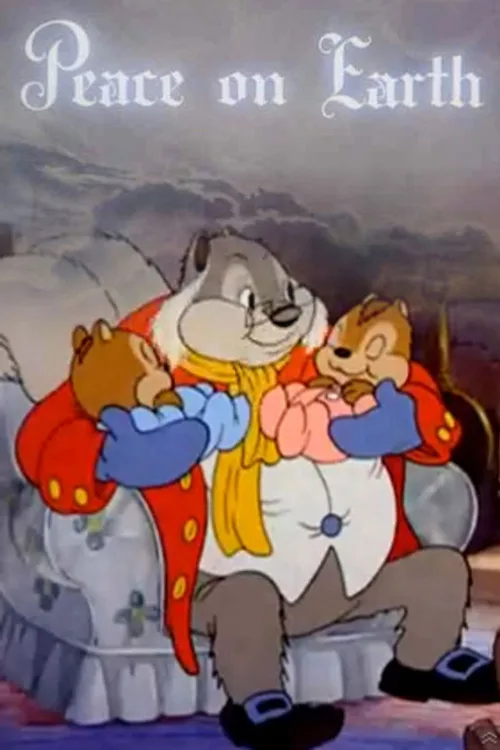
Peace on Earth (1939)
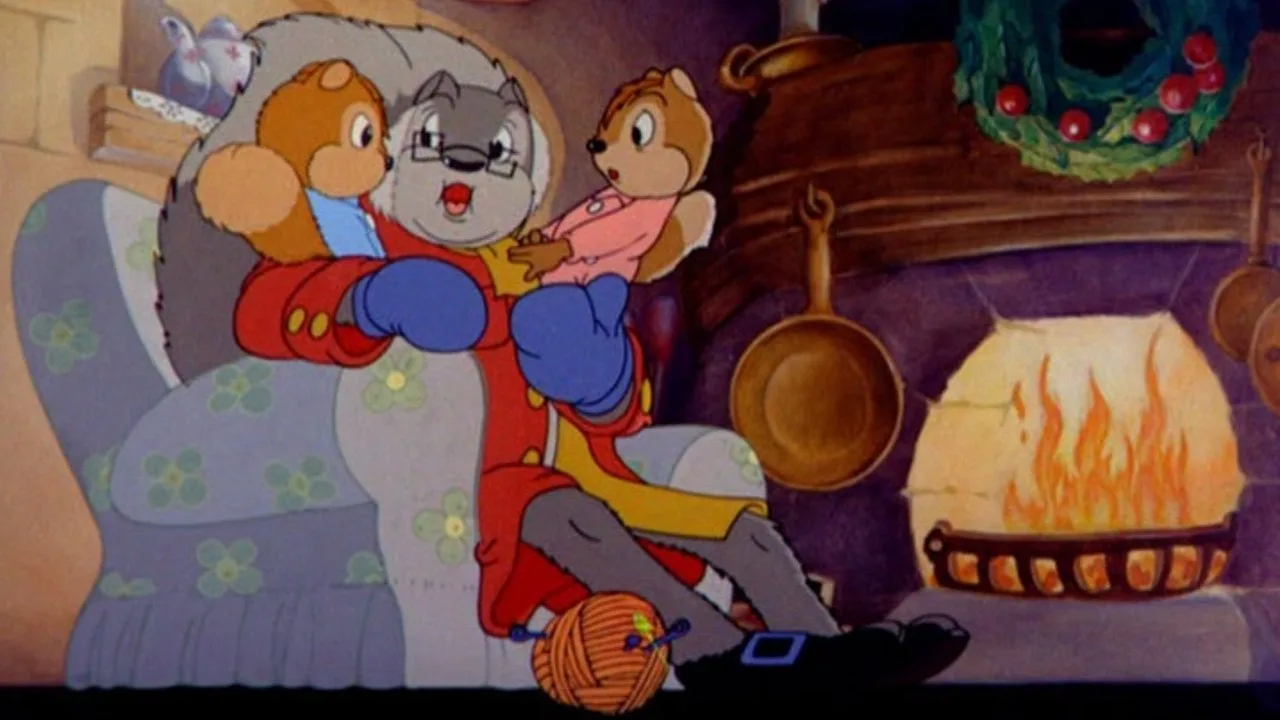
Two baby squirrels ask grandpa to explain what "men" are when he comes in singing "peace on earth, goodwill to men". Grandpa tells the story of man's last war. This classic animation short was an Academy Award Best Short Subject, Cartoons nominee.
 rating 9/10 User rating 60 votes 70%
 ❄ Christmas Connection
Peace on Earth is set on Christmas Eve, when a grandfather squirrel tells his grandchildren a bedtime story about the origin of their world. The holiday framing is deliberate: humanity destroyed itself through war, and the animals inherited a peaceful earth, making Christmas Eve the night this sobering origin story is passed down. The carol "Hark the Herald Angels Sing" opens the film, and the animals have repurposed human churches as homes.
Our Review
Peace on Earth runs seven minutes and was made in 1939 by MGM. It was nominated for the Nobel Peace Prize. Both of those things are true at the same time, and the tension between them tells you everything you need to know about what Hugh Harman accomplished.
What Peace on Earth Is About
The film opens on a snowy Christmas Eve. Animals have settled into a village built from human ruins: a church now serves as a burrow, a helmet becomes a roof, rifle stocks are repurposed as logs. Baby squirrels ask their grandfather what "men" were, because the word appears in the carol playing outside. The grandfather sits them down and explains.
What follows is a remarkably graphic account of human warfare for a 1939 cartoon. Soldiers march, machine guns fire, poison gas rolls across battlefields, and the last two men on earth kill each other in a trench. No survivors. The animals come out of hiding and build a new world from the wreckage, guided by what they find written in a book: the Sermon on the Mount.
The grandfather finishes his story. The grandchildren fall asleep. The film ends with woodland creatures singing carols in their human-artifact village. It is not a happy ending so much as a quiet one.
Why MGM Released This in 1939
The timing was not accidental. Germany invaded Poland on September 1, 1939. Peace on Earth premiered December 8 of that year. Hugh Harman had been developing the concept for some time, but the film reached theaters as Europe descended into exactly the kind of war it depicted. American audiences watching cartoon soldiers gas each other knew what they were watching.
MGM was not known for this kind of material. The studio's animation unit mostly produced Tom and Jerry and one-off theatrical shorts. Peace on Earth was a deliberate departure: Harman wanted to make something that mattered. The studio let him.
The result was submitted to the Nobel Committee for the Nobel Peace Prize, making it one of the very few animated films ever to receive that nomination. It lost. But the nomination itself is a measure of how seriously the film was taken outside the context of Saturday matinee cartoons.
The Animation Holds Up
Harman's team built the animal village with genuine craft. The background detail rewards close attention: a shell casing becomes a lamp, a boot becomes a house, the animals have incorporated every remnant of human civilization into their new domestic life. The contrast between the warm, detailed animal community and the stark, grey warfare sequences is not subtle, but it doesn't need to be.
The human soldiers are rendered as vague, helmeted shapes rather than distinct characters. That choice is probably practical as much as thematic, but the effect is that the humans feel like a force of nature rather than individuals. The animals, by contrast, have faces. The grandfather squirrel has wrinkles and a patient sadness.
The violence is handled obliquely but not softened. You see enough to understand what happened. For a 1939 cartoon aimed at general audiences, that was a meaningful editorial decision.
The 1955 Remake and What It Lost
MGM remade the film in 1955 as Good Will to Men, updated with CinemaScope and Technicolor and a mouse family instead of squirrels. The Cold War context was different from 1939: atomic weapons appear in the remake's war sequences, and the whole thing runs longer. It received its own Academy Award nomination for Best Animated Short Film.
The remake is not bad. It is also not as good. The 1939 version has a compression that gives it force. Seven minutes is the right length for that story. When you extend it and explain more, you lose the quality that made the original feel like it was told by someone who actually believed it.
The 1939 Peace on Earth was nominated for Best Animated Short Film at the Academy Awards and lost to The Milky Way, a Rudyard Kipling adaptation from MGM's own stables. That result has not aged well as a judgment of relative importance.
What It Is Actually Like to Watch
It's a children's cartoon in format and a pacifist argument in content, and it doesn't try to resolve that tension. The grandfather doesn't moralize at the end. The story speaks for itself. The grandchildren fall asleep because they're children, and the world outside is peaceful, and that's the point.
The film is freely available online and runs seven minutes. Most people who sit down to watch a 1939 MGM animated short expecting light holiday entertainment come away from it not entirely sure what just happened to them. That's the correct response.
There is a moment near the end where the grandfather squirrel closes his eyes and the camera pulls back to show the entire animal village, lit and warm, nestled in the ruins of a civilization that destroyed itself. Hugh Harman put that image in theaters in December 1939, while Europe was burning. It's a hard image to shake.
Fun Facts
Peace on Earth was nominated for the Nobel Peace Prize in 1940, making it one of the only animated short films in history to receive that nomination. The Nobel Committee had received submissions recommending it from peace organizations in the United States.
The film was released on December 8, 1939, just three months after Germany invaded Poland, giving its anti-war message an immediate real-world context for audiences who understood what was unfolding in Europe.
Director Hugh Harman developed the concept independently and brought it to MGM's animation unit. He was known primarily for lighter fare, and Peace on Earth represented a deliberate personal statement rather than a studio assignment.
MGM remade the film in 1955 as Good Will to Men, updating the war imagery to include nuclear weapons and converting the format to CinemaScope. The remake earned its own Academy Award nomination for Best Animated Short Film.
The animal village in the film is constructed entirely from human artifacts: helmets serve as roofs, rifle stocks become firewood, and a church that once served humans has been taken over by woodland creatures as a home.
The film's animals discover the Sermon on the Mount in the ruins of human civilization and use it as the founding document for their new peaceful society, a choice that goes uncommented on within the film itself.
Peace on Earth was nominated for the Academy Award for Best Animated Short Film at the 12th Academy Awards in 1940, losing to The Milky Way, a Rudyard Kipling-based MGM short directed by Rudolf Ising.
The film opens with a woodland choir singing "Hark the Herald Angels Sing," and the lyric "peace on earth and mercy mild" gives the film its title and frames the entire narrative that follows.
Cast