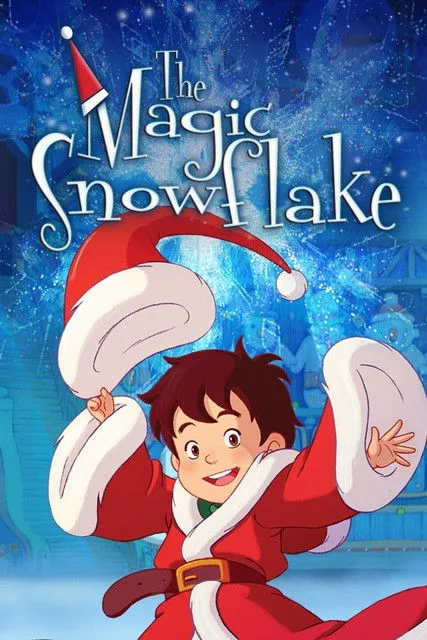
The Magic Snowflake (2013)
A young boy named Nicholas is about to become the next Santa Claus, but must first avoid a crisis that's threatening the magic of Christmas before he can succeed in his new role.
 rating 6/10 User rating 39 votes 64%
 ❄ Christmas Connection
The entire film takes place at the North Pole during the final days before Christmas, starring a seven-year-old Santa Claus whose failure to believe in Christmas magic is literally melting a snowflake and canceling the holiday. The plot hinges on an advent calendar, the spirit of giving, and what Christmas loses when its keeper stops acting like a child. This is as Christmas-specific as a movie gets.
Where to Watch


Our Review
The Magic Snowflake opens with a crisis that is absurd on its face and weirdly logical underneath it: a seven-year-old boy has just taken over as Santa Claus, and he is burning out. Nicolas has to be up at 5:30 every morning. He supervises elves. He signs off on toy designs. He manages deadlines. Two days before his first Christmas delivery, the magic snowflake at the center of the North Pole is melting, and it turns out Nicolas is the cause. He has contracted what the film calls "Grown-up-itis," the disease of children who try to act like adults before their time.
This is the premise of the 2013 French-Belgian animated film L'apprenti Pere Noel et le flocon magique, directed by Luc Vinciguerra and released in France on 20 November 2013. In English-speaking markets it became The Magic Snowflake, a sequel to Vinciguerra's earlier Santa's Apprentice (2010). The two films share a character and a world, though this one can be watched without the first.
Is The Magic Snowflake Worth Watching?
The answer is yes, for a specific audience. The Magic Snowflake is aimed at children roughly five to nine years old, and it works well for them. The animation, produced by Gaumont Animation with co-producers Snipple Animation and DaCapo Productions, is genuine 2D traditional animation. It has warmth and weight. The character designs mix a children's-book softness with slightly cartoonish proportions, and the North Pole setting has real visual invention: the elf dormitory, the toy workshop, the room where the magic snowflake sits suspended in a glass chamber.
What separates this film from cheaper seasonal fare is that it takes its own idea seriously. Nicolas is not struggling because of a villain or an accident. He is struggling because he was given adult responsibilities and responded by trying to become an adult. The film argues that this is itself the problem. The job of Santa Claus, in this telling, requires genuine childhood belief, not just the management of logistics.
What The Magic Snowflake Gets Right About Santa Claus
Most Santa Claus stories treat the character as a delivery mechanism for holiday sentiment. The Magic Snowflake tries something more interesting: it examines what makes someone qualified to be Santa in the first place. Nicolas was chosen because he was a child with a pure heart and a genuine belief in Christmas. The moment he starts treating Christmas as a job rather than a wonder, the magic begins to fail.
There is a sequence where the old Santa takes Nicolas through an advent calendar, one door at a time, showing him visions of his past and possible future. This is the film's best stretch. Each door reveals something specific about who Nicolas was before he took the role, and what he risks losing. The imagery is simple but effective.
The screenplay was written by Alexandre Reverend, Luc Vinciguerra, and David Freedman. The film runs 82 minutes, which is the right length. Nothing outstays its welcome.
The Animation and Its European Context
Vinciguerra trained at CFT Gobelins, the Paris animation school whose alumni include the directors of The Triplets of Belleville and several major Pixar productions. He started his career as an animator and layoutman in 1987, spent years in French TV animation, and directed the original SantApprentice television series for Alphanim before making the two feature films.
The SantApprentice TV series itself has a complicated heritage: it was created in 2006 by Belgian animator Jan Van Rijsselberge, produced by Alphanim, and co-financed across France, Germany, Ireland, Belgium, and the United Kingdom. The features inherit that European multi-country structure. Gaumont, one of the oldest film companies in the world, handled distribution for the sequel.
The Magic Snowflake drew around 632,000 cinema admissions in France during its theatrical run. That is a reasonable result for a local animated family film with a limited marketing budget, not a blockbuster but not a disappointment either. The English-language version reached Canada in late November 2013, and North American audiences largely discovered it through Netflix, where it became available in December 2015.
Where It Falls Short
The film's weakest element is its secondary cast of elves. They are played largely for slapstick, and the jokes are broad. The villain, such as there is one, is Grown-up-itis itself rather than any character, which means the third act has no real antagonist to push against. Nicolas needs to rediscover his own sense of wonder, and the film walks him through that journey in a fairly linear way.
The English dub, featuring Michael Sorich, Cole Sand, Mary Pat Gleason, and Andrew Morris, is competent but flattens some of the warmth in the original French performances. The score by Robert Marcel Lepage is serviceable, leaning on orchestral Christmas conventions without doing anything unexpected.
Parents watching alongside young children will find the film pleasant without finding it memorable. The film earns a 6.2 on IMDb, which is an accurate read. It does what it intends to do, and it intends modest things.
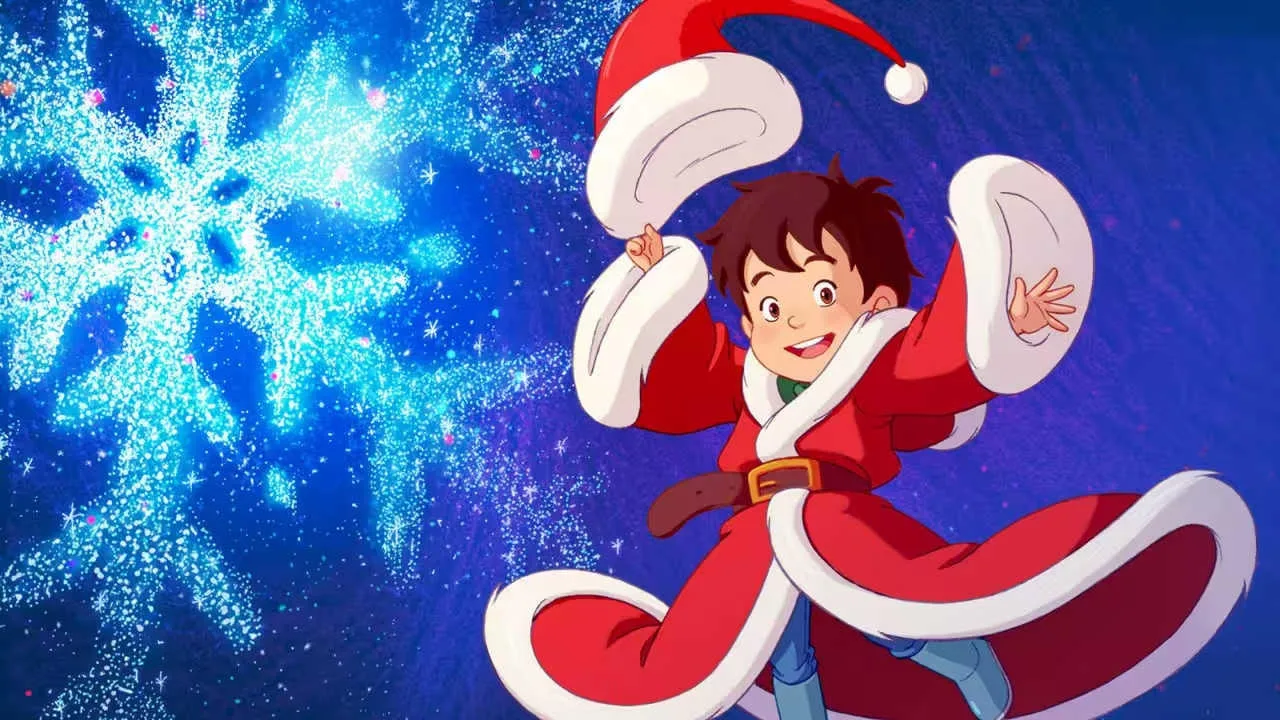
The image that stays with you: Nicolas, in his oversized Santa suit, standing in front of the advent calendar and slowly remembering that he is still a child, even with all those elves depending on him. It is a small moment. The film knows it and does not push too hard on it. That restraint is the most grown-up thing about the movie.
Fun Facts
The Magic Snowflake is based on a TV series called SantApprentice created by Belgian animator Jan Van Rijsselberge in 2006. The series was a Franco-German-Irish-Belgian-British co-production running to 50 episodes of 12 minutes each, before the concept was expanded into two theatrical feature films.
Director Luc Vinciguerra graduated from CFT Gobelins, the Paris animation school founded in 1936, and worked as a professional animator for over two decades before directing his first feature film with the original Santa's Apprentice in 2009.
The film was produced by Gaumont Animation, making it part of the output of Gaumont, the French film company founded in 1895 by Leon Gaumont, which is the oldest film company in the world still in operation.
The Magic Snowflake was released in France on 20 November 2013 and pulled approximately 632,000 cinema admissions during its domestic theatrical run, making it one of the better-performing locally produced French animated films of that holiday season.
The English-language version of the film did not receive a wide theatrical release in the United States. It debuted on Netflix on 20 December 2015, two years after the French theatrical premiere.
The original French voice cast included Benoit Allemane (the voice of Nicolas) and Vincent Grass as a Victorian-era Santa Claus who appears in flashback sequences, both veterans of French dubbing and animation voice work with careers spanning multiple decades.
The film's central concept, "Grown-up-itis" or "Big Personitis" depending on the translation, was designed to literalize a familiar fear in children's stories: that growing up means losing magic. The writers made it a diagnosable illness with visible symptoms, a choice that gives the abstract idea a concrete dramatic shape.
Cast