
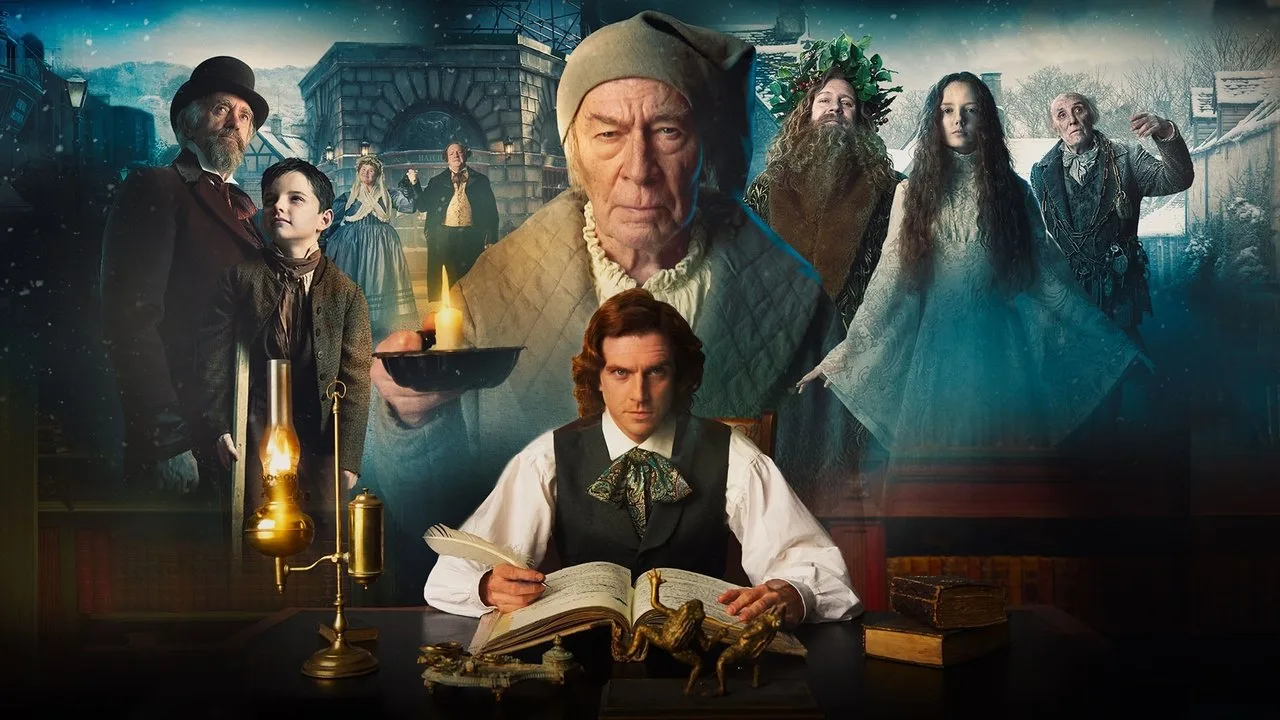
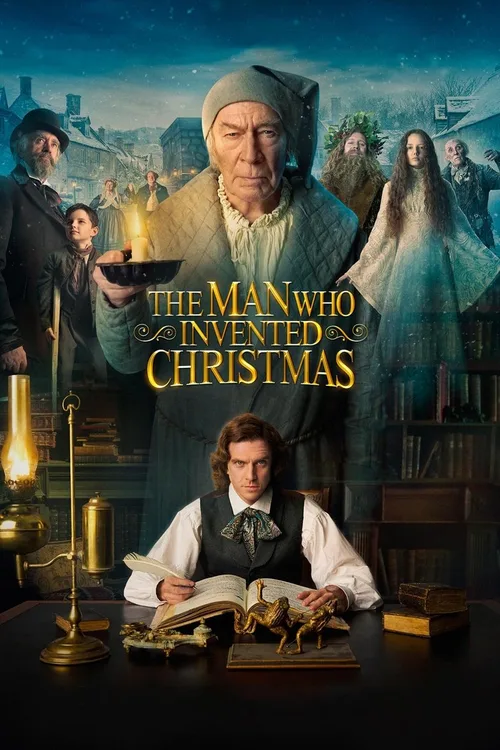
How Charles Dickens wrote “A Christmas Carol” and created a tradition.
The Man Who Invented Christmas (2017)
In 1843, despite the fact that Dickens is a successful writer, the failure of his latest book puts his career at a crossroads, until the moment when, struggling with inspiration and confronting reality with his childhood memories, a new character is born in the depths of his troubled mind; an old, lonely, embittered man, so vivid, so human, that a whole world grows around him, a story so inspiring that changed the meaning of Christmas forever.
 rating 7/10 User rating 862 votes 68%
 ❄ Christmas Connection
This film is literally about the creation of A Christmas Carol, the story that reshaped how the Western world celebrates Christmas. Every frame is steeped in Victorian Christmas imagery, from holly-decked streets to roaring hearth fires. It does not get more Christmas than a movie about the man who gave us Scrooge.
Where to Watch


Our Review
In 1843, Charles Dickens was broke. His last three novels had flopped. Creditors were circling. His wife was pregnant with their fifth child. So he did what desperate writers do: he bet everything on one project, self-financing a small book about a miser visited by ghosts on Christmas Eve. The Man Who Invented Christmas (2017) tells that story, and it does so with more charm and intelligence than the premise might suggest.
Directed by Bharat Nalluri and adapted by Susan Coyne from Les Standiford's 2008 nonfiction book of the same name, the film stars Dan Stevens as Dickens and Christopher Plummer as Ebenezer Scrooge. Not the fictional Scrooge, exactly, but the character as Dickens imagines him, arguing back, refusing to be redeemed, and generally making a nuisance of himself during the writing process.
The Man Who Invented Christmas Cast and Performances
Dan Stevens carries this film. His Dickens is vain, manic, generous, and selfish, often within the same scene. Stevens plays the writer not as a great literary genius but as a showman who talks to his characters out loud, acts out scenes in the street, and treats his household like a captive audience. It is a physical, energetic performance that keeps the film moving even when the script gets predictable.
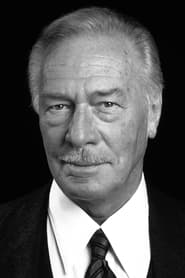
Christopher Plummer, who was 87 during filming, brings a dry, weary menace to Scrooge. He plays the character as someone who resents being invented, pushing back against Dickens' sentimentality with the stubbornness of a man who has had enough of Christmas cheer. Their scenes together are the heart of the film.
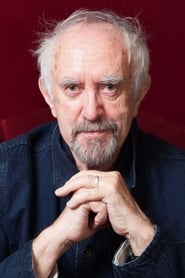
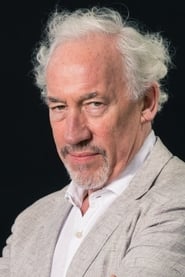
Jonathan Pryce rounds out the cast as John Dickens, Charles' irresponsible father and the real-life inspiration for Mr. Micawber. Pryce does not overplay the role. His John Dickens is likeable and infuriating in equal measure, a man who genuinely loves his son but cannot stop borrowing money from him. The supporting cast includes Miriam Margolyes, Simon Callow, and Ian McNeice, all doing solid work with limited screen time.
How Dickens Changed Christmas
The film's strongest material deals with the real history behind A Christmas Carol. Before Dickens published his novella on 19 December 1843, Christmas in England was a fading holiday. The industrial revolution had stripped away many old traditions. Workers rarely got the day off. The Puritans had actually banned Christmas celebrations in the 1640s, and the holiday had never fully recovered.
Dickens did not single-handedly invent modern Christmas, but A Christmas Carol did more than any other single work to revive it. The book sold out its first print run of 6,000 copies by Christmas Eve. Within months, charitable giving in England spiked measurably. The phrase "Merry Christmas" entered common usage partly because of Dickens. The book gave Victorians a template for the holiday: family gatherings, generosity to the poor, feasting, and goodwill.
The film handles this context through Dickens' walks through London, where he encounters the poverty and child labor that fueled his anger. These scenes avoid lecturing. They just show what Dickens saw, and let the audience connect it to the book he was writing.
Where the Film Falls Short
The weakest sections involve Dickens' domestic life. His marriage to Catherine (Morfydd Clark) gets the standard "neglected wife" treatment, where she stands by looking worried while he works obsessively. The film hints at deeper tensions but never commits to exploring them. Given that Dickens would later very publicly leave Catherine for a younger woman, there was richer material here than the screenplay was willing to touch.
The fantasy sequences, where Dickens walks through his own story as it takes shape, vary in quality. Some work beautifully, like the moment Scrooge first appears in Dickens' study unbidden. Others feel like they belong in a different, broader film. The Ghost of Christmas Past sequence leans a bit too far into special effects territory for a movie that works best in its quieter moments.
At 104 minutes, the pacing is tight, though the final act rushes through the actual publication in a way that feels compressed. Dickens wrote A Christmas Carol in roughly six weeks, and the film conveys that urgency, but the resolution comes too quickly.
Is The Man Who Invented Christmas Worth Watching?
This is a better film than its modest box office suggested. Released by Bleecker Street in November 2017, it earned around $8 million worldwide against a reported budget of roughly $10 million. It got lost in a crowded holiday season, which is a shame, because it offers something most Christmas movies do not: a genuine story about why Christmas matters, told through the lens of the writer who arguably defined its modern form.
It is not flawless. The domestic subplot is thin, and some of the fantasy elements feel forced. But Stevens and Plummer are excellent, the Victorian London setting is beautifully realized (filmed on location in Dublin and at Ardmore Studios in County Wicklow, Ireland), and the central question, whether a financially desperate writer can create something that outlasts his own problems, lands with genuine feeling.
Myles McGuckin composed the score, which leans on strings and piano without becoming saccharine. The production design by Paki Smith deserves particular credit for making Victorian London feel lived-in rather than museum-piece pristine. Muddy streets, cramped rooms, candlelight. It all looks right.
The last image of the film is not Dickens triumphant. It is a London street on Christmas morning, transformed by a book that a broke writer finished just in time. That restraint says more about the spirit of the story than any inspirational speech could.
Fun Facts
Christopher Plummer was 87 years old when he filmed his role as Scrooge, making him one of the oldest actors to ever portray the character on screen.
The film was shot entirely in Ireland, using Dublin streets and Ardmore Studios in County Wicklow, with sets previously built for the TV series Penny Dreadful repurposed for Victorian London.
Dickens really did self-publish A Christmas Carol in 1843 after his publisher Chapman and Hall refused to back it. He paid for the printing, binding, and hand-colored illustrations himself.
The first edition of A Christmas Carol sold all 6,000 copies by Christmas Eve 1843, but Dickens barely broke even because he insisted on expensive production values including gilt-edged pages and a hand-colored frontispiece.
Les Standiford's 2008 nonfiction book of the same name, which the film adapts, argues that A Christmas Carol was the single most influential work in shaping how the English-speaking world celebrates Christmas.
Dan Stevens had to learn to write with a quill pen using his left hand for the role, as Dickens was left-handed. Stevens is naturally right-handed.
The character of Tara (Anna Murphy), the young Irish maid who inspires some of Dickens' ideas, is a fictional creation not found in Standiford's book. She was added by screenwriter Susan Coyne to represent the real working-class people Dickens championed.
Cast